


Mental Health Is the New Workplace Advantage


Introduction
For years, the blueprint for workplace success was singular: a relentless focus on metrics. Organizations chased output, measuring success by delivery speed, system efficiency, and consistent revenue growth. Performance was purely a game of numbers, with high productivity as the undisputed champion.
However, this model was fundamentally incomplete. The human element, the people driving that performance, was often ignored. Employees were expected to operate at peak capacity, pushing through stress, pressure, and personal adversity. A culture emerged in which long hours were the norm, burnout was celebrated, and mental health was, at best, an afterthought. This approach is no longer viable. A powerful realization is now reshaping the modern workplace: performance and well-being are inseparable. The mental health of an organization's employees directly dictates their capacity to think, collaborate, innovate, and contribute. Consequently, mental health has moved from a fringe topic to a critical determinant of organizational success.
This integration of well-being and performance is rapidly becoming the definitive new workplace advantage.
The Silent Cost of Neglect: The Organizational Toll of Unaddressed Mental Health
While the profound, positive impact of prioritizing employee mental health is undeniable, the true, comprehensive cost of neglecting it remains a consistently underestimated factor in organizational health and finance. It is a silent, insidious tax that erodes the foundation of a successful business, manifesting across multiple dimensions.

The Gradual Onset of Burnout and Performance Decline
Burnout is not a sudden collapse but a slow, cumulative process. It builds in the shadows of daily deadlines and prolonged high-stress environments, often escaping notice until its consequences become impossible to ignore. Initially, this internal struggle translates into behavioral changes that directly impede work quality and quantity:
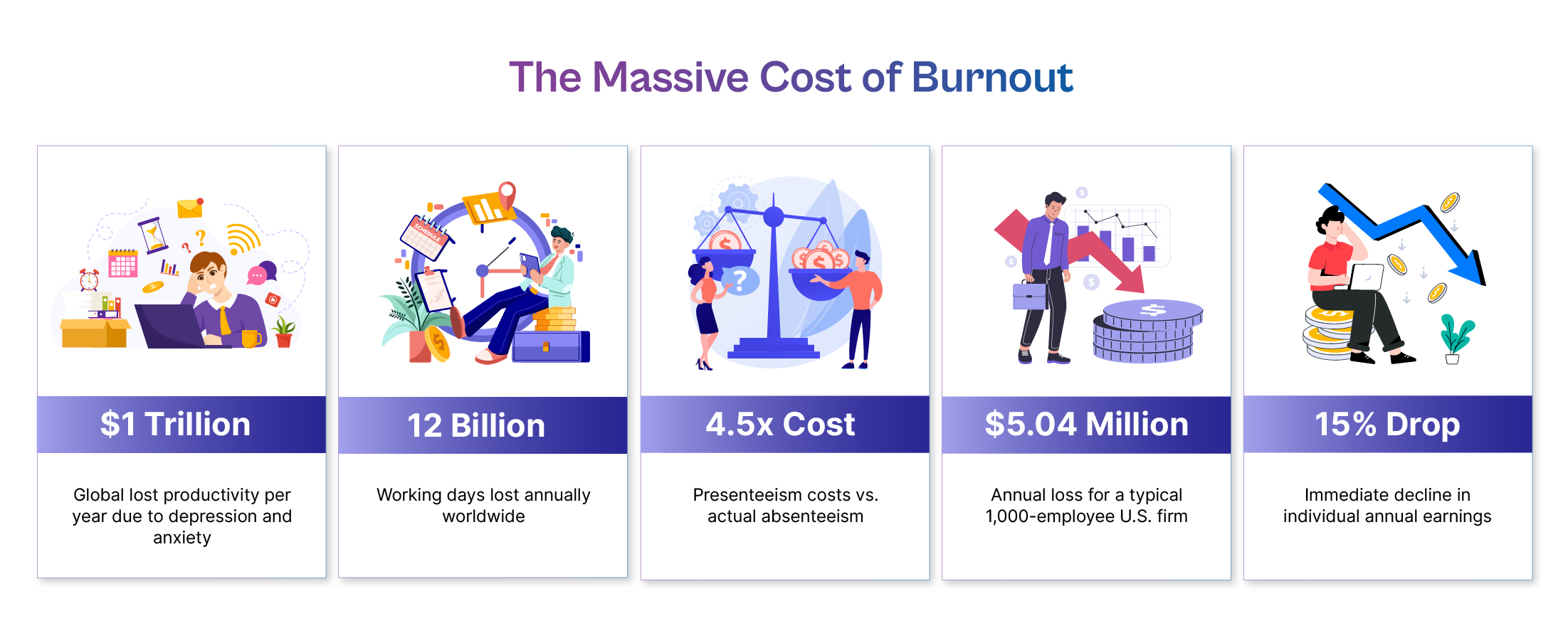
- Diminished Engagement and Apathy: Employees suffering from unmanaged stress and burnout become less invested in their roles. Their proactive initiative wanes, leading to a state of presenteeism, physically present but mentally absent, which severely limits their valuable contribution. In fact, presenteeism is the largest contributor to employers' mental health costs, costing four to four-and-a-half times more than actual absenteeism. In the UK alone, mental health-related presenteeism costs employers an estimated £24 to £28 billion annually
- Increased Irritability and Collaboration Barriers: The emotional fatigue of burnout often leads to heightened irritability and a shorter fuse. This emotional strain makes positive, constructive collaboration difficult, turning routine interactions into potential flashpoints for conflict.
- Escalation of Errors and Productivity Erosion: As cognitive resources are diverted to managing anxiety, focus deteriorates, resulting in a sustained decline in productivity. Globally, an estimated 12 billion working days are lost every year to depression and anxiety, resulting in a massive $1 trillion per year in lost productivity. At the company level, a typical 1,000-employee business in the U.S. loses roughly $5.04 million annually solely due to burnout. Individually, burnout causes a quantifiable, immediate 15% drop in annual earnings and productivity, leaving a "scar" where productivity remains 12% lower even seven years later.
The Fracture of Team Dynamics
The individual burden of stress quickly spreads, contaminating the collective environment and fracturing the intricate network of team dynamics:
- Communication Breakdown: Overwhelmed employees often retreat, leading to a failure to communicate critical information or seek necessary help. Misunderstandings proliferate, and the shared context that underpins effective teamwork dissolves.
- Increased Conflict and Reduced Psychological Safety: A high-stress environment breeds a defensive posture. Conflicts arise more easily, fueled by misinterpretation and emotional exhaustion. This continuous tension destroys the psychological safety necessary for candid feedback, risk-taking, and open discussion, crippling the team's ability to learn and adapt.
- Erosion of Morale: The visible struggle of colleagues and the overarching atmosphere of tension weigh heavily on general team morale. This collective fatigue lowers enthusiasm and energy, making the workplace feel punitive rather than supportive.
The Critical Loss of Human Capital
Perhaps the most catastrophic and difficult-to-reverse cost is the loss of valuable talent. Nearly 30% of employees have recently left their jobs or plan to leave in the next year, and mental health issues now account for nearly 40% of total turnover costs. Talent loss triggers a cascade of expensive consequences, including high recruitment and onboarding costs. Replacing a single employee costs an organization 50% to 200% of their annual salary, with executive-level turnover costing up to a staggering 400%.
- The Quiet Exit of Talent: Employees who feel their well-being is not valued or supported will inevitably seek better environments. They do not always provide mental health as the primary reason for leaving; instead, they cite "seeking new challenges" or "better opportunities." Regardless of the stated reason, the underlying need for a supportive work culture plays a major, often decisive, role in their departure.
- High Costs of Turnover: Talent loss triggers a cascade of costly consequences: recruitment costs, extensive time and resources required for onboarding, and an inevitable dip in team productivity during the training period. The loss of institutional knowledge, expertise, and established professional networks is an immeasurable cost that cripples long-term effectiveness.
The Innovation Stagnation
A high-stress environment breeds a defensive posture in which conflicts arise more easily, undermining the psychological safety necessary for open discussion and teamwork. This friction comes at a steep price: conflict costs U.S. employers an estimated $359 billion annually in lost productivity. Instead of focusing on innovation and strategy, managers in these environments spend up to 42% of their time navigating interpersonal disputes
- Resource Depletion for Creativity: The cognitive energy required for creative thinking, challenging assumptions, synthesizing disparate ideas, and developing novel solutions is a luxury available only when basic stress and performance demands are met. When employees are solely focused on "getting through the day" and meeting minimum requirements, they have little or no bandwidth left for discretionary effort or innovation.
- Limitation of Organizational Adaptability: This lack of creative energy limits the organization's collective ability to adapt to market changes, pivot strategies, and develop the next generation of competitive products or services. The organization becomes reactive rather than proactive, stifling long-term growth potential.
These costs, from diminished productivity and fractured teams to catastrophic talent loss and innovation stagnation, do not always register immediately in quarterly financial reports. Instead, they are forces that slowly, but certainly, shape the long-term health, competitiveness, and overall trajectory of the entire organization. Addressing mental health is not merely a moral imperative; it is a critical investment in sustained business success.
Navigating the Challenges of a Digital Workplace
Technology has made work more flexible and accessible, but it has also introduced new complexities.
The expectation to be constantly available can lead to mental fatigue. Notifications, emails, and virtual meetings create a sense of continuous activity, leaving little time for deep focus or rest. Over time, this can reduce both productivity and well-being. Organizations are beginning to address this by rethinking how work is structured. Encouraging breaks between meetings, setting clear expectations around communication, and creating space for uninterrupted work are small changes that can have a significant impact. It’s not about reducing the use of technology, but about using it more intentionally. When managed well, technology can enhance productivity without overwhelming employees.
The New Face of Workplace Culture
The contemporary understanding of workplace culture marks a fundamental departure from the past. Historically, the workplace was often governed by tacit, demanding norms: employees were expected to suppress stress, maintain strict professionalism, and consistently place professional obligations ahead of personal needs. In this environment, exhibiting vulnerability was commonly perceived as a defect. Today, these old paradigms are being actively dismantled. A truly positive culture is now defined by psychological safety, where staff feel empowered to speak freely, contribute ideas, and voice concerns without the threat of reprisal or judgment. Crucially, this shift normalizes mental health, treating it not as a forbidden subject, but as an ordinary facet of the human condition.
Another essential component is balanced expectations. While high performance remains necessary, it is no longer justifiable at the expense of employee well-being. Organizations are increasingly recognizing that long-term, superior performance is dependent on sustainable work practices.
Leadership is the central force driving this transformation. When leaders model healthy behaviors, communicate with transparency, and demonstrate genuine empathy, they effectively set the cultural standard for the entire organization.
Ultimately, workplace culture is not a product of official company documents. It is an evolving reality, defined by employees' daily experiences: how they are treated, the level of support they receive, and their overall sense of well-being upon arriving at work.
The Evolution of Modern Leadership: Beyond Results to Well-being and Empowerment
The definition and practice of leadership are undergoing a profound transformation, driven by the evolving dynamics and demands of the modern workplace. The traditional, results-at-any-cost model is giving way to a more holistic approach that places a strong emphasis not just on what is achieved, but critically, on how those results are delivered. This paradigm shift signals a move from purely transactional management to genuinely transformative leadership. Prioritizing Team Well-being and Psychological Safety
A fundamental component of this modern leadership model is the deliberate prioritization of team well-being and mental health. Today's effective leaders recognize that sustained high performance is impossible without a healthy and supported workforce. This means moving beyond superficial wellness programs to actively cultivating an environment of psychological safety.
- Attentive Observation: Modern leaders must be highly attuned to the subtle and overt signs of stress, burnout, and disengagement within their teams. This requires developing emotional intelligence and being able to read the room, rather than waiting for employees to formally report an issue.
- Individualized Understanding: Recognizing that every team member faces unique personal and professional challenges, leaders must strive to understand individual circumstances. A one-size-fits-all approach to support is no longer sufficient; empathy and flexibility are paramount.
- Fostering a Culture of Safety: The leader's role is to ensure that employees feel genuinely safe seeking assistance, admitting mistakes, and voicing concerns without fear of reprisal or judgment. When a culture of safety exists, innovation thrives, and problems are addressed proactively.
Leadership by Example: Modeling Healthy Behavior
Leaders are the culture architects of their teams, and the standards they set are primarily communicated through their actions, not just their words. This concept of "leading by example" takes on a new urgency in the context of well-being.
- Respecting Boundaries: A leader who diligently respects work-life boundaries, avoids sending non-urgent emails late at night, and encourages their team to fully disconnect during time off implicitly validates the importance of personal time.
- The Power of Taking Breaks: By openly taking breaks, using vacation time, and modeling effective self-care, leaders tacitly grant their teams permission to do the same. This counteracts the pervasive "hustle culture" that often leads to exhaustion and diminished returns.
- The Detriment of Overwork: Conversely, a leader who constantly champions or exhibits overworking, always available, perpetually stressed, inadvertently establishes an unhealthy, unsustainable norm. This creates a powerful negative pressure on employees to follow suit, leading them to believe that their commitment is measured by their exhaustion.
The Cornerstone of Effective Communication
Open, honest, and frequent communication remains an unshakeable pillar of effective leadership. In an era of rapid change and digital noise, clear dialogue is more vital than ever for maintaining trust and stability.
- Building Trust Through Transparency: Leaders must be transparent about company strategy, challenges, and decisions. Open dialogue minimizes ambiguity and reduces the 'information vacuum' where rumors and anxiety proliferate.
- Active Listening and Feedback: Effective communication is a two-way street. Leaders must become skilled active listeners to ensure employees feel truly heard. Furthermore, a commitment to providing and receiving constructive feedback is essential for continuous individual and team development.
- Driving Engagement and Commitment: When employees feel informed and valued in conversations, their engagement and commitment to the organizational mission naturally increase. They move from being mere implementers of tasks to active co-owners of the results.
The Power of Empowerment and Enabling Conditions
Ultimately, the most profound realization in modern leadership is that the leader need not be the ultimate source of all knowledge or the sole problem-solver. Instead, the leader's highest calling is to be the enabler. Effective leadership today is defined by the ability to establish the right conditions, psychological safety, clear communication channels, healthy behavioral models, and the necessary resources that genuinely empower every individual to perform at their absolute highest level. It is a shift from control to support, recognizing that the team's collective genius, when properly nurtured and unleashed, far surpasses that of any single leader.
Evolving Employee Expectations
The workforce today is more aware and more vocal about mental health than ever before.
Employees are looking for more than just a paycheck. They want meaningful work, supportive environments, and a sense of balance in their lives. Flexibility is no longer a perk; it is an expectation. Access to mental health resources is seen as a basic necessity. Younger generations, in particular, are driving this change. They are more open about discussing mental health and more willing to leave organizations that do not align with their values. This shift is influencing how companies approach hiring, retention, and workplace culture. Organizations that adapt to these expectations are better positioned to attract and retain top talent.
TheStrategic Business Case for Mental Health Support
Viewing employee mental health solely as a humanitarian concern misses its direct and significant effect on business performance. The return on investment is massive: employers see an average return of £5.30 for every £1 invested in mental health interventions. If you invest in proactive, organization-wide cultural changes, the return jumps even higher to £5.60 for every £1 invested. Furthermore, companies save $2.30 in gross medical spending for every dollar spent on behavioral health benefits, resulting in net savings of $159 per member per month.
- Direct Impact on Productivity and Outcomes: When employees are mentally supported, their ability to concentrate and engage dramatically improves. They are more present, make better decisions, and solve complex problems more effectively, ultimately leading to higher-quality results. Conversely, neglecting mental health immediately erodes productivity, even if the effects are initially subtle. Stress hinders focus, and burnout depletes motivation, making even routine tasks challenging for otherwise capable staff.
- Retention and Cost Savings: Prioritizing mental well-being is a powerful tool for retention. Employees are more committed to organizations that demonstrate care and value them as people. This cultivated sense of trust and belonging significantly reduces employee turnover, avoiding the substantial costs and disruption associated with continuous hiring and onboarding.
- Addressing Attendance and Engagement: Mental health issues manifest as both absenteeism (employees missing work) and the often-overlooked, yet more costly, presenteeism (employees being physically present but unproductive). Addressing the root causes of these challenges directly boosts overall team performance and efficiency.
- Strengthening Employer Brand: In a competitive talent market, a genuine commitment to well-being elevates an organization's employer brand. Companies that stand out for their empathy and supportive culture attract top talent and are seen as places where people can build long-term careers.
The evidence is clear: mental health is not a peripheral concern. It is inextricably linked to key business outcomes, including productivity, retention, cost management, and brand reputation.
Moving Toward a Human-Centered Future: Redefining Workplace Success
The paradigm of the modern workplace is undergoing a profound transformation, ushering in a new definition of success that moves beyond traditional, singular performance metrics. Today, progressive organizations are increasingly recognizing a fundamental truth: long-term, sustainable growth is inextricably linked to the well-being and flourishing of the people who drive it. The transactional model of work is yielding to one built on mutual investment and support.
This evolution is centered on adopting a truly human-centered approach to work. Such an approach is not merely a beneficial perk but a core business strategy focused on designing and cultivating work environments where employees can achieve their highest potential without compromising their mental or physical health. It is an intentional effort to strike a critical balance: leveraging the efficiency and speed of modern technology while championing the fundamental human needs for meaningful connection, genuine empathy, and robust, systemic support.
At the very core of this human-centered model lies mental health. It is the non-negotiable foundation upon which all other aspects of organizational success are built. An employee's mental state directly and fundamentally influences:
- Engagement and Productivity: The depth of an employee's investment in their role, their capacity for innovation, and their ability to execute tasks effectively.
- Team Collaboration and Cohesion: The quality of interpersonal relationships, the ability to navigate conflict constructively, and the psychological safety required for high-performing teams to thrive.
- Organizational Resilience and Growth: The collective capacity of the company to adapt to change, retain top talent, and build a positive reputation that attracts future generations of workers.
By prioritizing mental health, organizations are making a powerful statement: that their people are their most valuable asset, and their well-being is the ultimate metric of a thriving future. This shift represents a commitment to building workplaces that are not only productive but fundamentally supportive, ethical, and sustainable.
Conclusion: Redefining the True Advantage
The era of defining workplace success solely by efficiency is over. The future competitive advantage lies in prioritizing well-being. Mental health is no longer a peripheral benefit but a fundamental component of organizational success. Companies that invest in employee well-being aren't just demonstrating support; they are actively cultivating stronger, more resilient, and ultimately more innovative systems.
The evolving world of work has made one truth undeniable: people's performance improves when they feel supported; their contributions increase when they feel valued; and when employees are given the opportunity to truly thrive, the organization will follow suit. This commitment to human flourishing is the enduring and true advantage.
Build a healthier, higher-performing workplace with Cogent Infotech, where employee well-being fuels lasting business success.

