From Pilots to Production: Why Most AI Projects Fail Before Scale



Introduction: The Real Problem Behind AI Stagnation
AI has moved out of the innovation lab and into everyday business conversations. Enterprises pilot chatbots, forecasting engines, recommendation systems, and automation tools with confidence. Almost every organization today can point to at least one AI initiative in motion.
Yet very few of those initiatives ever reach full-scale production.
Teams prove that a model works in isolation, present promising results, and then watch momentum stall. The pilot stays trapped in slide decks. Business units revert to familiar processes. What looked like a transformation turns out to be a one-off experiment.
This gap exists because pilots answer a narrow question: Can this work? Production asks something far harder: Can the business operate this way, every day, at scale? That shift exposes issues far beyond algorithms. It surfaces challenges around data ownership, workflow integration, security, accountability, and trust.
Most AI projects fail not because the technology breaks, but because the organization never prepares for operational change. Enterprises treat AI as an innovation layer rather than as core infrastructure. The result is impressive demos with no durable impact. Industry research consistently reflects this pattern, with leading consultancies observing that only a small fraction of AI initiatives ever mature into enterprise-wide systems that deliver sustained value (McKinsey & Company, 2023).
This blog will explore why AI initiatives stall between pilot and production. It will examine the structural and organizational barriers behind that failure, clarify what “production-ready AI” actually requires, and outline how enterprises can redesign their approach to move from experimentation to real, scalable value.
The Five Core Failure Zones When AI Pilots Stall
Most AI pilots fail for reasons that have little to do with model accuracy. Teams often build something that works in isolation, but the breakdown happens when that solution meets the real enterprise environment. At that point, five predictable failure zones emerge.
These zones appear across industries, maturity levels, and budgets. They do not reflect a lack of ambition. They reflect misalignment between experimentation and operations.
1. Strategy Without a Business Anchor
Many pilots begin with curiosity rather than necessity. A team explores sentiment analysis because it sounds useful. Another builds a forecasting model because leadership wants “more AI.” These initiatives often lack a clear business owner and a measurable outcome.
Without a business anchor, the pilot becomes a showcase. It demonstrates possibility but not value. When the experiment ends, no one feels accountable for integrating it into daily work. The model answers an interesting question, but it does not solve a burning problem.
Production demands clarity, with someone owning the outcome. A business unit must depend on the result, where a metric must move. Without this structure, AI remains optional, and optional systems rarely scale. Gartner’s enterprise AI research highlights this pattern, noting that initiatives tied to explicit business objectives are dramatically more likely to reach operational maturity than those framed as exploratory technology programs (Gartner, 2024).
2. Data That Works in Theory, Not in Reality
Pilots typically operate on carefully prepared datasets. Teams invest significant effort in cleaning, labeling, and structuring information until it produces consistent results. This process demonstrates that a model can work, but it also masks the complexity of real-world data environments.
Production quickly reveals that complexity. Data arrives at irregular intervals. Critical fields appear incomplete or inconsistent. Formats shift as upstream systems evolve. Ownership spans multiple departments, each with different priorities. What seemed stable in a development environment becomes unpredictable in a live pipeline.
Enterprises often underestimate this transition because they view data as a technical input rather than as an operational asset. Few organizations define end-to-end ownership for data quality. Fewer still monitor drift or design pipelines for long-term resilience. As models begin to degrade quietly, confidence erodes. Business teams stop relying on the output.
A pilot can succeed with fragile data. A production system cannot. MIT Sloan’s research on enterprise analytics adoption emphasizes that data reliability, not model sophistication, is the dominant factor in whether AI becomes embedded in daily decision-making (MIT Sloan Management Review, 2023).
3. No Path Into Daily Work
A successful pilot often lives in a dashboard, a report, or a demo interface. It sits adjacent to real workflows instead of inside them.
Employees already juggle systems. They manage CRMs, ERPs, ticketing platforms, and analytics tools. When AI outputs exist outside these environments, they become optional. People glance at them, then return to what feels reliable.
Production demands integration into the systems and workflows where real decisions occur. The model must surface insights inside existing tools, not alongside them. It should align with how teams already work and simplify their process, rather than introduce an additional layer of effort.
Without this alignment, AI feels like advice from the sidelines. It never becomes part of how work actually gets done. IBM’s enterprise AI studies consistently show that embedded intelligence drives adoption far more effectively than standalone tools, even when those tools are technically superior (IBM Institute for Business Value, 2024).
4. Governance Arrives Too Late
Pilots often operate under informal norms. Teams move quickly, bypass security reviews, work with limited data, and defer compliance questions. This flexibility supports experimentation, but it does not scale.
Production introduces non-negotiable constraints around privacy, auditability, explainability, bias, vendor risk, and access control. When these requirements appear only after a pilot succeeds, governance feels like a blocker rather than a foundation.
Security teams need clarity on data flows. Legal teams must define ownership. Risk teams require transparency in decision logic. Without these answers, projects stall while teams attempt to retrofit structure into systems never designed for it.
Production-grade AI requires governance by design. Without it, pilots hit a wall. Deloitte’s enterprise AI maturity research shows that organizations integrating governance early progress to production at significantly higher rates than those that treat compliance as a downstream step (Deloitte, 2023).
5. No Operational Ownership
A pilot usually belongs to a small, motivated group. Data scientists build it. Innovation teams sponsor it. Consultants support it.
Production belongs to the enterprise.
Once a model goes live, someone must monitor performance. Someone must handle failures. Someone must update data pipelines. Someone must respond when the business asks, “Why did this prediction change?”
Most organizations never define this ownership. The pilot team moves on. The business assumes IT will manage it. IT assumes the business owns it. The model drifts into limbo.
Systems without owners decay. AI systems decay faster.
These five zones share a theme. Enterprises design pilots for learning, but production requires design for endurance. The transition fails when organizations treat scale as a technical step rather than as an operating shift.
In the next section, we will explore how organizational structure and culture quietly reinforce these failure zones, even when leaders invest heavily in AI.
Organizational Barriers No Model Can Fix
Even the most accurate model struggles to survive in an organization that is not designed to use it. These barriers rarely appear in technical plans. They show up in structure, incentives, and everyday behavior.
- AI lives in silos
Data teams build models. Business teams consume outputs. IT maintains systems. This separation creates distance between those who design intelligence and those who act on it. Pilots survive because collaboration stays tight. Production breaks when that connection fades. - Business teams disengage after the pilot
During experimentation, domain experts stay involved. Once the model “works,” ownership shifts. The system becomes something delivered to the business rather than built into it. Without continuous input, relevance declines and trust erodes. - Incentives reward novelty, not durability
Innovation teams earn recognition for launching pilots, not for sustaining them. Business leaders gain credit for adopting tools, not for redesigning workflows. No one owns the system’s long-term performance. - Decision culture resists algorithms
Many enterprises still rely on intuition and experience. When AI challenges judgment, people hesitate. They override recommendations. They ask for proof. Pilots avoid this tension because nothing depends on them. Production makes it unavoidable. - Accountability remains unclear
Teams ask who answers when a model fails. Managers wonder how to explain automated decisions. Leaders worry about responsibility. Without defined decision rights, AI feels risky rather than supportive.
Organizations that scale AI treat this as a leadership challenge. They redefine roles, clarify how humans and models collaborate, and prepare teams to think with AI rather than around it. Without that shift, even strong systems quietly fade from relevance.
What “Production-Ready AI” Actually Looks Like
Many enterprises assume that moving from pilot to production is a technical upgrade. They imagine stronger infrastructure, faster compute, or a more refined model. In practice, production readiness has far less to do with algorithms and far more to do with how the system lives within the business.
A production-ready AI system behaves less like a project and more like a core capability. It does not impress in demos. It earns trust in daily use.
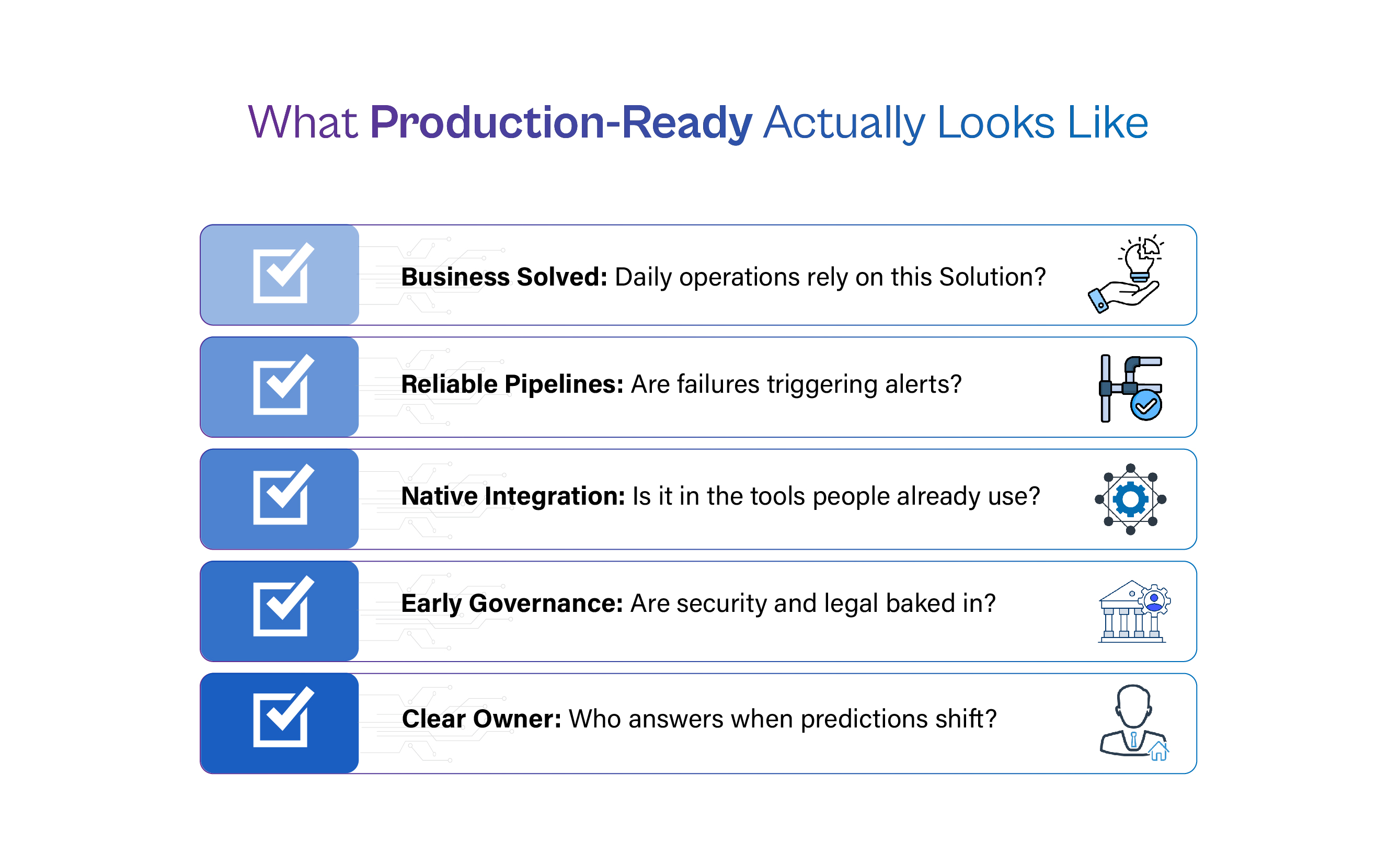
At a minimum, it reflects five characteristics:
- It solves a business problem, not a technical one
The system exists because a team depends on it. It influences pricing, risk, operations, customer experience, or planning. Someone owns the outcome. Success is measured in business terms, not model metrics. - It runs on dependable data, not curated samples
Pipelines are designed for volatility. Data quality has ownership. Drift is monitored. Failures trigger alerts. The model expects reality to be messy and continues to function anyway. - It fits into real workflows
Outputs appear inside tools that employees already use. Recommendations arrive at the moment decisions occur. The system reduces friction instead of creating another destination to check. - It operates under clear governance
Security, compliance, access control, and explainability are built in from the start. Teams know how data moves, who can see it, and how outcomes are justified. Governance enables trust rather than slowing progress. - It has an operational owner
Someone monitors performance. Someone responds when predictions shift. Someone improves the system over time. The model does not belong to “the AI team.” It belongs to the business.
This mindset changes how organizations design AI from the first line of code. Instead of asking, “Can we build this?” teams begin with, “How will this live inside the business for the next three years?”
That question reshapes every decision. It influences data architecture. It informs integration choices. It forces early conversations with security, legal, and operations. It invites business leaders into the design process, not just the demo.
Enterprises that scale AI successfully treat it as infrastructure rather than as an experiment. They expect it to be dependable, budget for its upkeep, plan for its evolution, and design it with trust in mind. AI becomes something the business can rely on, not something it occasionally tests.
Organizations that remain stuck in pilots take the opposite approach. They frame AI as exploration, celebrate potential, and defer responsibility. Scale becomes a future ambition rather than a present requirement. In most cases, that future never arrives.
How Enterprises Can Cross the Pilot-to-Production Gap
The organizations that move beyond experimentation do not rely on momentum. They redesign how AI is introduced into the business from the very beginning. Instead of treating scale as a later phase, they assume production as the starting point.
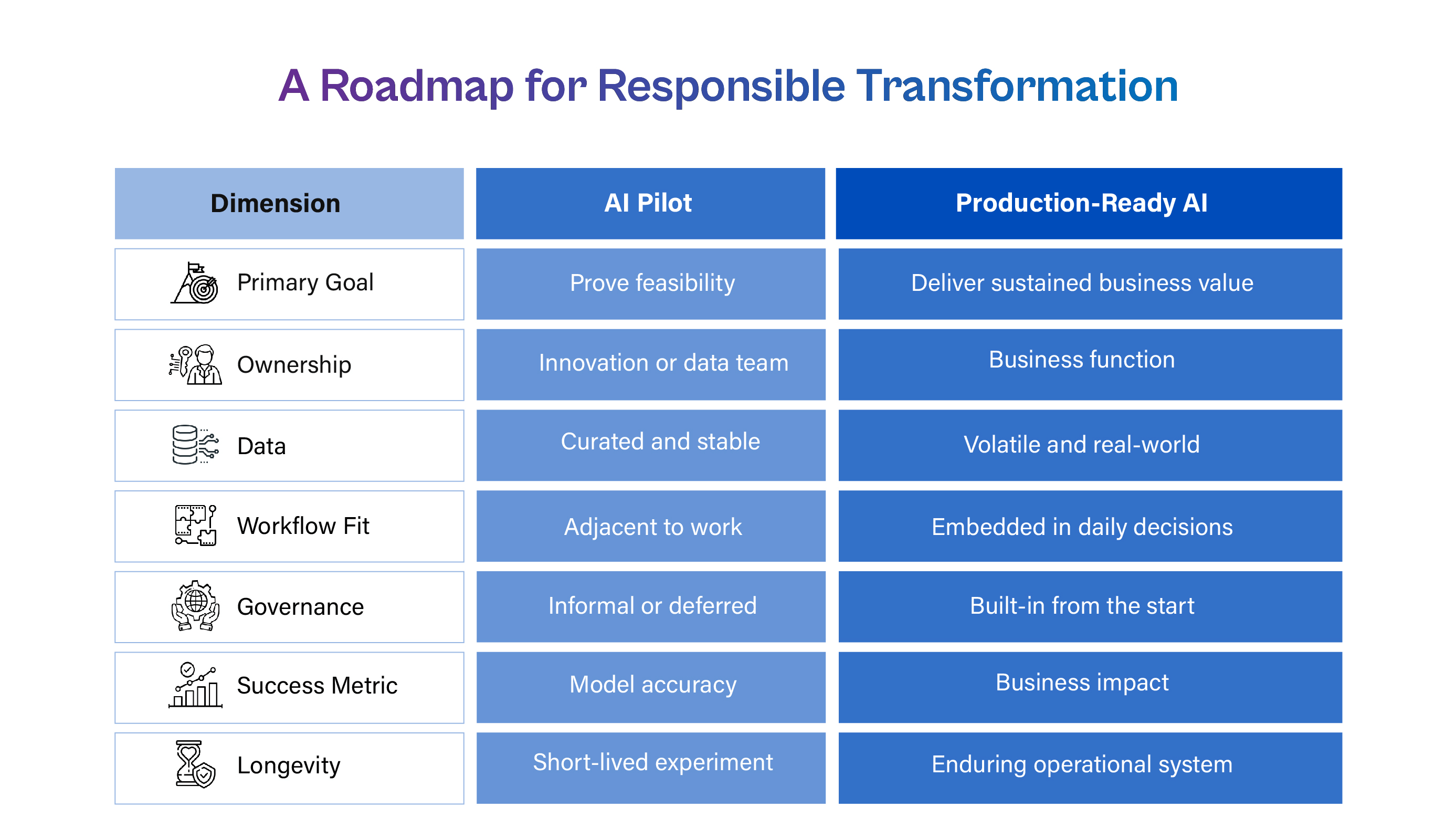
That shift shows up in a few consistent ways:
- They start with operational intent
Successful teams define the business decision first, not the model. They ask where the output will live, who will use it, and what changes once it exists. A use case only qualifies if a team is ready to depend on it. - They involve the business from day one
Domain leaders co-own the initiative. They shape requirements, test early versions, and define success. AI does not arrive as a finished product. It grows alongside the people who will rely on it. - They design for messy reality
Data pipelines assume inconsistency. Teams build monitoring into the system, not around it. They expect drift, plan for failure, and treat resilience as a core feature rather than an enhancement. - They bring governance forward
Security, legal, and risk teams participate during design. Instead of retrofitting controls, organizations embed them. This approach turns governance into an accelerator rather than a checkpoint. - They assign operational ownership
Every production system has a clear owner. That owner tracks performance, manages updates, and answers when outcomes change. The model belongs to a function, not to a lab. - They invest in change, not just code. Training focuses on how decisions evolve, not only on how tools work. Leaders communicate how humans and models collaborate. Teams learn when to trust, when to question, and how to improve the system through use.
This shift fundamentally changes how organizations think about AI work. Pilots no longer exist to showcase technical possibilities or to signal innovation. Instead, they serve as early tests of a future operating model. Each experiment begins to answer a more meaningful question than simple feasibility: Is this something the business can realistically depend on, day after day?
Enterprises that embrace this perspective stop collecting isolated proofs of concept and start building lasting capability. The change may feel subtle at first, but its effects compound over time. AI moves from being a special initiative to an expected part of how work happens. Models cease to function as demonstrations and begin to shape decisions, workflows, and thinking across the organization. That is the point at which experimentation turns into real advantage.
Why This Gap Will Define the Next Phase of Enterprise AI
The first wave of enterprise AI focused on discovery. Organizations experimented, learned what was possible, and built early confidence. That phase created momentum, but it also left behind a trail of pilots that never became systems. The next phase will look very different. It will not reward curiosity alone. It will reward the ability to operationalize intelligence.
- The market is moving from exploration to execution
Enterprises have spent years learning what AI can do. The next phase will reward those who can operationalize that learning. Competitive advantage will come from turning models into systems, not from running more experiments. - Operational fluency will matter more than algorithmic sophistication
Leaders will not win because they use more advanced models, but because they integrate intelligence into everyday decision-making. Faster feedback loops, embedded insights, and consistent use will compound value over time. - Pilot-heavy organizations will fall behind quietly
Companies that remain in experimentation mode will continue to invest and demo without changing how work happens. While they explore, competitors will convert learning into infrastructure and move ahead in subtle but structural ways. - The real question will shift from technology to readiness
Leaders will stop asking whether AI is mature enough and start examining whether their organization is. That means treating data as a product, models as operational systems, and governance as a design principle rather than an afterthought. - The most successful enterprises will look ordinary on the surface
Their AI will not feel experimental. It will feel routine. Decisions will flow through models, and workflows will assume intelligent support, making this normality their edge.
This is what makes the pilot-to-production gap a strategic dividing line rather than a technical inconvenience. In the years ahead, the distinction will no longer be about who is “doing AI.” It will be about who has learned how to run a business with it, quietly, consistently, and at scale.
From Experimentation to Enterprise Capability
The pilot-to-production gap persists because most organizations frame AI as a technical initiative rather than as an operating shift. They invest in models, tools, and platforms, but leave workflows, ownership, and culture largely unchanged. In that environment, pilots thrive, and systems stall.
Crossing this gap does not require perfect data or cutting-edge algorithms. It requires intent. Enterprises must decide that AI will not remain an experiment. They must design each initiative with a future state in mind, one where the business actually depends on the outcome. That decision changes how use cases are chosen, how teams collaborate, how data is managed, and how success is measured.
Organizations that make this shift stop asking whether a model works in isolation. They begin asking whether the business can run with it. They bring governance forward. They embed intelligence into daily work. They assign ownership and expect durability. Over time, AI becomes less visible and more powerful as it fades into how decisions are made.
Most enterprises already have the technical foundation to begin this transition. What they often lack is a clear operating philosophy for scale. The gap between pilots and production will continue to frustrate those who treat it as a tooling problem.
For those willing to treat it as a leadership and design challenge, it becomes an opportunity. Not to deploy more AI, but to build a business that learns, adapts, and decides differently at scale.
What Scale Really Demands
Most enterprises do not struggle with AI because they lack talent, tools, or ambition. They struggle because they underestimate what scale actually requires. Pilots reward curiosity and experimentation. Production demands commitment to changing how the organization operates.
Moving from a prototype to a system forces difficult questions. Who owns outcomes? Who maintains data quality? How do humans and models share responsibility? What happens when the system fails? These challenges extend far beyond engineering. They sit at the intersection of leadership, operations, compliance, and culture.
Organizations that succeed at this transition slow down their design even as they speed up execution. They treat AI as part of the operating model, not as an add-on. They build for reliability, accountability, and long-term use, assuming from the start that every successful pilot must eventually survive the complexity of real business environments. Scale, in this sense, is not a technical milestone but an organizational one.
Conclusion: From Pilots to Lasting Advantage
The distance between pilots and production continues to shape the real impact of enterprise AI. Many organizations will keep experimenting, showcasing promising use cases, and investing in new tools without ever changing how decisions are made. Others will take a different path.
They will design AI systems to live inside workflows, depend on imperfect data, operate under clear governance, and evolve with the business. Over time, intelligence will stop feeling like a separate initiative and become part of how the organization thinks.
The future of enterprise AI will not belong to those who adopt new models first. It will belong to those who build systems they can sustain, trust, and grow with.
That is where experimentation becomes capability, and capability becomes advantage.
Moving from experimentation to enterprise impact requires more than models. Partner with Cogent Infotech to embed AI into workflows, strengthen data foundations, and create systems that deliver measurable business outcomes at scale.
Contact Us Now!