


From Shadow AI to BYO-Agent: Keeping Productivity Without Leaking IP


Introduction
Artificial intelligence tools have become everyday productivity companions for modern employees. From drafting emails to analyzing datasets, generative AI platforms enable teams to move faster and produce better results. However, the rapid adoption of these tools has also introduced a major governance challenge for organizations: Shadow AI.
Shadow AI refers to the use of artificial intelligence tools without organizational approval or oversight. Employees often turn to publicly available AI platforms because they are convenient, accessible, and powerful. Yet this convenience comes with risks. When employees paste confidential documents, proprietary code, or customer information into external AI tools, they may unintentionally expose sensitive corporate data.
Many organizations initially responded to this trend with strict bans on generative AI. However, such bans rarely work in practice. Employees continue to use AI tools because they improve productivity and help teams meet tight deadlines. Instead of restricting usage, forward-thinking organizations now adopt a governance-first approach. They build structured policies, approved AI tools, and security frameworks that allow employees to innovate without risking intellectual property (IP).
This shift has led to the emergence of Bring Your Own Agent (BYO-Agent or BYOA) strategies. Rather than forcing employees to rely on uncontrolled external tools, organizations create secure ecosystems where approved AI agents, copilots, and automation tools operate within enterprise guardrails.
The Rise of Shadow AI in the Workplace
Shadow IT has existed for decades. Employees often adopt unauthorized tools when official systems slow down workflows. Generative AI has accelerated this behavior because these tools provide immediate value.
Recent industry research indicates that Shadow AI adoption is widespread across organizations. Studies from technology research firms reveal that employees frequently use generative AI tools for tasks such as writing documentation, analyzing spreadsheets, generating marketing content, and debugging code. Many of these uses occur outside the oversight of IT or security teams.
Industry analysts estimate that a large percentage of knowledge workers already experiment with generative AI in their daily workflows (Gartner, 2023). At the same time, enterprise security teams report growing concerns about the exposure of sensitive data when employees submit internal documents to external AI systems (IBM, 2024).
The risks associated with Shadow AI include:
- Exposure of proprietary business information
- Leakage of intellectual property and product roadmaps
- Unintentional sharing of customer data
- Compliance violations related to privacy regulations
- Generation of inaccurate or biased outputs that affect decision-making
Security leaders also face visibility challenges. When employees access AI tools through personal devices or external browsers, organizations lose the ability to monitor how corporate data flows through these systems.
However, organizations must also recognize an important reality: employees use AI because it improves productivity. Banning AI outright often creates friction between innovation and governance. Instead of stopping AI adoption, organizations must create structured environments in which AI use is safe, monitored, and aligned with enterprise security standards.
Why Organizations Are Moving Toward BYO-Agent
The concept of Bring Your Own Agent (BYOA) reflects a new model for enterprise AI adoption. Instead of restricting access to generative AI, organizations enable employees to use AI agents within controlled environments.
In a BYOA model, employees interact with AI assistants that operate within enterprise infrastructure. These agents integrate with internal knowledge bases, company documentation, and workflow systems while respecting security policies.
.jpg)
This approach offers several advantages.
- Productivity Without Uncontrolled Risk: Employees continue using AI tools for writing, coding, research, and analysis. However, enterprise guardrails ensure that sensitive information never leaves approved environments.
- Centralized Governance: Security teams gain visibility into how AI tools operate across departments. Organizations can monitor usage patterns, detect anomalies, and enforce policy compliance.
- Custom AI Capabilities: Enterprise AI agents can connect with internal systems such as CRM platforms, analytics tools, and knowledge repositories. This integration allows AI tools to deliver more relevant and accurate results.
- Improved Data Protection: BYOA frameworks apply data classification policies that determine what information AI tools can access or process.
Industry leaders emphasize that governance frameworks must evolve alongside AI adoption. Research organizations highlight that organizations will increasingly implement AI governance platforms to manage risk and compliance (Gartner, 2023).
Understanding Data Leakage Risks in Generative AI
To implement effective governance policies, organizations must first understand how generative AI systems interact with data. Unlike traditional software that operates within internal systems, generative AI platforms process user prompts, context, and uploaded files to generate responses. This means every interaction with an AI tool becomes a form of data exchange. When employees paste internal information into external AI platforms, they may unintentionally move sensitive data outside the organization’s secure environment.
Many AI providers process user inputs to maintain service quality and improve their models. Even when vendors implement privacy safeguards, organizations lose direct visibility over how that information is handled once it leaves their infrastructure. As a result, confidential assets such as internal reports, product strategies, or proprietary code may become vulnerable. In practice, these risks usually arise from a few common interaction patterns that unintentionally expose data.
Data exposure risks typically occur through three main channels:
- Prompt Injection: Employees may include confidential information within prompts when asking AI systems to summarize documents or analyze datasets.
- File Uploads: Some AI tools allow users to upload files for analysis. If employees upload internal reports or customer data, they may expose sensitive information outside enterprise boundaries.
- API Integrations: Developers often connect AI tools with enterprise systems through APIs. Poorly configured integrations may transmit sensitive data to third-party platforms.
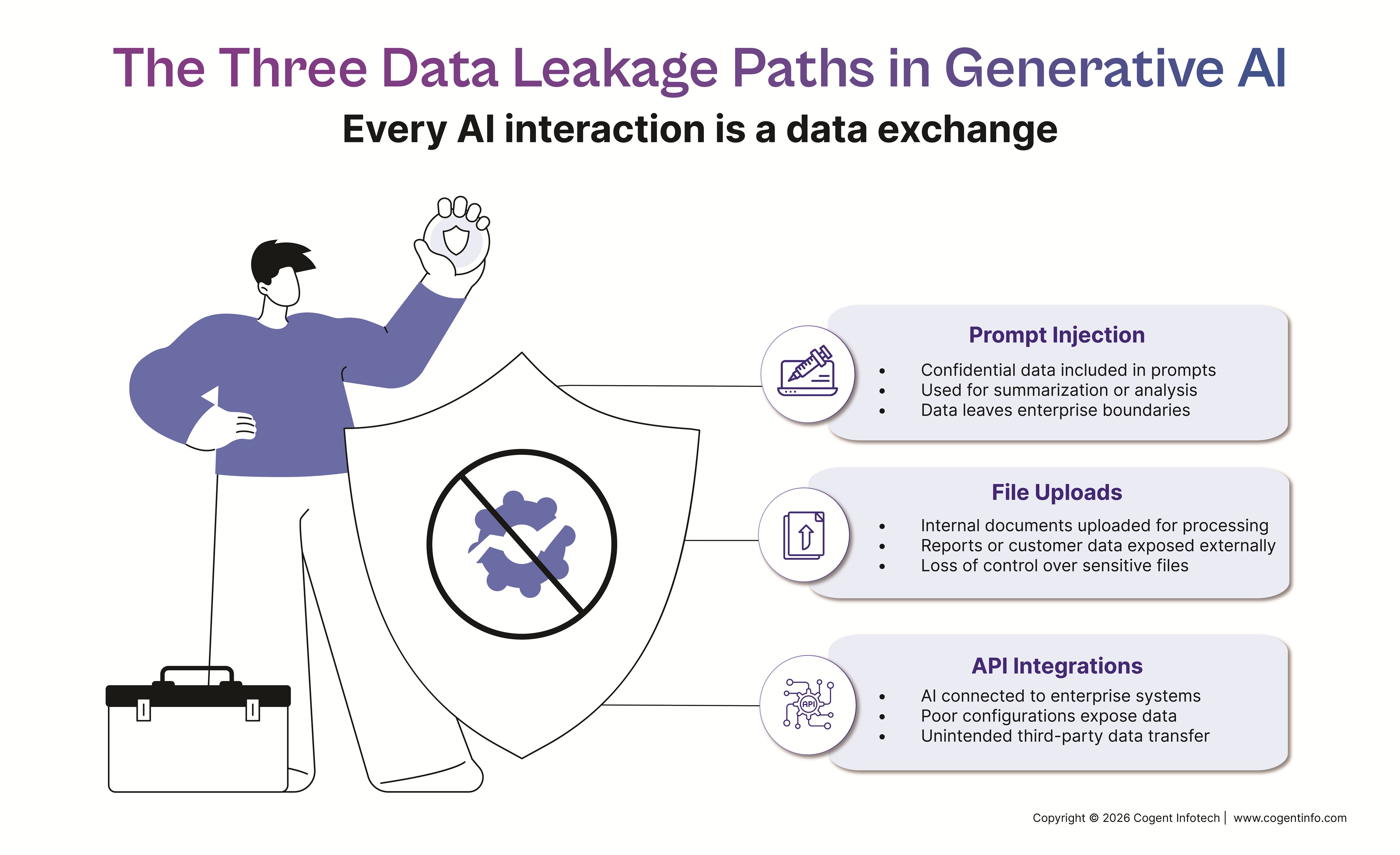
Organizations must therefore treat AI interactions as data transfer events that require security oversight.
Building a Practical BYOA Policy Framework
A strong BYOA policy provides clear guidelines for how employees interact with AI tools within the organization. It should clearly define what types of AI usage are acceptable, what data employees can share with AI systems, and which tools are approved for enterprise use. At the same time, the policy must strike a balance between encouraging innovation and maintaining strong security controls, while remaining simple enough for employees across departments to understand and follow.
Establishing clear governance principles helps organizations develop structured, responsible AI adoption practices. Well-defined policies support productivity while protecting intellectual property, ensuring that AI tools are used in ways that align with organizational security standards and compliance requirements.
Acceptable Use Guidelines
- Content drafting and editing: AI tools can assist employees in creating, refining, or proofreading written content such as emails, reports, or marketing copy.
- Data analysis using non-confidential datasets: AI can help analyze publicly available or non-sensitive data to generate insights and summaries.
- Research and brainstorming tasks: Employees can use AI to explore ideas, gather general information, or support early-stage problem-solving.
- Code generation for non-proprietary components: Developers may use AI to generate generic code snippets that do not contain proprietary logic or confidential information.
Approved AI Tools
- Enterprise copilots integrated with productivity suites: AI assistants embedded in workplace tools like document editors or communication platforms that operate within secure enterprise environments.
- Internal AI assistants connected to corporate knowledge bases: Organization-built AI tools that access internal documentation and data while maintaining security controls.
- Secure generative AI APIs deployed within private environments: AI services hosted in controlled infrastructure that allow companies to build applications without exposing data externally.
Prompt and Data Handling Rules
- Customer personally identifiable information (PII): Sensitive personal data such as names, contact details, or identification numbers that must never be shared with external AI tools.
- Financial records: Confidential financial data, including revenue figures, budgets, or transaction details that require strict protection.
- Intellectual property and product roadmaps – Proprietary ideas, designs, and strategic plans that represent a company’s competitive advantage.
- Internal security documentation: Sensitive technical information such as system architecture, security protocols, or vulnerability details that could expose organizational defenses.
Monitoring and Auditing
- Prompt activity logging: Recording AI interactions to maintain visibility into how employees use AI systems.
- Data access tracking: Monitoring what data AI tools access or process during employee interactions.
- Automated risk detection for sensitive information: Using security tools to automatically identify and flag prompts or files that contain confidential data.
Data Classification Rules for AI Prompts and Files
Data classification forms the foundation of safe AI adoption. Without clear classification rules, employees cannot determine what information they can share with AI tools.
Organizations can adopt a four-tier classification model for AI usage.
Public Data
- Marketing content: Promotional material such as campaigns, advertisements, or blog content that is intended for public audiences.
- Public product descriptions: Information about products or services that appears on websites, brochures, or other public platforms.
- Published research: Reports, studies, or articles that organizations have officially released for public access.
Internal Data
- Internal training materials: Educational resources created to train employees within the organization.
- Team documentation: Internal guides, process notes, or workflow documents used by teams to manage daily operations.
- Internal communication drafts: Preliminary versions of emails, memos, or announcements intended for internal organizational use.
Confidential Data
- Product development plans: Strategic documents outlining upcoming features, innovations, or product roadmaps.
- Client contracts: Legal agreements and service terms that contain sensitive business information.
- Internal financial reports: Financial data, such as revenue performance, budgets, and forecasting documents, are intended for internal stakeholders.
Restricted Data
- Customer PII: Personally identifiable information such as names, addresses, contact numbers, or identification details belonging to customers.
- Intellectual property and proprietary algorithms: Unique business innovations, formulas, models, or algorithms that provide a competitive advantage.
- Security architecture documentation: Detailed information about system infrastructure, security frameworks, or vulnerability management processes.
AI tools must never process restricted data unless organizations deploy fully secure internal AI environments.
Security leaders often integrate these classification levels with automated enforcement mechanisms such as data loss prevention (DLP) systems. These tools scan prompts and uploaded files to detect sensitive information before it leaves corporate networks.
Industry cybersecurity reports emphasize that organizations must integrate AI governance with existing data protection frameworks to reduce risk (IBM, 2024).
Enforceable Controls for Safe AI Usage
Policies alone cannot prevent the use of Shadow AI. Organizations must implement technical controls that enforce governance frameworks.
Several technologies can help organizations maintain safe AI environments.
Secure AI Gateways
AI gateways act as intermediaries between employees and external AI tools. They inspect prompts and responses to detect sensitive information.
Data Loss Prevention Systems
DLP tools analyze data flows across enterprise networks. When employees attempt to share sensitive information with external AI tools, these systems trigger alerts or block the request.
Identity and Access Management
Organizations can restrict access to AI based on user roles. For example, developers may access AI coding assistants while finance teams may use AI analytics tools.
API Governance Platforms
API governance ensures that enterprise applications communicate securely with AI services. These platforms monitor API traffic to detect unusual activity or unauthorized integrations.
Integrating clear policy frameworks with technical enforcement mechanisms helps organizations build strong AI governance systems. Policies outline responsible AI usage, while tools such as monitoring systems and data protection controls ensure compliance. Together, they enable organizations to support innovation while protecting sensitive data and intellectual property.
Detection and Response Playbooks for Shadow AI
Even with strong governance frameworks, organizations may still encounter unauthorized AI usage. Security teams must prepare response playbooks that address these incidents quickly.
A structured response process typically includes the following steps.
Detection
Security teams identify Shadow AI usage through network monitoring tools, endpoint security systems, or employee reports.
Indicators may include:
- Repeated access to external AI platforms
- Unusual data transfers involving sensitive files
- Unauthorized API integrations
Investigation
Security teams evaluate the scope of the incident.
Key questions include:
- What data was shared with external AI tools?
- Which employees or departments were involved?
- Did the activity violate existing policies?
Containment
Organizations must prevent further data exposure.
Possible actions include:
- Blocking access to unauthorized AI platforms
- Revoking compromised credentials
- Restricting API connections
Legal and Compliance Review
Legal teams evaluate potential regulatory implications, especially when incidents involve personal or confidential data.
Organizations should treat many Shadow AI incidents as learning opportunities. Instead of punitive actions, companies can educate employees about safer AI practices and approved alternatives.
Cybersecurity research indicates that organizations must combine technology, training, and governance to manage AI risks effectively (NIST, 2023).
Creating a Culture of Responsible AI Usage
Technology alone cannot solve Shadow AI challenges. Organizations must build cultures that encourage responsible AI adoption.
Leadership teams play an important role in shaping these cultures.
Encourage Transparent AI Usage
Employees should feel comfortable discussing how they use AI tools. Transparency helps organizations understand evolving workflows and identify potential risks early.
Provide Approved Alternatives
Employees often adopt Shadow AI tools because official systems lack comparable capabilities. Organizations should provide enterprise AI solutions that match the convenience and functionality of consumer tools.
Invest in AI Literacy
Training programs should teach employees how generative AI systems work and why certain data should remain protected.
Education initiatives can include:
- AI ethics workshops
- Data protection training
- Responsible and prompt engineering guidelines
When employees understand both the benefits and risks of AI, they become active participants in governance frameworks.
The Future of Enterprise AI Governance
As generative AI technologies continue to evolve, organizations will face new governance challenges.
Future enterprise AI ecosystems will likely include:
- AI agents that automate complex workflows
- Multimodal AI systems that process text, images, and video
- Autonomous agents that interact with enterprise software systems
These developments will increase productivity but also introduce new security considerations.
Technology leaders predict that organizations will increasingly adopt AI governance platforms that integrate security, compliance, and monitoring capabilities within a unified environment (Gartner, 2023).
Organizations that establish governance frameworks early will gain a competitive advantage. They will enable innovation while protecting valuable intellectual property.
Conclusion
Shadow AI represents one of the most pressing governance challenges in modern organizations. Employees increasingly rely on generative AI tools to enhance productivity, yet uncontrolled usage can expose sensitive corporate information.
Instead of restricting AI adoption, organizations must embrace structured governance strategies that balance innovation with security. The Bring Your Own Agent (BYOA) model offers a practical path forward. By providing secure enterprise AI tools, implementing clear policies, and deploying technical enforcement mechanisms, organizations can support employee productivity without risking intellectual property.
Effective AI governance requires collaboration across IT, security, legal, and business teams. Organizations must develop clear policies, classify data appropriately, deploy monitoring tools, and educate employees on responsible AI practices. Structured rollout plans and incident response playbooks ensure that governance frameworks evolve alongside emerging technologies.
As AI becomes deeply embedded in business workflows, organizations must treat AI governance as a strategic priority rather than a compliance exercise. Companies that successfully transition from Shadow AI to BYOA frameworks will unlock the full potential of AI while protecting their most valuable assets.
Navigating Shadow AI doesn’t have to be complex.
With Cogent Infotech, you can build secure, scalable AI ecosystems tailored to your business needs. Speak with our team to kickstart your BYO-Agent journey.

