Small & Specialized: Why Domain-Tuned SLMs Beat General LLMs in 2026



Introduction
In the early wave of AI adoption, Large Language Models (LLMs) were hailed as the ultimate solution: vast, general‑purpose systems capable of answering almost any query. Yet by 2026, enterprises will have learned that scale alone doesn’t guarantee success. Costs balloon, latency frustrates users, and compliance risks mount.
Enter Small Language Models (SLMs), compact, domain‑tuned systems optimized for specific tasks. They’re not just cheaper; they’re smarter in context. This article explores why SLMs are overtaking LLMs, how hybrid routing balances both, and what practical steps organizations should take to evaluate and govern them.
The Shift from Bigger to Smarter
In the early years of AI adoption, the prevailing belief was that scale equaled superiority. Frontier LLMs, with hundreds of billions of parameters, were celebrated as the pinnacle of progress. But by 2026, enterprises will have learned that bigger often means slower, costlier, and riskier. Small Language Models (SLMs), especially when tuned for specific domains, are proving to be the more practical choice.
Cost reality
- Training frontier LLMs requires clusters of GPUs or TPUs, specialized cooling, and enormous energy consumption.
- Licensing fees for commercial access can run into millions annually.
- Ongoing fine‑tuning, monitoring, and compliance audits add hidden operational costs.
- By contrast, SLMs deliver comparable utility at a fraction of the cost, making them financially sustainable.
Latency pressure
- Customer support systems cannot afford multi‑second delays; even a 3‑second pause can cause drop‑offs.
- Fraud detection requires millisecond‑level decisioning to block suspicious transactions in real time.
- Healthcare triage demands immediate responses in emergency scenarios.
- SLMs, with fewer parameters and optimized architectures, consistently deliver sub‑second latency.
Risk tolerance
- LLMs are prone to hallucinations, outputs that sound plausible but are factually incorrect.
- In regulated industries, a single hallucination can trigger compliance violations or endanger lives.
- Domain‑tuned SLMs reduce hallucination risk by narrowing scope to vetted, domain‑specific data.
- Their smaller size makes auditing and explainability more feasible, aligning with regulatory expectations.
Decision Matrix: SLM vs LLM vs Hybrid Routing
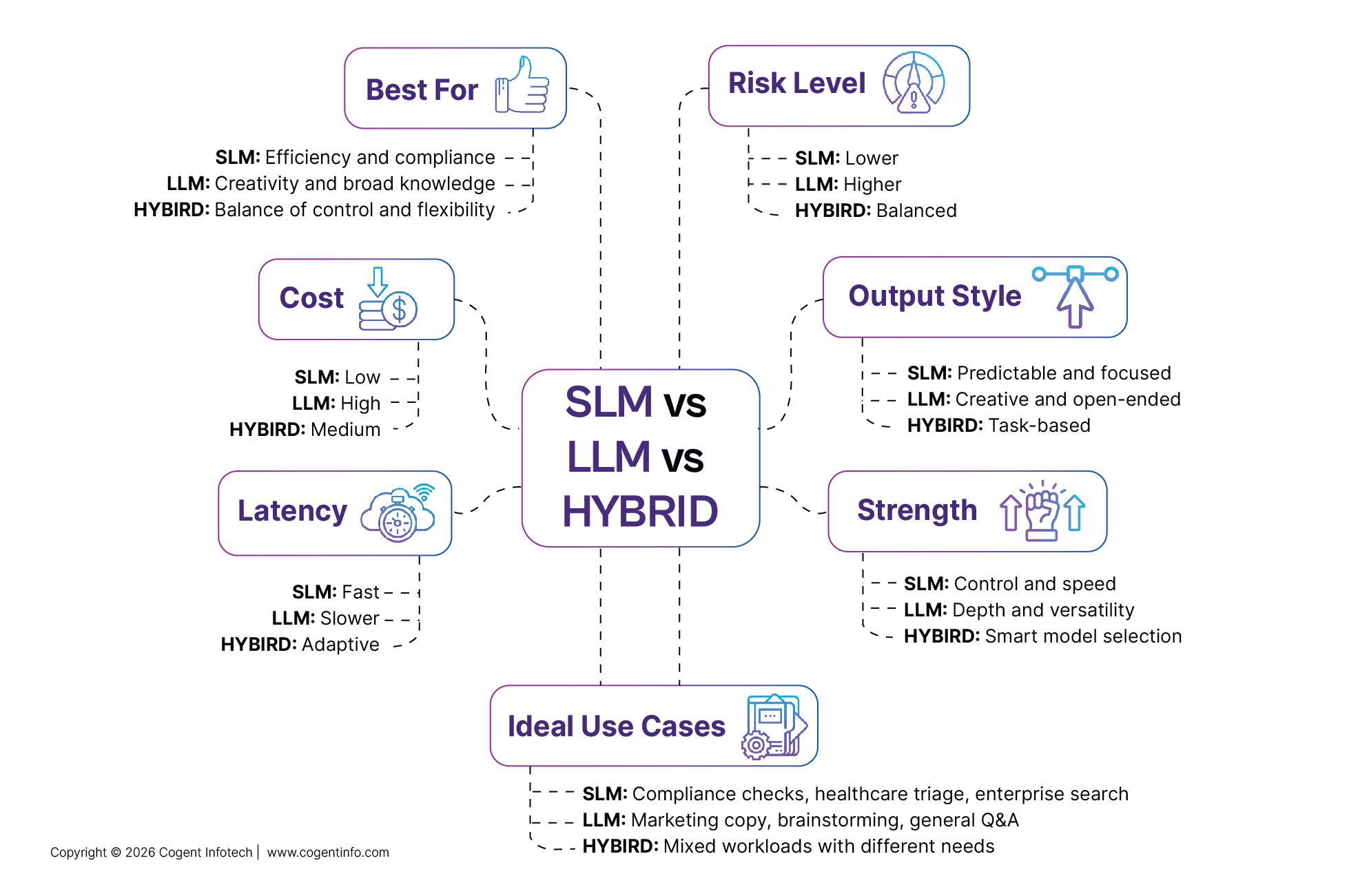
As organizations mature in their AI adoption, the choice is no longer simply “LLM or nothing.” By 2026, enterprises are weighing three distinct options:
- Domain‑tuned Small Language Models (SLMs) for efficiency and compliance.
- General Large Language Models (LLMs) for creativity and broad knowledge.
- Hybrid routing architectures that combine both, using classifiers or orchestration layers to decide which model handles which query.
This decision isn’t abstract, it’s driven by cost, latency, and risk triggers that vary by industry and workload.
Comparative Factors
Cost
- SLM: Low infrastructure footprint, efficient deployment, reduced licensing overhead. Ideal for budget‑constrained enterprises.
- LLM: High infrastructure requirements, expensive licensing, and significant energy consumption. Best justified when creative breadth is essential.
- Hybrid: Balanced approach, SLMs handle the majority of queries, while LLMs are invoked selectively for complex or open‑ended tasks.
Latency
- SLM: Millisecond‑level responses, optimized for real‑time decisioning.
- LLM: Often multi‑second delays due to parameter size and compute load.
- Hybrid: Adaptive routing ensures latency‑sensitive queries go to SLMs, while less time‑critical tasks can leverage LLMs.
Risk
- SLM: Predictable, auditable outputs with reduced hallucination risk. Easier to explain and govern.
- LLM: Higher hallucination risk, especially in regulated domains. Outputs may be creative but unreliable.
- Hybrid: Risk‑based routing ensures high‑stakes queries are handled by SLMs, while exploratory or creative queries can safely use LLMs.
Best Use Cases
- SLM: Regulated, proprietary tasks (compliance checks, healthcare triage, enterprise search).
- LLM: Creative, open‑ended tasks (marketing copy, brainstorming, general knowledge Q&A).
- Hybrid: Mixed workloads where efficiency, compliance, and creativity must coexist.
Evaluation Packs for Regulated Use
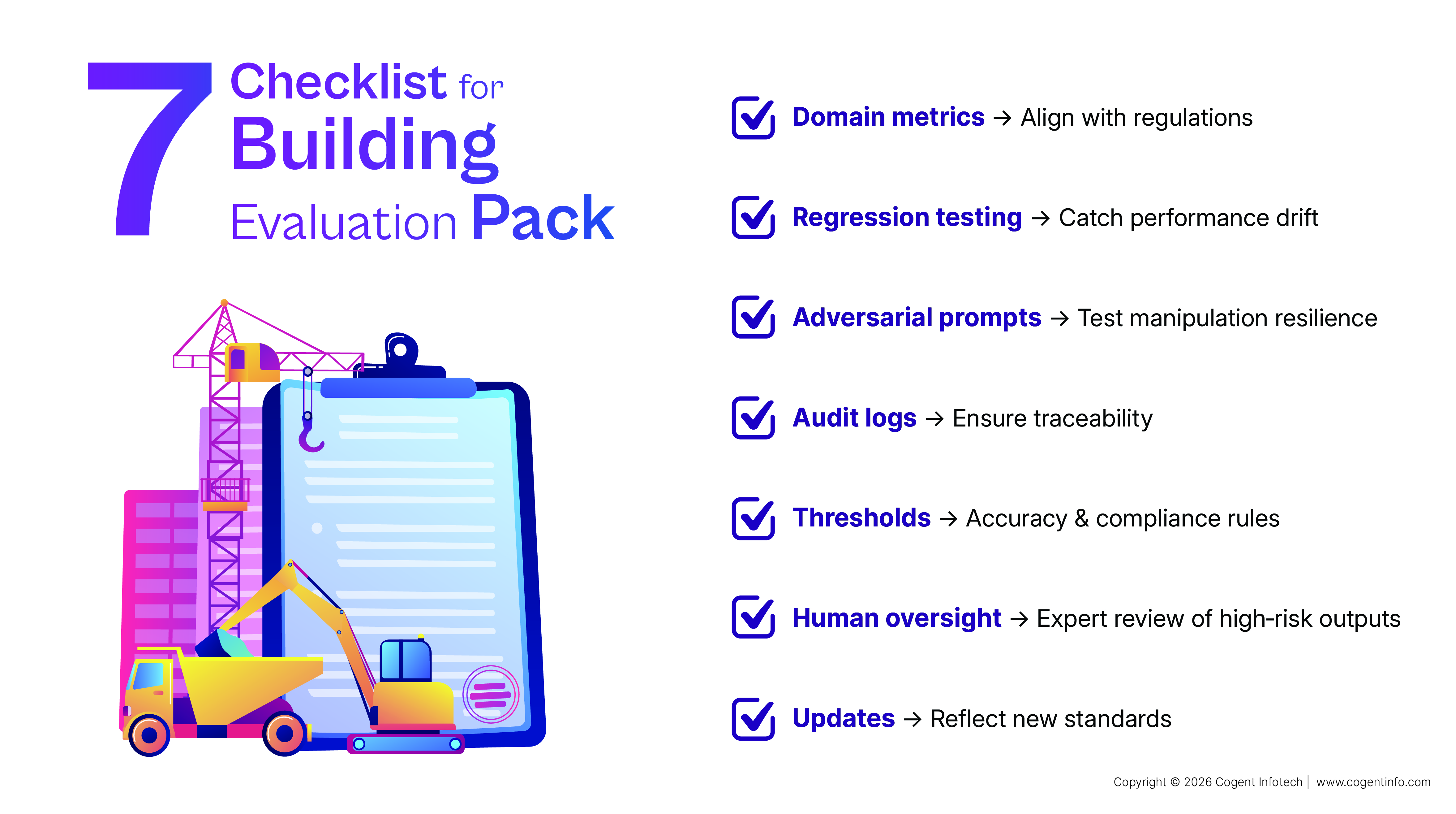
By 2026, regulators and enterprises alike demand structured, domain‑specific evaluation frameworks to prove that AI systems are safe, accurate, and auditable. Frontier LLMs, with their generalist nature, often fail these tests. Domain‑tuned SLMs, however, can be systematically evaluated against gold standards using tailored “evaluation packs.” These packs serve as compliance toolkits, ensuring models meet industry benchmarks before deployment.
Core Dimensions of Evaluation Packs
Evaluation packs measure performance across three critical dimensions:
Accuracy
- Benchmark outputs against domain‑specific gold standards (e.g., medical guidelines, financial regulations, legal precedents).
- Include regression tests to ensure updates don’t degrade performance.
- Use precision/recall metrics for tasks like classification, retrieval, or summarization.
Safety
- Bias detection across demographic groups.
- Toxicity filters to prevent harmful or offensive outputs.
- Stress testing with adversarial prompts to expose vulnerabilities.
Auditability
- Logging every query and response for traceability.
- Explainability mechanisms to show why a model produced a given output.
- Reproducibility checks to confirm consistent behavior across environments.
Domain‑Specific Examples
Healthcare
- Diagnostic accuracy measured against anonymized patient cases.
- Bias checks across gender, age, and ethnicity.
- Safety filters to prevent unsafe dosage or treatment recommendations.
Finance
- Audit trails for every compliance check.
- Explainability modules to justify risk scores or regulatory interpretations.
- Stress tests with ambiguous clauses to ensure robustness.
Legal
- Redaction fidelity to guarantee sensitive information is removed.
- Alignment with precedent databases to avoid fabricated citations.
- Audit logs for every document processed, ensuring reproducibility.
Training on Proprietary Data: Practical Guidance
By 2026, the competitive edge in AI doesn’t come from public datasets, it comes from proprietary, domain‑specific data. Whether it’s patient records, financial transactions, or legal documents, organizations are realizing that the value of SLMs lies in their ability to be tuned on trusted internal knowledge. But this advantage comes with risks: privacy breaches, regulatory violations, and data leakage. That’s why practical guidance for training on proprietary data is essential.
Framework for Safe Training
A structured framework ensures proprietary data is leveraged responsibly:
Redaction
- Strip personally identifiable information (PII) before ingestion.
- Apply automated anonymization tools to remove names, addresses, and sensitive identifiers.
- Use tokenization or pseudonymization for fields that must remain structurally intact (e.g., account numbers).
Governance
- Enforce role‑based access controls so only authorized teams can handle sensitive datasets.
- Maintain version control for datasets and fine‑tuned models to track changes.
- Establish clear approval workflows for dataset updates and model retraining.
Leakage Prevention
- Sandbox fine‑tuning environments to isolate experiments from production systems.
- Prefer retrieval‑augmented generation (RAG) for sensitive data, which keeps proprietary information in secure databases rather than embedding it directly into the model.
- Monitor prompts and outputs to detect potential leakage of confidential information.
Common Pitfalls
Organizations often stumble when is weak or oversight is missing:
- Shadow datasets: Informal or duplicate datasets created outside governance pipelines, leading to uncontrolled risk.
- Unmonitored prompts: Employees inadvertently leaking sensitive data through careless queries.
- Over‑fine‑tuning: Embedding proprietary data directly into models without safeguards, making it harder to prevent leakage.
- Lack of audit trails: No visibility into who accessed or modified datasets, creating compliance blind spots.
Best Practices
To mitigate risks and maximize value, enterprises must adopt a disciplined set of best practices that strengthen governance, protect sensitive data, and ensure reliable outcomes. These practices combine technical safeguards with human oversight, creating a balanced framework for responsible AI deployment.
Synthetic augmentation
- Generate synthetic data to supplement rare or sensitive cases, reducing reliance on actual confidential records.
- Use domain‑specific simulation tools to create realistic but non‑identifiable training examples.
Audit logs for every training run
- Record dataset versions, training parameters, and outputs.
- Ensure logs are immutable and accessible for compliance reviews.
- Automate alerts for unusual activity, such as unauthorized dataset access.
“Least privilege” principle
- Limit dataset access to only those roles that require it.
- Segment datasets by sensitivity level, ensuring high‑risk data is tightly controlled.
- Apply encryption at rest and in transit for all proprietary data.
Human‑in‑the‑loop oversight
- Require domain experts to review outputs during fine‑tuning.
- Establish escalation protocols for questionable outputs.
- Combine automated checks with expert judgment for high‑risk domains.
Hybrid Approaches: Routing and Orchestration
By 2026, enterprises have realized that no single model can meet all needs. SLMs excel in speed, cost efficiency, and compliance, while LLMs shine in creativity and open‑ended reasoning. The solution is hybrid orchestration: routing queries intelligently between SLMs and LLMs based on context, risk, and performance requirements. This approach transforms AI from a monolithic tool into a flexible ecosystem.
How Hybrid Routing Works
Hybrid routing is the backbone of modern multi‑model AI systems, acting like a traffic controller that ensures queries are directed to the right engine. By balancing speed, cost, and risk, it allows organizations to maximize efficiency while maintaining reliability and compliance.
- Classifier role
At the center of hybrid routing is the classifier, a lightweight model that triages queries before execution. It evaluates the type, complexity, and risk level of each request to determine whether it should be handled by a smaller, faster SLM or a more powerful LLM. For instance, a factual query such as “What is the capital of Japan?” would be routed to an SLM for quick and low‑cost resolution, while a creative task like “Write a short story about space travel” would be directed to an LLM. This process ensures that resources are allocated intelligently without sacrificing quality.
- Architecture snapshot
The routing process follows a structured flow: input passes through the classifier, which then directs the query to either an SLM or an LLM. The chosen model generates the output, which is recorded with an audit log for transparency and accountability. Routing decisions are guided by cost thresholds to stay within budget, latency SLAs to distinguish between real‑time and batch tasks, and risk categories to separate compliance‑critical queries from exploratory ones. This layered architecture ensures that every query is handled by the most appropriate model, balancing performance, safety, and governance.
Benefits of Hybrid Orchestration
Cost savings
- SLMs handle the majority of queries, reducing reliance on expensive LLM calls.
- Enterprises report up to 60% lower compute costs with hybrid routing.
Risk mitigation
- High‑stakes queries (e.g., compliance checks) are routed to domain‑tuned SLMs.
- Creative or exploratory queries are safely handled by LLMs.
- This ensures regulators can see clear logic behind model selection.
Balanced performance
- Latency‑sensitive tasks benefit from SLM speed.
- Complex reasoning tasks leverage LLM depth.
- Hybrid orchestration delivers both efficiency and flexibility.
Advanced Routing Strategies
Advanced routing strategies represent the next stage of hybrid orchestration, moving beyond simple model selection into dynamic, risk‑aware, and adaptive decision making. These strategies ensure that multi‑agent systems remain efficient, resilient, and aligned with organizational priorities even under shifting workloads and complex conditions.
Dynamic routing
Dynamic routing uses real‑time classifiers to adjust how queries are distributed based on workload and system health. During peak hours, for example, more queries may be routed to smaller SLMs to maintain latency service levels, while off‑peak periods allow for greater use of LLMs. This approach ensures that performance targets are met without sacrificing responsiveness or cost efficiency.
Risk‑tiered routing
Risk‑tiered routing categorizes queries into low, medium, and high‑risk tiers, assigning them to different pathways accordingly. Low‑risk queries are handled by SLMs for speed and efficiency, medium‑risk queries use hybrid fallbacks to balance accuracy and cost, and high‑risk queries are escalated to human‑in‑the‑loop workflows supported by LLMs. This tiered approach ensures that sensitive or compliance‑critical tasks receive the highest level of oversight.
Adaptive orchestration
Adaptive orchestration introduces a feedback loop where systems learn from past routing decisions to improve future performance. Audit logs feed back into classifiers, refining their logic over time and reducing misroutes. This continuous learning process strengthens reliability, making the system smarter and more efficient with each cycle of operation.
The 2026 Landscape
Market Signals
By 2026, the AI market is showing clear signals of a strategic pivot. Enterprises are shifting budgets, regulators are shaping adoption patterns, and procurement practices are evolving to favor smaller, domain‑tuned models. Together, these signals highlight a move away from generalist frontier LLMs toward hybrid ecosystems built on efficiency, compliance, and fit‑for‑purpose design.
- Budget shifts toward SLMs: Enterprises are reallocating spend from frontier LLM licenses to domain‑tuned SLM deployments. CFOs increasingly highlight SLM adoption as a cost‑containment strategy, with savings reinvested into orchestration and compliance infrastructure.
- Regulatory encouragement: Regulators in finance, healthcare, and legal sectors are explicitly recommending domain‑tuned models for auditability. Guidance documents now emphasize explainability, reproducibility, and narrow scope, all areas where SLMs outperform LLMs.
- Procurement trends: RFPs (Requests for Proposals) increasingly specify “domain‑tuned” or “small model” requirements, signaling that enterprises want fit‑for‑purpose AI rather than generalist systems.
Vendor Ecosystem
The vendor ecosystem for AI has rapidly diversified, reflecting the hybrid adoption trend. Organizations now have access to open‑source models, proprietary domain‑specific solutions, and orchestration platforms that tie everything together. This layered landscape is shaping how enterprises deploy and govern agentic systems.
Open‑source SLMs
- Communities like Hugging Face and EleutherAI are releasing lightweight, domain‑adaptable models.
- Enterprises leverage these as starting points, layering proprietary fine‑tuning and governance frameworks.
- Open‑source SLMs are particularly attractive for organizations seeking transparency and control.
Enterprise DSLMs (Domain‑Specific Language Models)
- Proprietary offerings tuned for verticals such as healthcare, finance, and legal.
- Vendors provide pre‑built evaluation packs, compliance certifications, and integration pipelines.
- DSLMs are marketed as “ready‑to‑deploy” solutions, reducing time‑to‑value for regulated industries.
Orchestration platforms
- Specialized platforms now offer routing, monitoring, and evaluation pack management.
- Features include dynamic routing classifiers, audit dashboards, and compliance reporting modules.
- These platforms are becoming the middleware layer of enterprise AI, enabling hybrid ecosystems to function seamlessly.
Predictions
Looking ahead, several trends are solidifying into industry norms, reshaping how enterprises adopt and govern hybrid AI systems. These predictions highlight the sectors leading adoption, the evolving role of frontier models, and the rise of orchestration as the default enterprise pattern.
Regulated industries lead adoption
- Finance, healthcare, and legal sectors are at the forefront, driven by compliance mandates.
- Their early adoption sets benchmarks that other industries will follow, especially in governance and evaluation pack design.
Frontier LLMs reserved for creative/complex tasks
- Large, generalist models remain valuable for brainstorming, content generation, and exploratory analysis.
- However, they are increasingly siloed into low‑risk, high‑creativity domains, where hallucinations are tolerable.
Hybrid orchestration becomes the default enterprise pattern
- Enterprises no longer ask “SLM or LLM?”, they design ecosystems where both coexist.
- Hybrid routing ensures efficiency without sacrificing flexibility, with orchestration platforms acting as the glue.
- By 2026, hybrid orchestration is not an experiment but the operating standard for responsible AI deployment.
Conclusion
Small Language Models (SLMs) have proven themselves to be specialized champions rather than scaled‑down versions of LLMs. In 2026, enterprises recognize that success in AI deployment depends on fit, governance, and adaptability rather than sheer size. By building decision matrices to guide model selection, evaluation packs to validate accuracy and safety, and governance pipelines to manage proprietary data responsibly, organizations unlock AI that is faster, cheaper, and more trustworthy.
The broader lesson is that efficiency, domain specificity, and hybrid orchestration now define the new era of enterprise AI. LLMs remain valuable for creativity and complex reasoning, but SLMs carry the operational load where compliance, speed, and cost matter most. The winning organizations are those that ask not “How big is the model?” but “Is this model the right fit for the task?”, a mindset that ensures AI delivers measurable ROI and long‑term resilience.
Looking to balance AI performance, cost, and compliance?
Partner with Cogent Infotech to design domain-tuned SLM and hybrid AI strategies that deliver faster, safer, and smarter business outcomes.


.jpg)