AI-Native FinOps: Controlling GPU and LLM Cloud Costs



Artificial Intelligence (AI) is no longer just a luxury or futuristic concept for enterprises, it has become a core part of operations. Whether it's automating customer service, driving advanced data analytics, or enhancing decision-making processes, AI has a profound impact on how businesses operate. However, with AI adoption comes a significant challenge: managing costs.
Traditional cloud computing cost models, which focus on compute, storage, and networking, are no longer enough to handle the complexity and scale of modern AI workloads. Today, enterprises face rising costs tied to Graphics Processing Units (GPUs), Large Language Models (LLMs), token-level pricing, inference workloads, and other AI-specific infrastructure. These new technologies introduce financial unpredictability, as AI models and workloads can vary greatly in terms of compute needs, training time, and data usage.
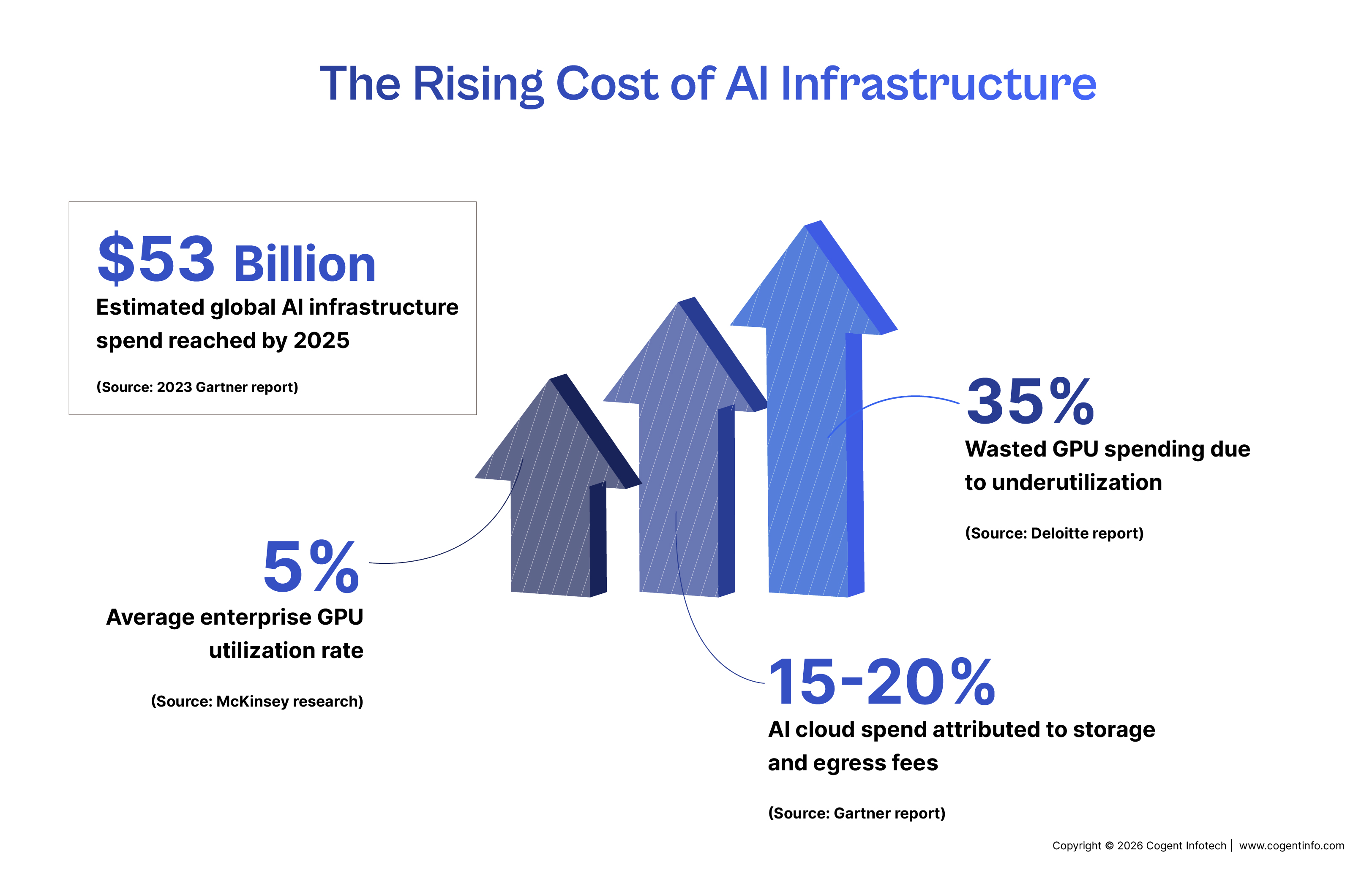
As AI infrastructure becomes more complex, enterprises are struggling to predict and control their AI costs. According to a 2023 Gartner report, global spending on AI infrastructure was estimated to reach over $53 billion by 2025, with a significant portion of this cost tied to GPUs and model training. With such exponential growth in AI investments, businesses need a new approach to cloud cost management, one that goes beyond traditional cloud practices. This is where AI-native FinOps (Financial Operations) comes into play.
AI-native FinOps is the discipline needed to handle these new challenges. By evolving traditional FinOps to account for the complexity of AI infrastructure, businesses can better manage GPU, LLM, and other AI-related costs while ensuring that AI resources are used efficiently.
The rapid rise of artificial intelligence (AI) across industries has brought new challenges to the forefront, particularly when it comes to managing the costs associated with AI infrastructure. While traditional cloud computing was primarily about managing resources like compute and storage, AI workloads have introduced new complexities, GPUs, Large Language Models (LLMs), inference costs, and other specialized AI components are reshaping the landscape of cloud cost management. As AI adoption grows, organizations find themselves navigating a multidimensional cost structure, one that extends far beyond basic compute power or storage usage.
What’s more, these new AI infrastructure components often come with unpredictable usage patterns, which means that the old ways of tracking and forecasting cloud costs simply don’t apply. Enterprises are not only paying for storage or compute; they are now facing costs driven by GPU-intensive tasks, model training, data pipelines, and token-level charges for APIs used to run LLMs. AI workloads such as inference queries and training large models are also often unpredictable, with costs that vary depending on model size, query volume, or resource requirements. Without the proper tools and strategies in place, businesses risk runaway costs that can spiral out of control.
In fact, AI infrastructure spending is projected to reach over $53 billion by 2025, with a significant portion of these costs tied to resources such as GPUs and the usage of LLM APIs. This massive growth highlights the urgency for businesses to adopt a new approach to managing AI costs, one that goes beyond traditional FinOps (Financial Operations) and aligns specifically with the unique needs of AI workloads. AI-native FinOps is the solution that many organizations need to implement in order to gain control over their AI expenses while driving sustainable growth.
This article explores how AI-native FinOps can help enterprises optimize costs related to GPUs, LLMs, and other AI infrastructure, as well as how it provides the necessary visibility, automation, and governance to manage the complex and often unpredictable costs associated with AI. Through better resource allocation and the right governance strategies, businesses can not only reduce their AI-related spend but also unlock value from their investments in AI.
Why Traditional FinOps Falls Short for AI
Traditional FinOps focuses on managing cloud costs for compute, storage, and networking resources. In this model, businesses pay for what they consume, and the usage tends to be more predictable. However, when it comes to AI workloads, these traditional models fall short in several key areas. AI technologies such as GPUs, LLMs, and inference models introduce a level of unpredictability that traditional cloud models are not designed to handle.
Key Challenges:
- Unpredictable GPU Usage
GPUs are essential for training and running AI models, particularly deep learning models. However, these resources are often costly and frequently underutilized. According to McKinsey research, the average GPU utilization rate across enterprises using AI is around 5%, which means businesses are paying for GPU resources they do not fully use. The high cost of GPUs, combined with low utilization, creates inefficiencies that traditional FinOps methods are ill-equipped to address. - Token-Level Costs for LLMs
The rise of LLMs such as OpenAI's GPT-3 has introduced a new cost structure, token-level pricing. In this model, businesses are charged based on the number of tokens they process, which can be highly variable depending on the complexity and length of the input/output data. For instance, running a single API call through an LLM like GPT-3 could result in costs ranging from $0.0004 to $0.06 per 1,000 tokens. With AI services like ChatGPT being used in customer service, marketing, and other business functions, costs can escalate quickly if token usage is not carefully managed. This introduces a new layer of unpredictability that traditional cloud cost management frameworks cannot handle. - Complexity of Inference Workloads
AI inference, the process of applying a trained model to real-world data, can be particularly expensive, especially for large-scale applications. Inference is often billed based on the number of API calls, which can vary widely depending on the volume and frequency of requests. Amazon Web Services (AWS), for instance, charges for inference based on the number of inference requests made, while Microsoft Azure has a similar model where businesses are charged per compute minute for running their models. Enterprises running AI-driven applications may find their costs ballooning due to high inference requests, especially if they haven’t anticipated the costs tied to the frequency and scale of those requests. - Data Pipeline Costs
AI models require vast amounts of data, which must be processed, transferred, and stored. The cost of maintaining and moving data, whether across regions, between cloud providers, or through data pipelines, can add up quickly. In a 2022 Forrester report, 59% of AI practitioners indicated that data-related costs, including storage and transfer, were significant contributors to their overall AI spend. Additionally, businesses often fail to realize how fragmented their data is across different cloud platforms, which results in increased egress and storage costs. - Training Costs
The cost of training AI models is another area where traditional FinOps struggles. Large models like GPT-3, for instance, require substantial computing power, which can mean months of training across a large GPU cluster. According to OpenAI, the cost of training a model like GPT-3 was in the millions of dollars, and many enterprises with their own AI initiatives can expect similar expenses. Training costs vary widely depending on model size, dataset complexity, and the number of training iterations. Traditional cloud cost models that focus on static compute usage do not capture the scale and duration of training processes, leading to a lack of visibility.
The Hidden Drivers of AI Cloud Spend
AI cloud spend isn’t just driven by the obvious costs of compute and storage. Several hidden drivers can lead to significant AI-related expenditures, particularly for GPUs, LLMs, and other specialized resources.
Hidden Costs of AI Cloud Spend:
- Over-Provisioned GPUs
As previously mentioned, GPUs are often over-provisioned in enterprise environments. Many businesses pay for high-performance GPUs without fully understanding their needs. As a result, enterprises might end up paying for GPUs that are often sitting idle. A report from Deloitte indicated that AI-driven organizations waste up to 35% of their GPU spending due to underutilization. - LLM Token Overuse
The costs associated with LLM APIs like GPT-3 are tied directly to the number of tokens processed. According to OpenAI, a single query to the GPT-3 model can cost anywhere from $0.0004 for a short input to $0.06 for longer, more complex queries. Enterprises that don't track token usage carefully risk generating massive costs, particularly if they're running frequent, long queries. - Inefficient Data Pipelines
Data pipelines for AI can also become a source of hidden costs. Whether it’s moving large datasets across regions or processing data through multiple stages in a pipeline, the associated costs can accumulate quickly. As mentioned, 59% of AI practitioners reported significant data-related costs in their operations, especially when working with unstructured data or data stored across multiple cloud environments. - Complex Cloud Storage and Transfer Fees
Storing and transferring large datasets required for AI workloads often results in higher cloud fees than anticipated. Enterprises frequently store data in cold storage for long-term retention, but retrieving and transferring that data when needed can come with additional costs. According to a report from Gartner, 15-20% of AI-related cloud spend can be attributed to storage and egress fees, particularly when data needs to be accessed across multiple platforms.
What AI-Native FinOps Looks Like
AI-native FinOps is the answer to these challenges. It’s a financial operations practice specifically designed to handle the unique requirements of AI workloads. By combining cost visibility, automation, and governance, AI-native FinOps offers a dynamic approach to controlling the costs associated with AI infrastructure.
Key Features of AI-Native FinOps:
- Real-Time Cost Visibility
AI-native FinOps goes beyond monitoring basic cloud resources like compute and storage. It tracks the granular costs of running AI workloads, from GPU utilization to token consumption for LLMs and inference workloads. Tools like Kubeflow, Weights & Biases, and CloudHealth by VMware allow businesses to track AI-specific resources, giving them clear visibility into where costs are being incurred. - Cost Optimization Automation
Automation is a critical component of AI-native FinOps. Since AI workloads can fluctuate unpredictably, automation allows enterprises to dynamically scale resources based on actual demand. For instance, autoscaling features for GPUs can ensure that enterprises only pay for what they use. Similarly, policies can be set up to limit token usage or restrict API calls after a certain threshold is met. - AI Governance and Policy Setting
Governance ensures that AI resources are being used effectively and within budget. AI-native FinOps involves establishing clear policies for resource allocation, cost limits, and usage monitoring. For example, enterprises can define which teams or projects have access to high-performance GPUs and set guidelines around when and how to scale resources. - Forecasting and Budgeting
AI-native FinOps also includes forecasting and budgeting tools that can predict future AI-related costs. By using predictive models that account for factors like training cycles, token usage patterns, and data pipeline activity, businesses can forecast their AI spend and prepare for unexpected spikes in cost.
Practical Strategies to Reduce GPU and LLM Costs
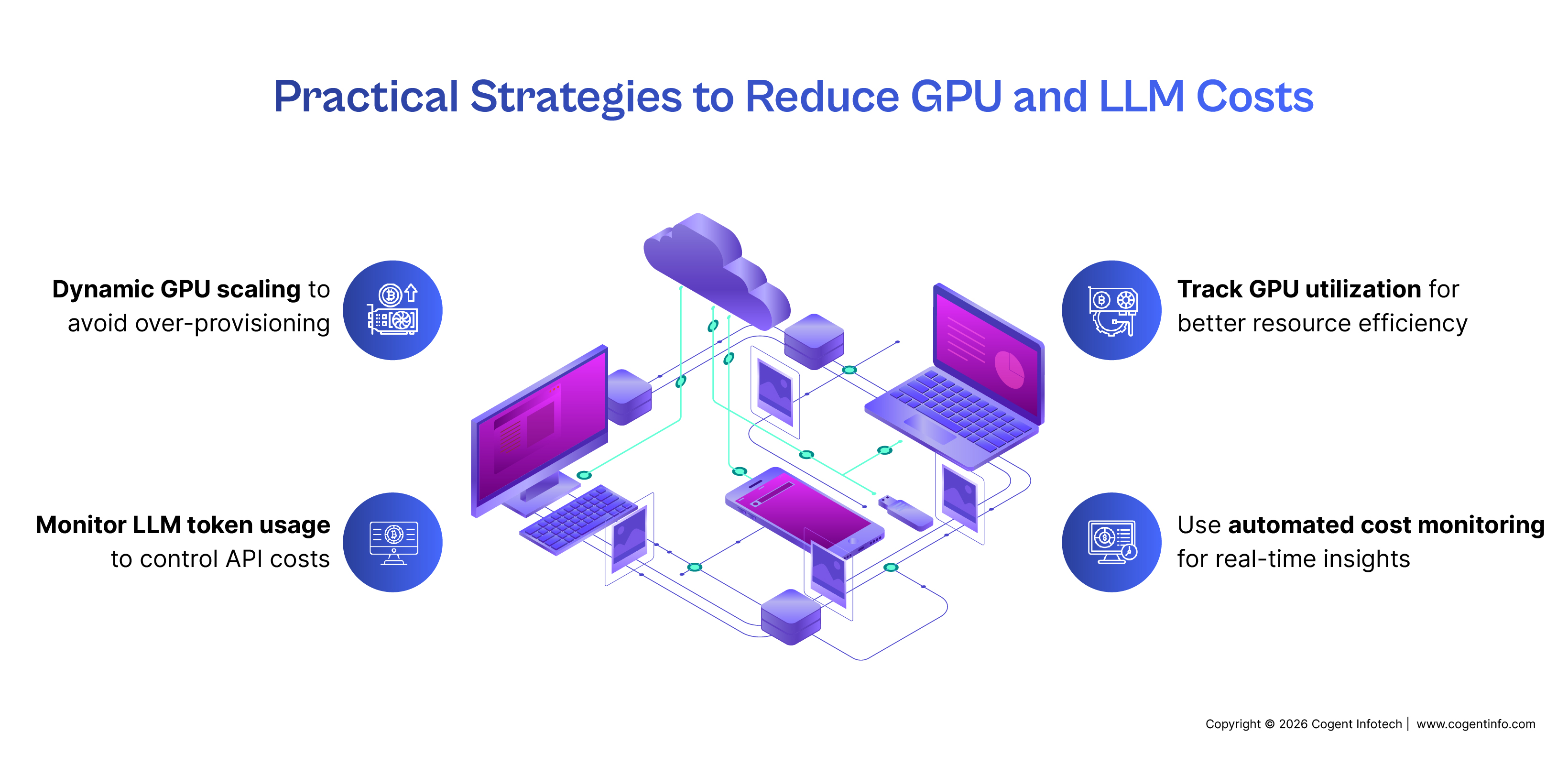
Reducing GPU and LLM costs doesn’t just require tracking and monitoring; it also requires implementing proactive strategies. Below are key strategies that enterprises can adopt to reduce their GPU and LLM cloud expenditures while maintaining operational efficiency.
1. Optimize GPU Resource Allocation
As discussed, GPUs are one of the largest costs in AI infrastructure. GPU utilization is often low in many enterprise settings, leading to wasted expenditure. To optimize GPU costs, organizations can take several steps:
- GPU Type Optimization: Different types of GPUs are suited for different tasks. For example, NVIDIA Tesla V100 GPUs are great for training deep learning models but may not be necessary for simpler tasks like inference. Businesses should assess whether they’re using the most cost-effective GPU for their workloads and adjust accordingly.
- Dynamic Scaling: Many cloud providers, including AWS and Google Cloud, offer auto-scaling capabilities that allow organizations to scale GPU resources up or down based on usage. By implementing autoscaling strategies, businesses can avoid paying for idle resources and only consume what is required for each workload.
- Spot Instances: Using spot instances (also called preemptible VMs) can significantly reduce GPU costs. These instances are often priced lower than on-demand instances but come with the tradeoff of being less predictable. For tasks that are fault-tolerant or can be restarted if interrupted, spot instances are an excellent way to save money.
2. Control Token-Level Costs for LLMs
When working with LLMs like GPT-3 or similar APIs, token-level costs can be unpredictable. Managing token usage is essential to control costs effectively:
- Input Size Management: Keep the length of your inputs and outputs as short as possible. Limiting the size of the input prompts and the expected responses can have a significant impact on the cost, especially in large-scale deployments.
- Batch Processing: For multiple queries, consider batching requests to reduce the number of API calls. This can lower the overall cost per token because some cloud providers offer discounts for batch processing.
- Use Open-Source Models: If possible, switch to open-source models that can be deployed on private infrastructure, eliminating the need for continuous API calls. Models like GPT-Neo or GPT-J can be used in place of more expensive API services like GPT-3, providing substantial savings.
3. Improve Data Pipeline Efficiency
Efficient data management is critical to controlling AI infrastructure costs. By optimizing data pipelines, enterprises can reduce unnecessary storage and transfer costs associated with their AI workloads:
- Data Compression: Compress data before storing or transferring it to reduce storage and network transfer costs. Compression can significantly lower costs associated with both data egress and long-term data storage.
- Cold Storage: For infrequently accessed data, use cold storage options provided by cloud providers like AWS Glacier or Google Cloud Coldline. These options provide low-cost storage for data that does not need to be retrieved frequently.
- Regional Optimization: Store and process data within the same region to minimize data transfer costs. Moving data between different regions can incur significant egress fees, so it’s cost-effective to centralize processing in one region whenever possible.
4. Use Cost Management Tools and Dashboards
Employ cloud cost management and FinOps tools that provide granular visibility into AI-specific resources. These tools track GPU usage, LLM API consumption, and overall cloud expenditures, offering detailed insights that help optimize spending.
- CloudHealth by VMware: A comprehensive cloud cost management tool that allows businesses to track and manage GPU and LLM usage.
- Kubeflow: A machine learning toolkit for Kubernetes that can help manage the lifecycle of AI workloads and optimize the use of compute resources.
By using these tools, organizations can generate reports that help them identify which areas of AI workloads are consuming the most resources and which could be further optimized.
Governance: Making AI Cost Accountable
Governance plays a crucial role in controlling AI costs and ensuring that the resources are being utilized responsibly and efficiently. Establishing a framework for governance around AI cloud spend helps ensure accountability, transparency, and consistent cost management.
1. Set Clear Budget Limits and Policies
Enterprises should define clear budget limits for AI workloads and enforce policies that prevent overruns. For example:
- Limitations on GPU Allocation: Set policies for which teams or projects can access high-performance GPUs, and limit usage to only essential tasks.
- Set API Call Caps: For LLM APIs, enterprises can set usage limits on API calls to prevent runaway token usage. This prevents the unexpected surge in token costs from affecting the overall cloud spend.
2. Implement Resource Allocation Strategies
Governance should include policies around resource allocation. This ensures that resources like GPUs and cloud storage are used efficiently, reducing the risk of wastage. Some strategies include:
- Prioritize High-Impact Workloads: Limit access to high-cost resources like GPUs for critical projects or tasks that directly contribute to business outcomes, like training foundational models.
- Track and Enforce Usage: Continuously monitor AI resource usage to ensure that teams and departments comply with cost guidelines. Track resource utilization over time to spot inefficiencies and potential savings.
3. Leverage Automation for Resource Scaling
As AI workloads can fluctuate, automating resource scaling based on real-time usage is essential for maintaining cost control. By automating the scaling of compute resources (e.g., GPUs or inference nodes), enterprises can ensure they are only using and paying for what’s required at any given time. Automation tools allow for dynamic scaling, preventing unnecessary resource consumption during off-peak periods.
From Cost-Cutting to Value Optimization
While cutting costs is important, enterprises should shift from simply reducing expenses to optimizing the value derived from AI investments. The ultimate goal of AI-native FinOps is not just cost reduction, but ensuring AI investments are aligned with business objectives.
1. Align AI Spend with Business Objectives
Aligning AI spend with business outcomes ensures that AI investments are generating value. For example, AI models used in customer service should not only reduce operational costs but also improve customer satisfaction or drive revenue through enhanced service offerings. Cost optimization strategies should always be viewed through the lens of maximizing business value.
2. Evaluate ROI of AI Projects
Enterprises should regularly evaluate the return on investment (ROI) of AI projects. By comparing the operational cost of AI initiatives with the financial benefits (e.g., improved decision-making, reduced manual labor, enhanced customer experiences), businesses can justify their AI spend and ensure that each project contributes positively to the bottom line.
3. Invest in AI Experimentation and Innovation
While controlling costs is important, businesses should also invest in AI experimentation. Experimentation drives innovation and helps organizations uncover new opportunities that could lead to greater operational efficiencies or novel revenue streams. Experimentation should be tracked and managed to ensure that the resources being consumed align with long-term value generation.
Conclusion: Embracing AI-Native FinOps for Sustainable Growth
The rise of AI in enterprise environments presents new financial challenges, but also opportunities for efficiency and growth. Traditional cloud cost management frameworks are no longer enough to handle the complexity and unpredictability of AI workloads, including GPUs, LLMs, and inference models.
By adopting AI-native FinOps, businesses can gain the visibility, control, and governance necessary to manage GPU and LLM cloud costs effectively. Strategies like optimizing GPU usage, controlling token-level costs, improving data pipeline efficiency, and leveraging cost management tools help reduce AI-related expenses while maximizing resource utilization.
However, the true value of AI-native FinOps goes beyond cost reduction. By aligning AI spend with business outcomes, regularly evaluating ROI, and investing in AI innovation, businesses can ensure that their AI investments drive long-term value. Through this approach, enterprises can embrace the potential of AI while keeping costs manageable and ensuring sustainable growth.
Scale AI smarter with Cogent Infotech to gain better control over GPU, LLM, and cloud costs while maximizing AI performance and ROI.