AI vs. AI: Defending Against Machine-Speed Cyberattacks


TL;DR: Key Takeaways
- AI is making cyberattacks faster, more scalable and harder to distinguish from legitimate business activity.
- Traditional security systems struggle to respond to attacks that can move across networks in minutes or even seconds.
- AI-powered cybersecurity enables real-time threat detection, automated response and predictive risk analysis.
- Businesses must secure their own AI systems, identities, cloud environments and third-party connections.
- The future of enterprise cybersecurity depends on combining intelligent automation with human oversight and strategic decision-making.
The Next Cyberattack May Be Faster Than Your Security Team Can React
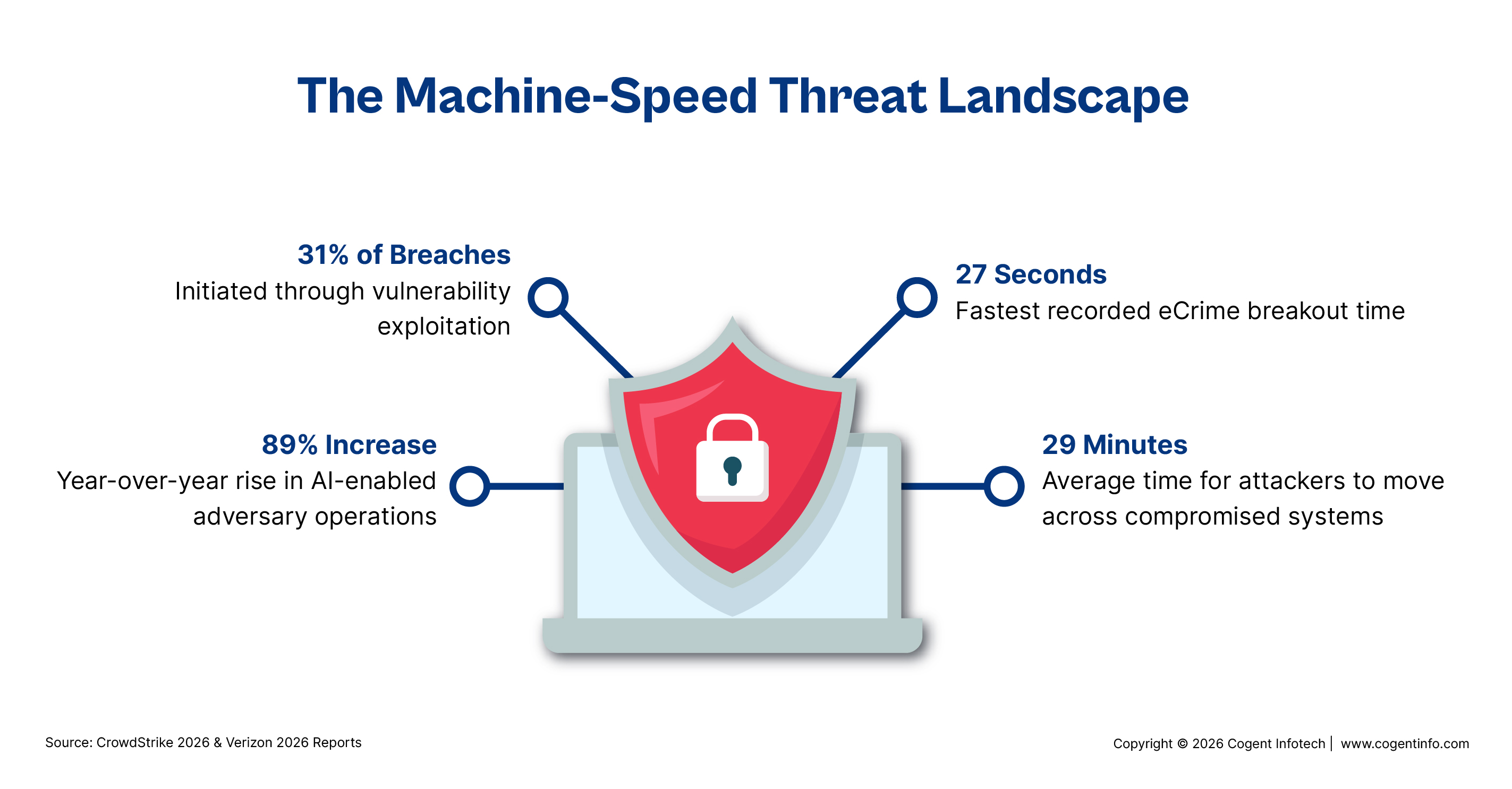
27 seconds. That's all it took for an attacker to move from one compromised system to another. CrowdStrike's 2026 Global Threat Report recorded a fastest eCrime breakout time of 27 seconds, an average of 29 minutes and an 89% increase in AI-enabled adversary operations year over year. (Source: CrowdStrike 2026 Global Threat Report)
Think about what this means for businesses. Before security teams can react, attackers could already be accessing sensitive data, exploring systems and exploiting weaknesses. AI is making cyberattacks faster, smarter and harder to contain.
For businesses, the challenge is no longer just preventing cyberattacks. It's about protecting critical systems, sensitive data and operations against threats that evolve faster than traditional security teams can respond.
When attackers are moving at machine speed, how long can businesses afford to rely on human-speed defence?
The answer lies in AI vs. AI: using intelligent defence systems to detect threats early, automate responses and protect business operations.
Why AI Has Changed the Cybersecurity Landscape
Cyberattacks have always evolved alongside technology, but AI introduces a different level of speed and accessibility. Tasks that once required significant technical expertise, manual research and considerable time can now be assisted by automated systems. Attackers can use generative AI to produce convincing messages, research potential targets, analyse exposed information and support different stages of an attack.
The scale of this change is becoming increasingly visible. According to CrowdStrike's 2026 Global Threat Report, AI-enabled adversary operations increased by 89% year over year in 2025. (CrowdStrike – 2026 Global Threat Report) The report also found that the average eCrime breakout time had fallen to just 29 minutes, with the fastest recorded breakout taking only 27 seconds. These findings demonstrate how quickly attackers can move once they gain access to an organisation.
For businesses, the concern is not simply the increasing number of attacks. It is the shrinking time available to identify and contain them. A security team that discovers a suspicious login several hours after it happens may already be dealing with compromised accounts, exposed information or disrupted operations. Cybersecurity must therefore become a continuous process rather than a series of checks performed at scheduled intervals.
AI vs. AI: Understanding the New Cybersecurity Battle
The idea behind AI vs. AI is straightforward: attackers are using intelligent technology to automate cyber threats, while defenders are using intelligent technology to identify and stop them. However, this is not simply a competition between two algorithms. It is a shift in how organisations approach security, moving from tools that respond to known threats towards systems that can recognise unusual behaviour and make informed decisions as situations develop.
The biggest advantage of AI-powered defence is its ability to analyse large volumes of activity continuously. Instead of relying entirely on predefined rules, intelligent systems can identify patterns, compare behaviour against established baselines and flag activities that may indicate an emerging threat. They can also help security teams prioritize alerts, reducing the time spent investigating low-risk events.
However, AI is not a replacement for cybersecurity professionals. Automated systems can make incorrect decisions, miss unfamiliar attack patterns or generate false positives. Human expertise remains essential for evaluating context, approving high-impact actions and making decisions that affect business operations.
The objective is not to remove people from cybersecurity; it is to give them the intelligence and response capabilities needed to stay ahead.
The Threats Enterprise Leaders Should Be Watching
AI-powered attacks do not always look like traditional cyberattacks. They can exploit familiar business processes, trusted identities and everyday communication channels. This makes them particularly challenging for organisations where employees, applications, vendors and automated systems regularly exchange sensitive information.
1. AI-Generated Phishing and Social Engineering
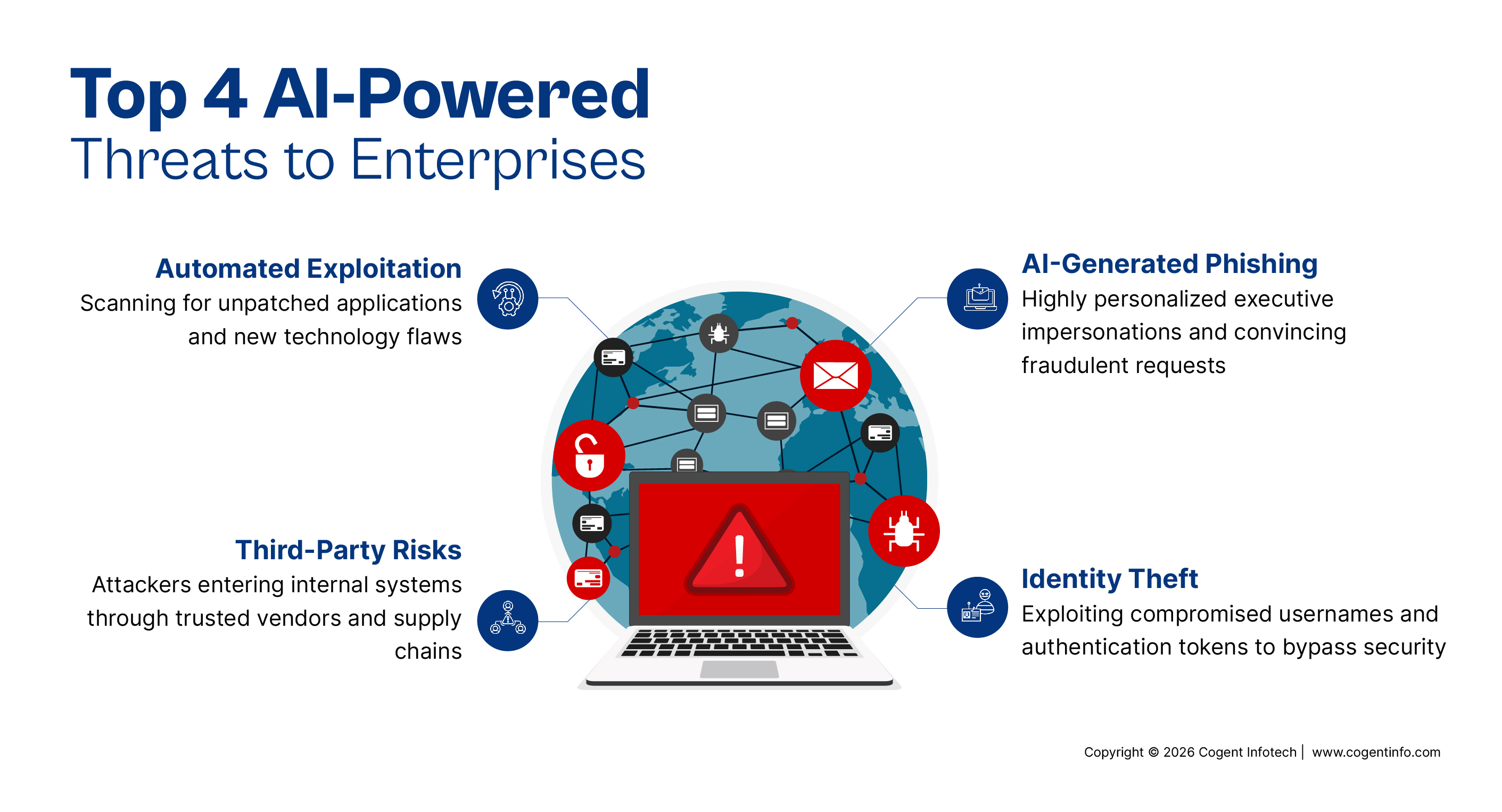
Phishing has become more sophisticated with generative AI. Attackers can create personalised emails, realistic business messages and convincing impersonations of senior executives. They can also adapt language and communication styles to make fraudulent requests appear genuine. In a corporate environment, this could mean an employee receiving what appears to be an urgent payment instruction from a senior leader or a request to share confidential information with a familiar business contact.
Traditional awareness training remains important, but organisations cannot expect employees to identify every AI-generated message. AI-based email security can help detect suspicious patterns, unusual communication behaviour, malicious links and impersonation attempts. Businesses should also introduce stronger verification procedures for financial transactions, access requests and sensitive information sharing.
2. Identity Theft and Credential-Based Attacks
One of the biggest cybersecurity challenges today is that attackers do not always need to break through security systems. Sometimes, they simply need to enter using stolen credentials. Compromised usernames, passwords and authentication tokens can allow attackers to operate through accounts that appear legitimate.
CrowdStrike's 2026 Global Threat Report found that 82% of detections in 2025 were malware-free. (CrowdStrike – 2026 Global Threat Report) This highlights how attackers can operate through legitimate tools, identities and system access without relying on traditional malicious software.
For enterprises, this makes identity security a business priority. AI-powered monitoring can help identify unusual login locations, abnormal access patterns, unexpected privilege changes and suspicious activity across connected applications. Multi-factor authentication, privileged access management and continuous identity monitoring should work together to reduce the possibility of unauthorised access.
3. Automated Vulnerability Exploitation
Every organisation has a technology environment that changes constantly. New applications are deployed, software is updated, cloud services are integrated and third-party platforms are connected. Each change can introduce vulnerabilities that attackers may attempt to exploit.
Verizon's 2026 Data Breach Investigations Report found that vulnerability exploitation accounted for 31% of breaches, (Verizon – 2026 Data Breach Investigations Report) making it the leading initial access vector in its reporting dataset. The report also highlighted the use of generative AI across 15 distinct attack techniques in the median case where threat actors verifiably researched or used the technology.
AI-assisted security tools can help organisations continuously scan their environments, identify exposed assets and prioritise vulnerabilities according to their potential business impact. Rather than treating every vulnerability as equally urgent, security teams can focus on weaknesses that affect critical systems, sensitive data and essential operations.
4. Attacks Through Third-Party Connections
Modern enterprises depend on vendors, cloud providers, software platforms and external service partners. These connections make business operations more efficient, but they also create additional entry points for attackers. A weakness in a trusted partner's environment can potentially expose the organisation to risks beyond its direct control.
Verizon's 2026 DBIR reported that third-party involvement appeared in 48% of breaches, representing a 60% increase compared with the previous year. (Verizon – 2026 DBIR Findings) This makes supply chain security an important part of enterprise cybersecurity planning.
Organisations should use continuous third-party risk assessments, restrict unnecessary access and monitor integrations that connect external platforms to internal systems. AI can help analyse vendor activity and identify unusual patterns, but accountability for supplier security must remain part of the organisation's governance framework.
How AI-Powered Defence Strengthens Enterprise Security
AI-powered cybersecurity works best when it is integrated across the organisation rather than treated as another independent security tool. Its value comes from connecting information, identifying relationships between events and helping security teams act before a potential threat becomes a major incident.
Some of the most valuable applications include:
- Predictive threat intelligence: Analyses emerging attack patterns and historical security information to help identify potential risks before they affect business operations.
- Behavioural analytics: Monitors user and system activity to identify unusual behaviour that may indicate compromised accounts or unauthorised access.
- Automated incident response: Helps isolate affected devices, disable suspicious sessions and trigger predefined security procedures.
- Intelligent vulnerability management: Identifies security weaknesses and helps prioritise remediation based on exposure and business impact.
- Security operations automation: Supports security teams by correlating alerts, reducing repetitive investigations and improving incident response workflows.
The real advantage comes when these capabilities work together. For example, an unusual login attempt may initially appear harmless. However, when an intelligent security platform connects it with unexpected file access, suspicious privilege changes and unusual network activity, it can identify a larger pattern that individual security alerts may not reveal.
This ability to connect information across systems is particularly valuable for large organisations with complex IT environments. It allows security teams to move from investigating isolated incidents towards understanding how threats develop across the enterprise.
Building an AI-Driven Cybersecurity Strategy: Where Should Businesses Start?
Adopting AI-powered security requires more than investing in new technology. Businesses need a clear understanding of their existing security gaps, the systems they need to protect and the level of automation they are prepared to introduce. Without proper governance, even advanced AI tools can create additional risks.
A practical enterprise approach should include the following steps.
Step 1: Identify the Organisation's Biggest Security Risks
Begin by assessing critical business systems, sensitive information, cloud environments, employee access and third-party connections. Identify where valuable data is stored, who can access it and which systems would create the greatest operational disruption if compromised. This assessment provides a foundation for deciding where AI-powered security can deliver the most value.
Step 2: Strengthen Identity and Access Management
Establish strong authentication policies, multi-factor authentication and role-based access controls. Employees and automated systems should only have access to the information and applications required for their responsibilities. Regularly review permissions, remove unnecessary access and monitor privileged accounts for suspicious activity.
Step 3: Integrate AI Into Security Operations
Introduce AI capabilities into existing security operations, including threat detection, vulnerability management, endpoint monitoring and incident response. Focus on solutions that integrate with the organisation's current technology environment rather than creating disconnected security systems. Start with well-defined use cases where automation can improve detection speed and reduce manual workloads.
Step 4: Establish Clear AI Governance
AI-powered security systems must operate within clearly defined rules. Businesses should establish guidelines around data access, privacy, model usage, automated decision-making and human approval. They must also assess the risks created by their own AI applications, including unauthorised access, sensitive data exposure and manipulation of AI systems.
The NIST AI Risk Management Framework provides guidance for organisations looking to manage risks throughout the design, development, deployment and evaluation of AI systems.
Step 5: Test, Measure and Improve
Cybersecurity strategies should be evaluated continuously. Conduct regular penetration tests, incident response exercises and security assessments to understand how systems perform under different threat scenarios. Track measurable outcomes such as mean time to detect, mean time to respond, vulnerability remediation time and the number of high-risk incidents successfully contained.
An effective strategy does not simply introduce AI into cybersecurity; it ensures that every investment contributes to measurable improvements in business resilience.
The Business Case: Why Cybersecurity Is Now a CXO Priority
Cybersecurity is no longer a concern that belongs exclusively to IT departments. A successful attack can affect revenue, customer confidence, regulatory obligations, business continuity and long-term brand reputation. For CXOs, the real question is not how many security tools the organisation owns, but whether those tools can protect critical business operations when an incident occurs.
AI-powered security can improve operational efficiency by reducing repetitive tasks, helping teams prioritise threats and supporting faster incident response. It can also provide leadership with better visibility into organisational risk, making cybersecurity decisions more closely connected to business priorities. However, these benefits depend on responsible implementation, reliable data and clear accountability.
Leadership teams should also recognise that AI introduces risks of its own. An organisation that adopts AI without proper access controls, data protection and governance may unintentionally create new vulnerabilities. Security must therefore be built into AI adoption from the beginning, not added after deployment.
Cybersecurity investment should be measured by the business risks it reduces, not simply by the technology it introduces.
The Future of Cybersecurity: Faster Intelligence, Stronger Human Oversight
The next phase of cybersecurity will involve increasingly autonomous systems that can analyse threats, coordinate responses and support security decisions with limited manual intervention. As organisations adopt AI agents and connect more applications to automated workflows, their security environments will become more complex. Protecting these systems will require continuous monitoring, strong identity controls and a clear understanding of how AI interacts with business data.
However, the future should not be viewed as a contest in which machines replace human expertise. AI can process information at a scale that would be difficult for human teams to manage, but it cannot independently understand every business consequence, regulatory requirement or organisational priority. Human oversight will remain essential, particularly when security decisions involve sensitive data, financial transactions or critical operations.
For CXOs, the opportunity is to build an organisation where intelligent technology strengthens human decision-making. That means investing in capable security teams, establishing responsible AI governance and ensuring that cybersecurity evolves alongside business innovation.
Conclusion: The Best Defence Is One That Does Not Wait for an Attack
AI has changed the speed and scale of cyber threats. Businesses can no longer depend on traditional security systems alone. They need smarter, faster and more proactive defences that combine AI-powered detection, automated response and human expertise.
Staying ahead means having the right technology and the right people to make it work. Cogent Infotech helps businesses strengthen their technology capabilities, build smarter security strategies and prepare for an evolving digital threat landscape.
With Cogent Infotech, build a defence that thinks ahead, acts faster and keeps your business moving.
Frequently Asked Questions
1. What does AI vs. AI mean in cybersecurity?
AI vs. AI refers to the use of artificial intelligence by both cyber attackers and cybersecurity professionals. While attackers use AI to automate and improve malicious activities, defenders use it to identify threats, detect unusual behaviour and respond to potential attacks more quickly.
2. Can AI prevent cyberattacks completely?
No. AI can improve threat detection, automate security responses and help organisations identify vulnerabilities, but it cannot guarantee complete protection. Effective cybersecurity still requires strong access controls, regular testing, human oversight and continuous risk management.
3. How does AI detect cyber threats?
AI analyses large volumes of data, including network traffic, login activity, system behaviour and security alerts. It identifies unusual patterns, compares activity against expected behaviour and flags potential threats for investigation or automated response.
4. Why are traditional cybersecurity systems no longer enough?
Traditional security systems often depend on predefined rules and known threat signatures. Modern attacks can adapt, exploit legitimate credentials and move quickly across connected environments. AI-powered security adds behavioural analysis, continuous monitoring and faster response capabilities to address these challenges.
5. What should businesses prioritise when adopting AI-powered cybersecurity?
Businesses should prioritise identity and access management, real-time threat detection, vulnerability management, incident response automation and AI governance. These capabilities should be aligned with business risks and integrated into the organisation's wider cybersecurity strategy.