


Moving Past Hype: Designing the Agentic Enterprise Operating Model



TL;DR (Key Takeaways)
- An agentic enterprise operating model enables AI agents to plan, act, collaborate, and continuously improve business processes, not just respond to prompts.
- Real business value comes from redesigning operating models, not simply adding AI tools to existing workflows.
- Successful adoption requires trusted data, strong governance, human oversight, and technology that can scale responsibly.
- Organizations that embrace agentic AI can improve productivity, decision-making, customer experiences, and operational efficiency while remaining adaptable to change.
- Building an agentic enterprise is a phased journey that starts with high-impact use cases and expands through continuous optimization.
Introduction
Artificial intelligence has dominated boardroom conversations for the past few years. Organizations have experimented with chatbots, copilots, and generative AI tools to streamline work, improve customer experiences, and boost productivity. While many of these initiatives have delivered value, others have struggled to move beyond pilot projects, with Gartner research, indicating that at least 30% of generative AI initiatives will be abandoned after proof-of-concept due to poor integration, escalating costs, or unclear business value. The challenge isn't a lack of AI capabilities; it's figuring out how to integrate them into the way the business actually operates.
That's where the conversation is beginning to shift.
Instead of asking how AI can assist employees with individual tasks, business leaders are exploring how intelligent AI agents can take on broader responsibilities. Industry analysts at Capgemini report that over 80% of organizations plan to implement AI agents within the next three years, reflecting a major departure from passive assistants toward proactive systems. These agents can plan, make decisions within defined boundaries, coordinate with other systems, and work alongside employees to complete complex processes. Rather than acting as another software tool, they become active participants in getting work done.
This shift is giving rise to the agentic enterprise operating model, an approach that brings together people, processes, technology, and governance to support AI-driven operations that are both autonomous and accountable. The market urgency is substantial: McKinsey & Company estimates that agentic workflows and advanced AI systems could unlock trillions in global economic value by automating complex operational processes that currently swallow up to 70% of employee time. It isn't about replacing employees or handing complete control to AI. It's about creating an operating model where humans and intelligent agents each contribute what they do best.
In this blog, we'll explore what an agentic enterprise operating model looks like, why organizations are moving beyond AI experimentation, the building blocks required for success, common implementation challenges, and practical steps for building an enterprise that's ready for the next era of intelligent operations.
What Is an Agentic Enterprise Operating Model?
An agentic enterprise operating model is a way of organizing work so that AI agents can actively participate in business operations rather than simply support them. Instead of waiting for instructions or completing isolated tasks, these intelligent agents can understand objectives, plan actions, interact with multiple business systems, and collaborate with employees to achieve specific outcomes.
This represents a significant shift from traditional automation. Conventional automation follows predefined rules, if one event occurs, the system performs a specific action. AI agents operate differently. They can evaluate context, adapt to changing conditions, and decide how best to accomplish a goal while remaining within the policies and boundaries set by the organization.
It's also different from using standalone AI tools such as chatbots or writing assistants. Those tools typically help employees complete individual tasks. AI agents, on the other hand, work across systems and processes. A customer service agent, for example, might retrieve account information, update records, schedule a technician, and notify the customer, all as part of a single workflow.
That doesn't mean AI replaces people. In a well-designed agentic enterprise, employees remain responsible for strategic decisions, oversight, and exception handling. AI agents take care of repetitive coordination and operational tasks, allowing teams to focus on work that requires judgment, creativity, and relationship-building.
Ultimately, becoming an agentic enterprise isn't about deploying more AI tools. It's about redesigning how work flows across the organization so people and AI can operate together more effectively.
Why Organizations Are Moving Beyond AI Hype
A year ago, many AI conversations centred on experimentation. Organizations were eager to explore what generative AI could do, often launching pilots across different departments. Today, the focus has changed. Business leaders are asking a much more practical question: Where is the measurable value? This pressure is well-founded, as research from Gartner shows that less than 42% of enterprise AI prototypes successfully make the leap from proof-of-concept into full production.
Simply deploying an AI chatbot or productivity assistant is no longer enough. Executives want technologies that improve decision-making, increase efficiency, reduce operational costs, and create better customer experiences. In fact, a recent C-suite survey from Deloitte revealed that over 90% of organizations plan to increase their AI investments, but leaders are now judging success using strict ROI performance metrics like direct revenue generation and operational cost savings rather than basic usage numbers. In other words, AI is being evaluated less as an innovation initiative and more as a business capability.
This shift is happening as organizations face increasing complexity. Teams work across multiple platforms, data is scattered across different systems, and business decisions need to happen faster than ever. At the same time, customers expect personalized, seamless experiences, while employees are expected to accomplish more without adding unnecessary complexity.
Fortunately, AI technology has matured. Today's AI agents can reason through tasks, access enterprise knowledge, interact with business applications, and coordinate activities with both people and other AI systems. That makes them far more capable than the standalone AI tools many organizations first experimented with. Enterprise research by capgemini indicates that organizations deploying agentic AI are already seeing an average 1.7x return on their AI investments, driving a nearly 50% increase in agentic AI implementations year-over-year.
As a result, leading organizations are moving away from isolated AI pilots and embedding intelligent agents into their operating models. The goal isn't to use AI for the sake of innovation, it's to create a business that can adapt faster, operate more efficiently, and continue delivering value as market conditions evolve.
The Building Blocks of an Agentic Enterprise Operating Model
Building an agentic enterprise starts with technology, but it succeeds because of strategy. Organizations need a strong foundation that enables AI agents to operate responsibly, securely, and in alignment with business goals.
The first requirement is clearly defined business objectives. AI agents should solve real business problems, whether that's improving customer service, accelerating software delivery, or reducing operational bottlenecks. Starting with measurable outcomes helps ensure AI investments deliver lasting value.
Equally important is designing AI agents around business processes, not individual tasks. The most effective agents understand how work flows across departments, allowing them to coordinate activities, retrieve information, and complete actions without creating additional complexity.
Reliable AI also depends on trusted enterprise data. If business data is inaccurate, fragmented, or outdated, AI agents will struggle to make informed decisions. A strong data foundation gives agents the context they need to deliver consistent, reliable results.
Despite growing autonomy, human oversight remains essential. Employees should guide strategy, review high-impact decisions, and intervene when situations require judgment or experience. This balance helps organizations build trust while maintaining accountability.
As AI becomes more deeply integrated into operations, governance and compliance become equally important. Clear policies, role-based access, security controls, and audit trails help ensure AI operates responsibly and aligns with regulatory requirements.
Finally, successful agentic enterprises treat AI as an evolving capability. They invest in continuous learning, regularly evaluate performance, and encourage close collaboration between business leaders, IT teams, data specialists, and operational experts. This cross-functional approach allows AI agents to improve alongside the business rather than remain fixed after deployment.
Where Agentic Operating Models Deliver Business Value
The real value of an agentic enterprise operating model isn't measured by how many AI agents an organization deploys, it's measured by how much easier, faster, and smarter work becomes. Instead of handling isolated tasks, AI agents can support entire workflows, helping teams spend less time on routine coordination and more time on high-value work.
In customer service, AI agents can resolve common requests, retrieve account information, recommend solutions, and seamlessly hand complex issues to human representatives when needed. Customers receive faster responses without sacrificing personalized support.
Within IT operations, agents can monitor systems around the clock, identify anomalies, recommend corrective actions, and even automate routine maintenance. This allows IT teams to focus on strategic initiatives rather than constantly reacting to operational issues.
Software engineering teams are also benefiting from agentic AI. Beyond generating code, AI agents can assist with testing, documentation, bug tracking, and release preparation, helping development teams move projects forward more efficiently.
Functions such as finance, HR, and supply chain management are seeing similar improvements. AI agents can process invoices, answer employee questions, support recruitment, monitor inventory, and flag potential supply chain disruptions before they become larger issues.
Knowledge-intensive organizations are using AI agents to surface relevant information from across the enterprise, making it easier for employees to find accurate answers without searching through multiple systems.
The common thread is simple: AI agents don't replace business functions, they help every function operate more effectively.
Benefits of an Agentic Enterprise Operating Model
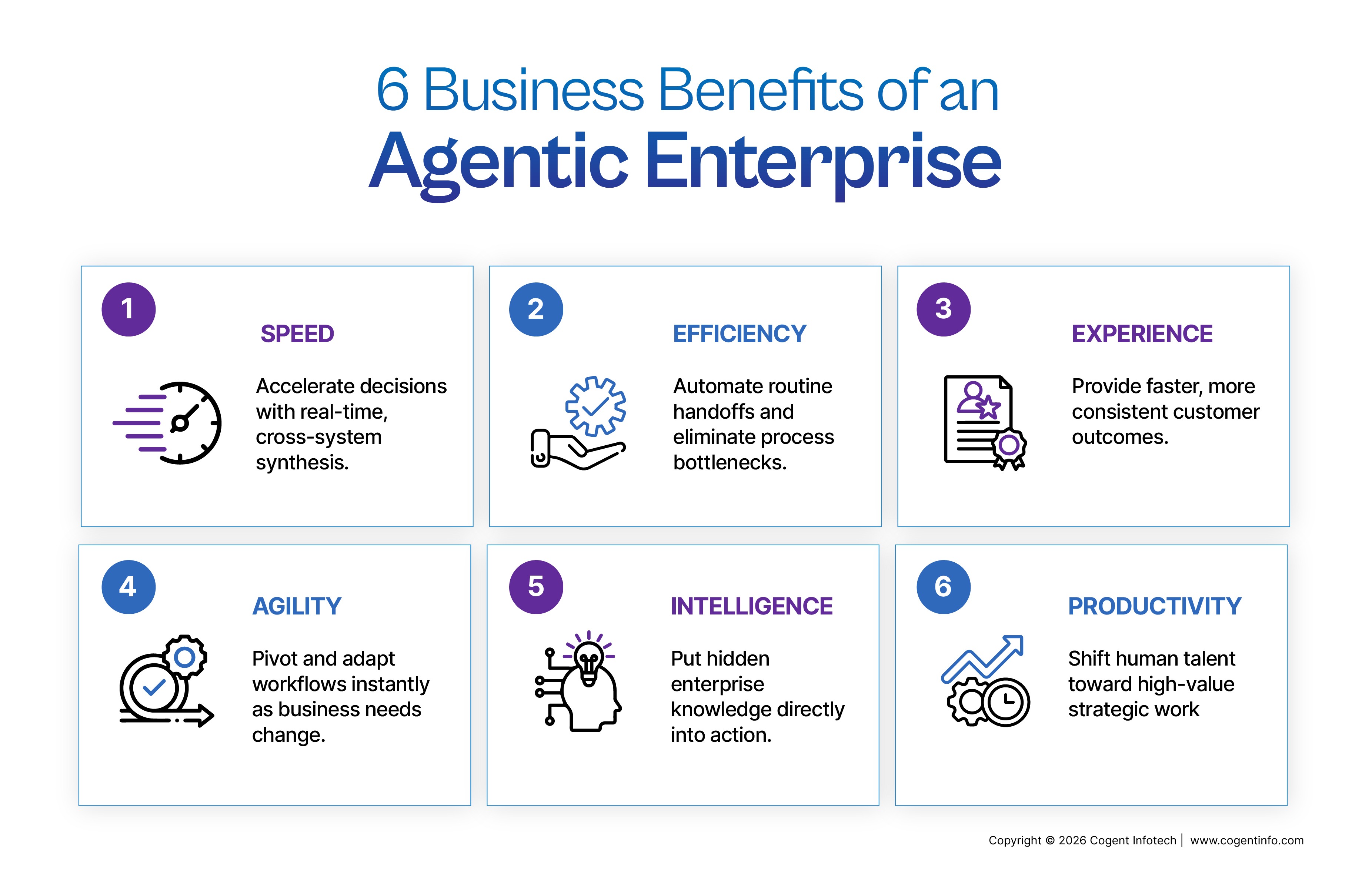
Organizations investing in agentic operating models are looking for more than automation, they're looking for measurable improvements across the business. When AI agents are thoughtfully integrated into everyday operations, the benefits extend well beyond saving time.
One of the biggest advantages is faster decision-making. AI agents can gather information from multiple systems, analyze it in real time, and present recommendations, enabling employees to act more quickly and with greater confidence.
They also improve operational efficiency by reducing repetitive work and keeping processes moving without unnecessary delays. Instead of switching between applications or manually coordinating tasks, employees can focus on work that requires expertise, creativity, and strategic thinking.
Customers benefit as well. Faster service, more consistent experiences, and quicker issue resolution all contribute to higher satisfaction and stronger long-term relationships.
An agentic operating model also makes organizations more agile. As business priorities change, AI agents can adapt to new workflows, helping companies respond more quickly without completely redesigning existing processes.
Another often-overlooked benefit is better use of enterprise knowledge. AI agents can access and apply information from across the organization, ensuring employees have the right context when making decisions.
Ultimately, organizations gain a more productive workforce, more consistent operations, and a stronger foundation for innovation, advantages that become increasingly important in a rapidly changing business environment.
Challenges Organizations Must Address
While the potential of agentic AI is significant, successful implementation requires more than deploying intelligent agents. Organizations must address several foundational challenges before AI can deliver consistent business value.
One of the most common issues is data quality. AI agents rely on accurate, current, and well-governed information. If enterprise data is incomplete or inconsistent, the quality of AI-driven decisions will suffer.
Legacy technology presents another obstacle. Many organizations still rely on systems that weren't designed to integrate with modern AI platforms. Rather than replacing everything at once, most businesses achieve better results through phased modernization that connects existing systems over time.
Trust is another critical factor. Employees need confidence that AI recommendations are accurate, transparent, and aligned with business policies. Building that trust requires clear governance, explainable decision-making, and appropriate human oversight.
Organizations must also address security, privacy, and compliance from the beginning. AI agents often interact with sensitive business information, making strong access controls and responsible AI practices essential.
Finally, people remain at the centre of every successful transformation. Employees need the skills to work effectively with AI, while leaders must communicate how intelligent agents will support, not replace, the workforce. When technology, governance, and people evolve together, organizations are far more likely to achieve lasting success.
A Step-by-Step Roadmap for Building an Agentic Enterprise
.jpg)
Building an agentic enterprise isn't about transforming everything overnight. The most successful organizations start with targeted opportunities, learn from early results, and expand their capabilities over time. A phased approach helps reduce risk while delivering measurable business value at every stage.
Step 1: Identify high-impact opportunities. Focus on business problems where AI agents can reduce manual work, improve decision-making, or enhance customer experiences. Prioritize initiatives with clear business outcomes rather than adopting AI for its own sake.
Step 2: Build a strong data foundation. Ensure enterprise data is accurate, accessible, and well governed. AI agents are only as effective as the information they rely on.
Step 3: Modernize core systems. Connect applications, remove unnecessary silos, and create an environment where AI agents can work seamlessly across business functions.
Step 4: Introduce AI agents gradually. Start with targeted workflows, define clear success metrics, and evaluate performance before expanding to more complex processes.
Step 5: Establish governance and oversight. Put policies, security controls, compliance measures, and human review processes in place to ensure AI operates responsibly and transparently.
Step 6: Measure, learn, and refine. Track business outcomes, gather feedback from employees, and continuously improve how AI agents perform in real-world environments.
Step 7: Scale with purpose. Once early initiatives demonstrate value, expand successful use cases across departments while maintaining consistent governance and responsible AI practices.
An agentic enterprise isn't built through a single technology implementation. It's developed through continuous learning, thoughtful planning, and a commitment to improving how work gets done across the organization.
How Cogent Infotech Helps Organizations Build Agentic Enterprises
Building an agentic enterprise takes more than introducing AI into existing workflows. It requires a modern digital foundation, connected systems, trusted data, and a strategy that aligns technology with business goals. That's where Cogent Infotech helps organizations accelerate transformation.
Through expertise in AI & ML, intelligent automation, application development and modernization, cloud solutions, data and analytics, digital engineering, and cybersecurity, Cogent Infotech helps businesses simplify operations, modernize legacy environments, and create the foundation for intelligent, AI-enabled workflows. Our approach combines innovation with strong governance, security, and scalability so organizations can adopt AI responsibly while delivering measurable business value.
Whether you're modernizing core business applications, improving operational efficiency, or expanding enterprise AI initiatives, Cogent Infotech helps organizations build resilient, future-ready operating models that support continuous innovation and long-term growth.
Conclusion
The next phase of AI transformation is about more than adopting intelligent technology, it's about building an operating model that enables people and AI to work together effectively. By aligning strategy, processes, data, governance, and technology, organizations can improve productivity, accelerate innovation, and create more resilient operations.
Building an agentic enterprise is an ongoing journey, but organizations that start with clear business goals and scale responsibly will be better positioned for long-term success. With the right strategy and technology partner, businesses can confidently transform today's AI investments into lasting competitive advantage.
Ready to Go Agentic?
Turn AI potential into real business value with Cogent Infotech.
Build smarter. Move faster.
.jpg)


