The Rise of the Lean Enterprise: Why Simplicity Is Becoming the Ultimate Competitive Advantage
.jpg)


TL;DR (Key Takeaways)
- Adopting a lean approach enables businesses to optimize customer value by systematically cutting out operational waste.
- Transitioning to a lean model fosters enhanced adaptability, heightened efficiency, robust resilience, and sustainable commercial advancement.
- Advancements in modern technology, specifically cloud computing, data analytics, artificial intelligence, and automation, are facilitating enterprise-wide lean execution.
- Achieving this organizational evolution relies on an intentional blend of strategic planning, technological tools, corporate culture, and a commitment to ongoing improvement.
- Enterprises that prioritize lean methodology today position themselves effectively to navigate a highly volatile and shifting marketplace.
Introduction
Businesses today are expected to innovate faster, deliver better customer experiences, and improve efficiency, all while navigating economic uncertainty, evolving customer demands, and rapid technological change. However, many traditional operating models struggle to keep pace. Legacy systems, disconnected processes, and siloed teams often create unnecessary complexity that slows decision-making and limits growth, with Mckinsey and company, reporting that knowledge workers spend up to 20% of their workweek simply searching for information scattered across disconnected systems.
This is why the lean enterprise is becoming a strategic priority for organizations across industries. Rather than focusing solely on cutting costs, a lean enterprise is built around delivering greater customer value by simplifying operations, eliminating waste, and continuously improving how work gets done. Eliminating this waste is critical considering industry benchmarks from Gartner and deloitte, showing that enterprises routinely spend 60% to 80% of their IT budgets just maintaining legacy infrastructure rather than driving growth.
Advances in artificial intelligence (AI), automation, cloud computing, and data analytics have also made lean transformation more achievable than ever. According to Mckinsey research, AI and intelligent automation have the potential to add $2.6 trillion to $4.4 trillion annually to the global economy by streamlining repetitive activities that currently consume 60% to 70% of employee time. Businesses can leverage these tools to streamline workflows, improve collaboration, and make faster, data-driven decisions while creating more agile and resilient operations.
In this blog, we'll explore what defines a lean enterprise, why more organizations are embracing this operating model, the core principles behind successful lean transformation, and the technologies helping businesses build a competitive advantage through simplicity.
What Is a Lean Enterprise?
A lean enterprise is an organization that continuously improves the way it operates by eliminating unnecessary complexity and focusing on activities that create value for customers. Instead of viewing lean as a cost-cutting initiative, leading organizations treat it as a long-term strategy for improving efficiency, agility, and innovation.
Originally developed in manufacturing, lean principles have evolved into an enterprise-wide approach that applies across industries, from healthcare and financial services to retail and technology. Today, businesses use lean practices to simplify workflows, improve collaboration, reduce manual work, and deliver better customer experiences.
Rather than making one-time operational improvements, lean enterprises foster a culture of continuous improvement. Teams regularly evaluate processes, identify inefficiencies, and implement changes that enhance productivity without compromising quality.
This shift also changes how organizations define success. Instead of measuring performance purely through cost savings, lean enterprises prioritize value creation, helping employees work smarter, respond faster to change, and deliver better outcomes for customers and the business alike.
Why Lean Enterprises Are on the Rise
The demand for lean enterprises is being driven by a combination of economic pressure, technological change, and rising customer expectations. Organizations are expected to innovate faster, control costs, and respond quickly to changing market conditions, all without sacrificing quality or customer experience.
At the same time, digital transformation has introduced new levels of operational complexity. According to Okta's Businesses at Work report, the average enterprise now deploys over 100 distinct applications. Rather than improving productivity, this fragmented digital ecosystem creates tool sprawl and app fatigue, leading workers to lose nearly an hour each week navigating disconnected systems and switching between overlapping platforms.
Customer expectations continue to rise as well. Research from the sales force reveals that 86% of consumers and 91% of business buyers view the experience a company provides to be just as important as its products or services. Businesses are expected to deliver faster service, personalized experiences, and consistent quality across every interaction, which requires streamlined operations and better visibility across the organization.
Talent shortages are another contributing factor. With skilled professionals in high demand, organizations are looking for ways to reduce repetitive tasks and enable employees to focus on strategic initiatives. This focus is urgent, as Asana’s Anatomy of work index shows that knowledge workers spend 60% of their time on "work about work", such as chasing approvals, searching for files, and managing status updates, rather than performing the high-value work they were hired to do. Technologies such as AI, automation, and analytics are making it possible to reclaim this time.
As a result, organizations are moving beyond isolated efficiency initiatives and adopting lean as an enterprise-wide operating model that improves agility, resilience, and long-term growth.
The Core Principles of a Lean Enterprise
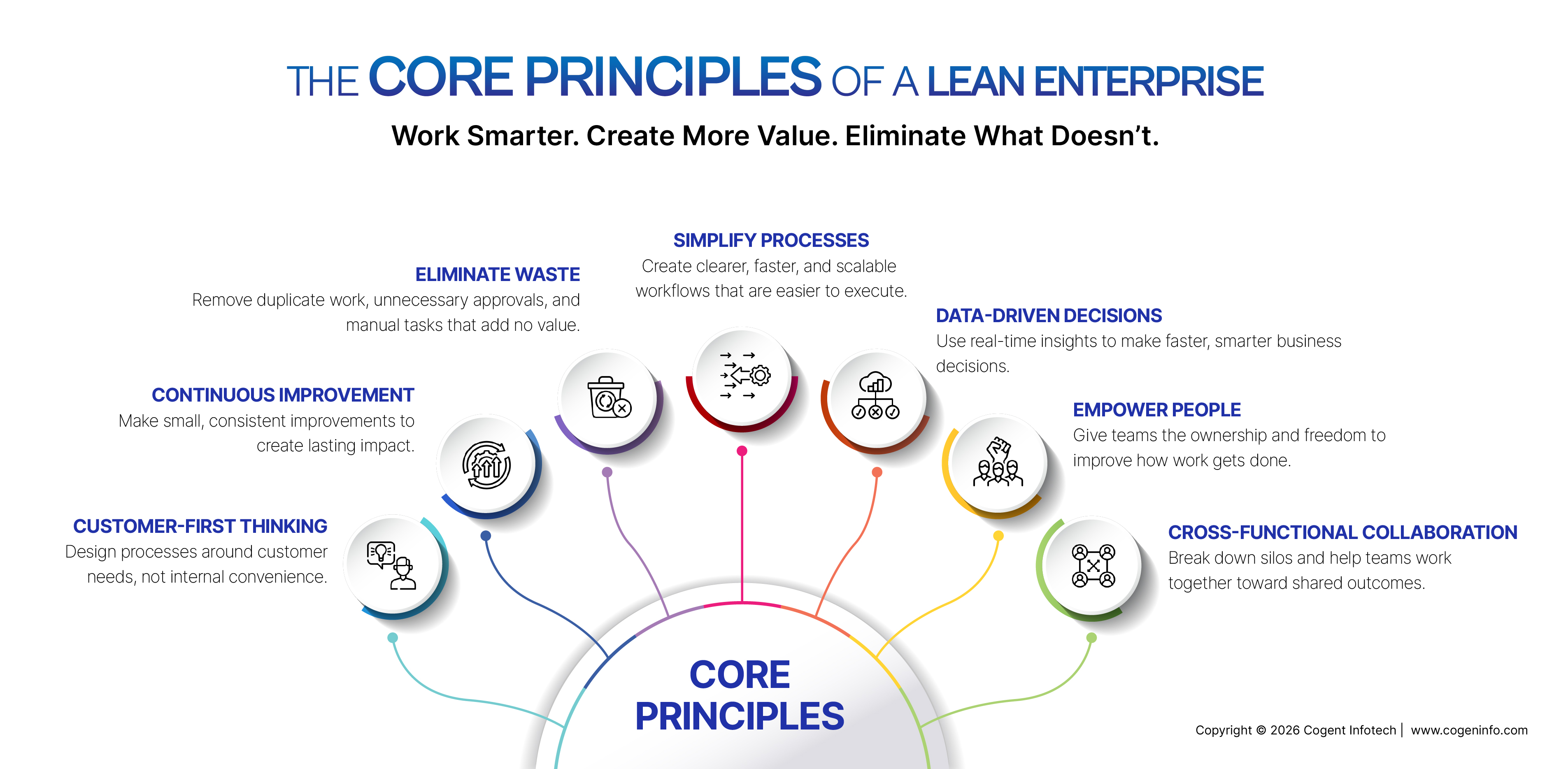
Lean enterprises are guided by a set of principles that help organizations operate more efficiently while creating greater value for customers.
Customer-first thinking ensures every process is designed around customer needs rather than internal convenience. By focusing on what matters most to customers, organizations can deliver better experiences and stronger business outcomes.
Continuous improvement encourages teams to regularly identify opportunities to simplify work, remove bottlenecks, and refine processes. Small, ongoing improvements often create a greater long-term impact than occasional large-scale changes.
Another key principle is eliminating waste. This includes reducing duplicate work, unnecessary approvals, manual tasks, and other activities that consume time without adding value.
Lean organizations also prioritize process simplification, making workflows easier to understand, execute, and scale. Simpler processes improve consistency while enabling faster decision-making.
Data-driven decision-making allows leaders to act on real-time insights rather than assumptions, helping organizations respond more quickly to changing business conditions.
Finally, employee empowerment and cross-functional collaboration create a culture where teams work together, share ideas, and continuously improve how work gets done across the organization.
Technologies Driving the Lean Enterprise
Technology has become a key enabler of lean transformation, helping organizations simplify operations, improve productivity, and make faster decisions at scale.
Artificial Intelligence (AI) supports smarter decision-making by analyzing large volumes of data, identifying trends, and automating routine tasks. Intelligent automation further reduces manual effort by streamlining repetitive business processes, allowing employees to focus on more strategic work.
Cloud computing provides the flexibility and scalability needed to support modern business operations while enabling teams to collaborate more effectively across locations. Meanwhile, data analytics gives organizations real-time visibility into performance, helping leaders identify opportunities for continuous improvement.
Businesses are also adopting low-code platforms to build applications and automate workflows faster, reducing development time and accelerating innovation. At the same time, enterprise integration platforms connect systems and data across departments, eliminating silos and creating a more unified operating environment.
Together, these technologies help organizations turn lean principles into measurable business outcomes by making operations simpler, faster, and more responsive.
Benefits of Becoming a Lean Enterprise
Adopting a lean enterprise model delivers measurable business value that extends well beyond improving efficiency. By simplifying operations and focusing resources on high-impact activities, organizations become better equipped to innovate, respond to change, and deliver consistent customer value.
One of the most immediate benefits is improved operational efficiency. Streamlined processes and automation reduce bottlenecks, minimize manual effort, and enable teams to accomplish more with the same resources. This also accelerates innovation, allowing businesses to launch new products, services, and improvements more quickly.
Lean organizations also create better customer experiences by reducing delays, improving service quality, and responding faster to changing expectations. At the same time, eliminating unnecessary work helps lower operating costs without compromising performance.
Beyond efficiency, lean enterprises gain greater business agility, enabling them to adapt more quickly to market shifts, regulatory changes, and competitive pressures. Employees become more productive when they spend less time on repetitive tasks and more time on strategic, value-driven work.
Finally, a lean operating model helps organizations maximize the return on technology investments. Integrated systems, data-driven insights, and automation work together to strengthen resilience and support sustainable growth, even during periods of economic uncertainty.
Common Challenges During Lean Transformation
While the benefits of lean transformation are significant, the journey is rarely without challenges. Many organizations struggle to modernize operations while maintaining day-to-day business performance.
A common obstacle is legacy technology, where outdated systems limit integration, automation, and access to real-time data. Data silos and disconnected applications can further reduce visibility and slow decision-making across the enterprise.
Transformation also requires people to embrace new ways of working, making organizational resistance a frequent challenge. Without clear communication and leadership support, employees may be hesitant to adopt new processes or technologies.
Many businesses also rely heavily on manual workflows, creating inefficiencies that become difficult to scale. At the same time, skills gaps in areas such as AI, automation, and cloud technologies can slow transformation efforts.
Finally, achieving enterprise-wide success requires strong leadership alignment. When priorities differ across departments, transformation initiatives often become fragmented and fail to deliver lasting results.
Organizations that address these challenges with a clear strategy, phased implementation, and a culture of continuous improvement are far more likely to achieve sustainable success.
A Practical Roadmap to Building a Lean Enterprise
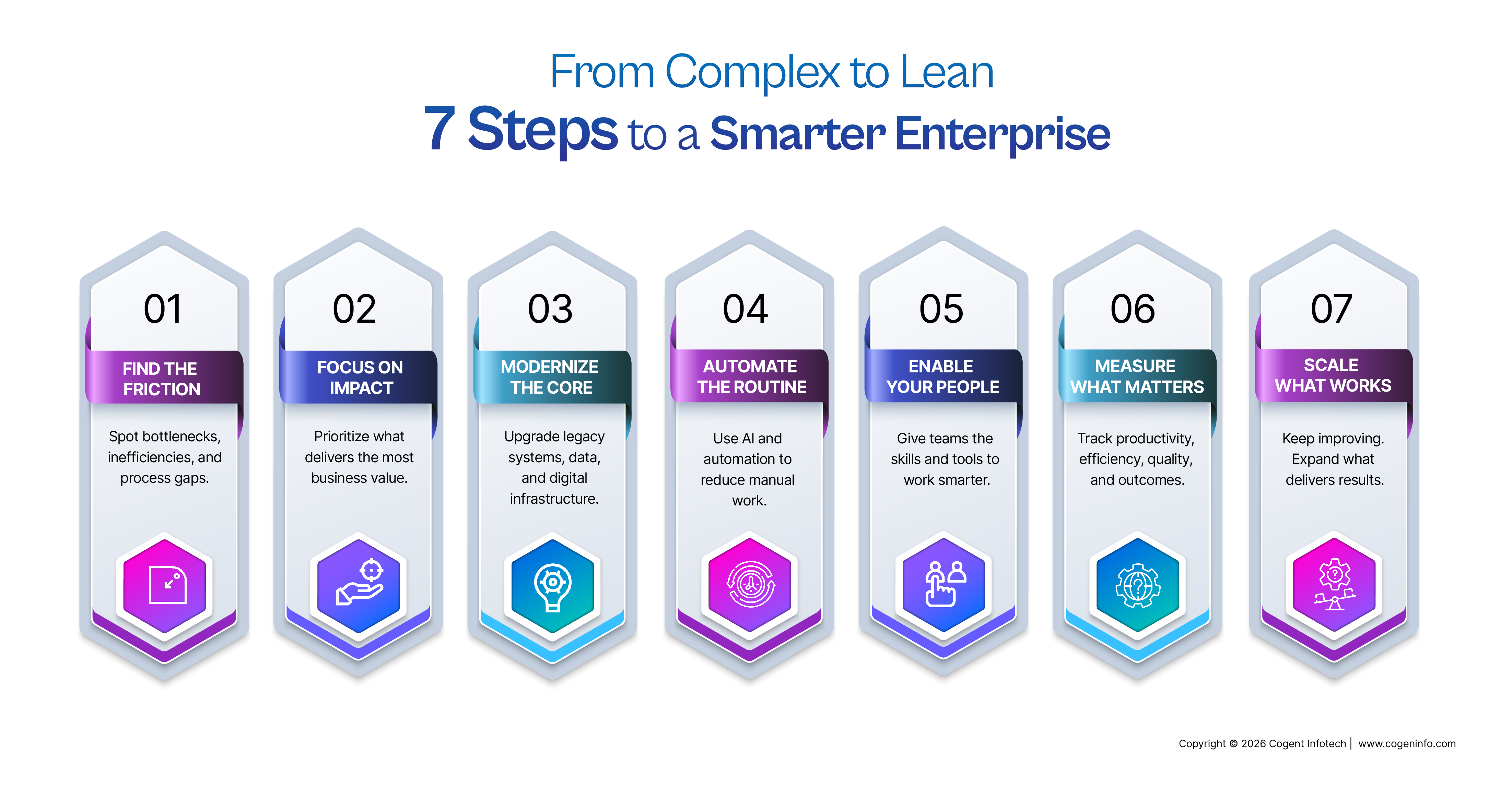
Building a lean enterprise is an ongoing journey that combines strategic planning, technology modernization, and continuous improvement. A structured approach helps organizations deliver measurable results while minimizing disruption.
Step 1: Assess current operations. Begin by evaluating existing processes, technologies, and workflows to identify inefficiencies and opportunities for improvement.
Step 2: Prioritize high-value initiatives. Focus on projects that deliver the greatest impact for customers and the business, rather than trying to transform everything at once.
Step 3: Modernize technology and data. Upgrade legacy systems, improve data accessibility, and establish a connected digital foundation for future growth.
Step 4: Automate repetitive work. Introduce AI and intelligent automation to reduce manual tasks, improve accuracy, and increase operational efficiency.
Step 5: Empower employees. Equip teams with the skills, digital tools, and training needed to adopt new technologies and drive continuous improvement.
Step 6: Measure business outcomes. Track meaningful KPIs such as productivity, cycle time, customer satisfaction, and operational efficiency to evaluate progress.
Step 7: Continuously improve and scale. Use performance insights to refine processes, expand successful initiatives, and embed continuous improvement across the organization.
How Cogent Infotech Supports Lean Enterprise Transformation
Becoming a lean enterprise requires more than implementing new technologies—it demands a strategic partner that can align technology, people, and business goals. Cogent Infotech helps organizations modernize operations through integrated digital transformation strategies that drive measurable business outcomes.
From enterprise application modernization and cloud transformation to AI-powered automation, data and analytics, and digital engineering, Cogent Infotech helps businesses simplify complex operations and improve organizational agility. These capabilities enable faster decision-making, more efficient workflows, and greater visibility across the enterprise.
Security and operational resilience are equally important. By combining robust cybersecurity practices with scalable managed services, Cogent Infotech helps organizations build a secure and reliable technology foundation that supports long-term growth.
Rather than focusing solely on technology implementation, Cogent Infotech works with organizations to create sustainable operating models that improve efficiency, accelerate innovation, strengthen resilience, and position businesses to compete confidently in a rapidly evolving digital economy.
The Future of the Lean Enterprise
The next generation of lean enterprises will be shaped by intelligent technologies that make organizations more adaptive, predictive, and autonomous. As AI capabilities continue to evolve, lean transformation will increasingly focus on enabling smarter decision-making rather than simply improving efficiency.
Technologies such as Agentic AI and hyperautomation will automate more complex business processes, while predictive analytics will help organizations anticipate operational issues before they occur. Intelligent decision-making powered by real-time data will enable businesses to respond faster to changing market conditions.
The future will also see greater human-AI collaboration, where employees use AI as a strategic partner to improve productivity, creativity, and decision-making instead of replacing human expertise.
At the same time, organizations will place greater emphasis on sustainable operations, balancing efficiency with environmental and long-term business goals. Continuous optimization, supported by connected systems and advanced analytics, will become a defining characteristic of successful enterprises.
Organizations that embrace lean as an ongoing journey, not a one-time initiative, will be better positioned to adapt, innovate, and thrive in an increasingly dynamic business landscape.
Conclusion
A lean enterprise is not simply about reducing costs, it's about creating greater value through smarter processes, empowered people, and the strategic use of technology. By simplifying operations and embracing continuous improvement, organizations can improve efficiency, accelerate innovation, enhance customer experiences, and build greater resilience in an increasingly competitive market.
Successful lean transformation requires the right balance of strategy, culture, technology, and leadership. When these elements work together, businesses become more agile, adaptable, and prepared for future growth.
As market conditions and technologies continue to evolve, organizations that commit to lean principles today will be better equipped to navigate tomorrow's challenges with confidence.
Whether you're modernizing legacy systems, adopting AI-driven automation, or building a more connected digital enterprise, Cogent Infotech can help you accelerate transformation, improve operational performance, and build a resilient enterprise designed for long-term success.
Simplify the way you work. Strengthen the way you grow.
Explore how Cogent Infotech can help you build simpler, smarter operations.