


Beyond the SOC Dashboard: Alleviating "Alert Fatigue" with Human-Centric Security Operations.


Introduction
Inside every modern security operations center, there’s a paradox that rarely gets talked about openly. The tools are better than ever. Visibility is deeper. Detection is faster. Automation is smarter.
And yet, the people responsible for defending systems often feel more overwhelmed than ever before.
At the center of this paradox is a growing problem: alert fatigue.
Every day, security analysts are flooded with alerts, thousands of them in some environments. These alerts come from firewalls, endpoint detection tools, cloud platforms, identity systems, and more. Each one signals something that might be wrong. But when everything looks urgent, it becomes increasingly difficult to tell what actually is. Over time, this constant stream of notifications stops being helpful. It becomes noise.
And when noise dominates the system, even the best tools can fail, not because they don’t detect threats, but because the humans interpreting those signals are stretched too thin.
This is why the future of security operations isn’t just about better detection. It’s about better design, specifically, design that puts humans at the center.
The Real Problem Isn’t Alerts - It’s Overload

Alerts, in themselves, are not the issue. They are essential to modern cybersecurity. Without them, organizations would have no visibility into potential threats.
The problem is volume without clarity.
As environments grow more complex, spanning cloud infrastructure, remote devices, SaaS applications, and hybrid networks, the number of signals generated increases exponentially. Every login attempt, configuration change, or unusual behavior can trigger a notification. In theory, this level of visibility should improve security. In reality, it often overwhelms the people responsible for managing it.
Analysts are forced into a constant cycle of triage, reviewing alerts, determining their validity, and deciding on next steps. Many of these alerts turn out to be false positives or low-risk events, but they still require time and attention. This creates a cognitive bottleneck. Human attention is limited. When it’s consumed by low-value tasks, there’s less capacity for deep analysis, strategic thinking, or proactive defense.
That’s where risk begins to grow, not from a lack of detection, but from an inability to process what’s already being detected.
How Alert Fatigue Impacts Decision-Making
One of the most dangerous aspects of alert fatigue is how subtly it affects judgment.
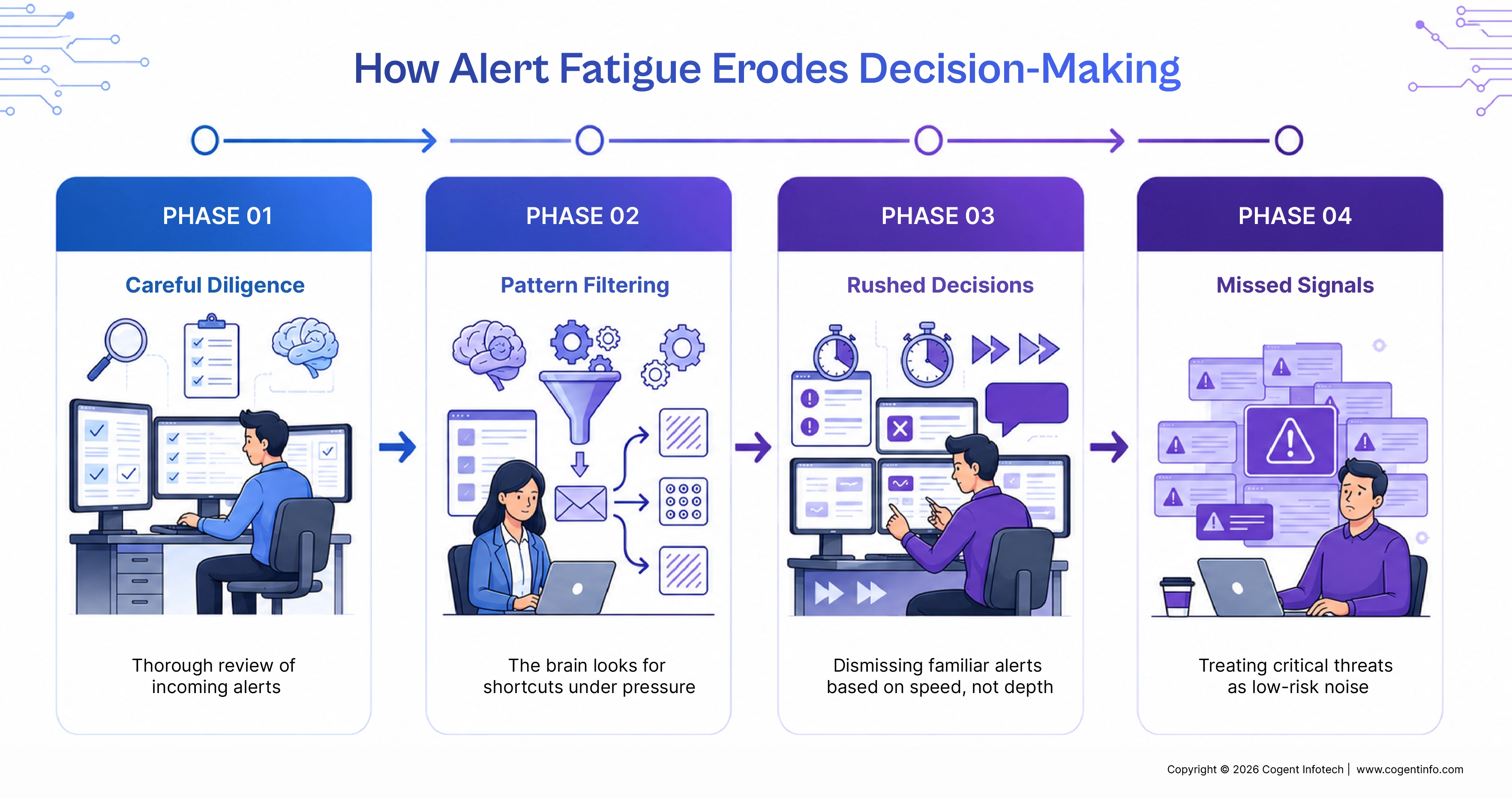
At first, analysts approach alerts with care and diligence. But as volume increases, patterns begin to change. Decisions become faster, sometimes rushed. Alerts that look familiar are dismissed more quickly. The threshold for what feels “important” starts to shift. This is a natural human response to overload.
When faced with too much information, the brain looks for shortcuts. It filters aggressively. It prioritizes speed over depth. In a security context, this can lead to missed signals.
A critical alert might resemble a hundred low-risk ones that came before it. Under pressure, it’s easy to treat it the same way. Not because the analyst lacks skill, but because the system has conditioned them to move quickly. Over time, this dynamic erodes confidence and increases stress.
Analysts know the stakes are high. They know that missing something could have serious consequences. But they are also working within systems that make consistent vigilance difficult to sustain.
The Limits of a Tool-Centric Approach
For years, the industry’s response to growing complexity has been to add more tools. Need better visibility? Add another monitoring solution. Too many alerts? Add an automation platform. Struggling with response times? Introduce AI-driven detection. Each of these solutions offers value on its own. But when layered together without a unifying design, they can create new problems. Fragmentation is one of them.
Analysts often have to switch between multiple interfaces to investigate a single issue. Data is spread across systems. Context is incomplete. Workflows become disjointed.
Instead of simplifying operations, the toolset adds friction.
There’s also the issue of overlapping functionality. Different tools may generate alerts for the same event, increasing noise rather than reducing it. The result is a system that is technically advanced but operationally inefficient.
What’s missing is not capability, it’s cohesion.
Shifting to Human-Centric Security Operations
A human-centric approach to security operations begins with a simple but powerful idea: systems should be designed around the people who use them. This means acknowledging that analysts are not just operators executing tasks. They are decision-makers working under pressure, often in high-stakes situations.
Designing for that reality requires a shift in priorities.
Instead of focusing solely on detection accuracy, organizations need to consider how information is presented, how workflows are structured, and how decisions are supported. The goal is to reduce cognitive load, not by hiding information, but by organizing it in a way that makes sense.
When systems are intuitive, contextual, and aligned with human behavior, analysts can work more effectively. They can focus on what matters, rather than getting lost in noise.
Making Alerts Smarter, Not Just Fewer
One of the most effective ways to address alert fatigue is not by reducing the number of alerts, but by improving their quality. An alert should answer key questions immediately: What happened? Why does it matter? What should be done next?
Too often, alerts provide only partial information. Analysts are left to gather context manually, pulling data from multiple sources to understand the situation. This slows down response and increases frustration.
By enriching alerts with relevant context, such as user behavior, asset criticality, historical activity, and threat intelligence, organizations can make them more actionable. Correlation is also critical.
Instead of treating each alert as an isolated event, systems should group related signals into a single incident. This reduces duplication and provides a clearer picture of what’s actually happening.
The result is fewer, more meaningful alerts that support faster and more confident decision-making.
Automation as a Force Multiplier
Automation has a key role to play in reducing alert fatigue, but its effectiveness depends on how it’s implemented.
When used thoughtfully, automation can handle repetitive, time-consuming tasks, such as data collection, initial triage, and response to known patterns. This allows analysts to focus on more complex and high-value work. However, automation should not replace human judgment where it matters most.
Security decisions often involve nuance, context, and risk assessment. Fully automating these decisions can introduce new risks, especially if the system lacks sufficient understanding. The most effective model is collaborative.
Automation handles the routine. Humans handle the exceptions.
This balance not only improves efficiency but also builds trust in the system. Analysts are more likely to rely on automation when they see it as a support tool rather than a black box.
Streamlining Workflows and Reducing Friction
Workflow design is another critical factor in human-centric security operations.
In many environments, analysts must follow complex, multi-step processes to investigate and respond to alerts. These processes often involve switching between tools, manually documenting actions, and navigating unclear escalation paths. Each of these steps adds friction.
Reducing this friction can significantly improve both efficiency and accuracy.
This might involve integrating tools to create a unified interface, standardizing playbooks for common scenarios, or automating documentation and reporting tasks. Clarity is key.
When analysts know exactly what to do and have the tools to do it quickly, they can work with greater confidence and less stress.
The Role of AI in Supporting Analysts
Artificial intelligence is increasingly being used to address alert fatigue, but its role should be carefully defined.
AI excels at processing large volumes of data, identifying patterns, and filtering out noise. It can prioritize alerts, suggest actions, and even predict potential threats. But its true value lies in augmentation.
By handling data-heavy tasks and presenting insights in a clear and structured way, AI reduces the cognitive burden on analysts. It acts as a guide, helping them focus on what matters most. This partnership between human and machine is where real progress happens.
Rather than replacing analysts, AI enhances their ability to make informed decisions quickly and effectively.
Rethinking Metrics and Success
Another important step in addressing alert fatigue is rethinking how success is measured. Traditional metrics often focus on volume, how many alerts were processed, how quickly tickets were closed, how many incidents were resolved.
While these metrics provide some insight, they don’t capture the full picture. In fact, they can create unintended pressure to prioritize speed over accuracy.
A more meaningful approach includes metrics like signal-to-noise ratio, false positive rates, analyst workload, and incident impact. These measures provide a better understanding of how well the system supports its users.
They also align performance with real outcomes, rather than just activity.
Supporting the Human Side of Security
Beyond systems and processes, there’s a human dimension that cannot be ignored.
Security analysts work in high-pressure environments where mistakes can have serious consequences. The constant flow of alerts, combined with the need for rapid decision-making, can lead to stress and burnout. Addressing alert fatigue means addressing this reality.
Organizations need to invest in their people, through training, support, and a culture that values well-being as much as performance. This includes creating opportunities for growth, encouraging collaboration, and recognizing the challenges that analysts face. When people feel supported, they perform better. And in security operations, that can make all the difference.
Moving Beyond the Dashboard
The traditional SOC dashboard was built to provide visibility, a central place to monitor activity and track alerts. But visibility alone is no longer enough.
What security teams need today is clarity, context, and control.
They need systems that highlight what matters, reduce noise, and support decision-making in real time. They need workflows that are intuitive and efficient. And they need tools that work together, not in isolation. Moving beyond the dashboard means rethinking how security operations are designed, from the ground up.
Building a More Sustainable Security Model
Alert fatigue is not a temporary issue. It’s a structural challenge created by the scale and complexity of modern digital environments. Solving it requires more than incremental improvements.
It requires a shift toward human-centric security operations, an approach that recognizes the limits of human attention and designs systems accordingly. This approach doesn’t just improve efficiency. It enhances resilience.
When analysts are supported, systems are clearer, and workflows are streamlined, organizations are better equipped to respond to threats, not just quickly, but effectively.
In the end, cybersecurity is not just about technology. It’s about the people who interpret signals, make decisions, and take action. And when those people are empowered, everything else becomes stronger.
At Cogent Infotech, we help organizations build smarter, human-centric security operations that reduce noise, improve response, and strengthen resilience.

