


Gen Z and AI: How the Next Generation Uses Artificial Intelligence



Introduction
For years, conversations about digital natives focused on internet access, smartphones, and social media. Gen Z grew up with all three. They learned in an environment where information was always available, communication was instant, and algorithms quietly shaped everything from entertainment choices to shopping recommendations.
But artificial intelligence represents something different.
The internet gave users access to information. AI increasingly helps them interpret, organize, create, and act on that information.
That distinction matters because Gen Z is entering higher education and the workforce at precisely the moment when generative AI is moving from novelty to utility. Unlike previous workplace technologies that required extensive training before employees could derive value from them, modern AI tools are designed to be conversational and intuitive. Many young people have adopted them naturally, incorporating them into everyday workflows long before organizations have formalized AI strategies.
As a result, Gen Z is not approaching AI as a specialized technology reserved for data scientists or software engineers. They are using it as a general-purpose tool for learning, communication, research, productivity, and creativity.
This shift is already visible in workforce research. According to the Deloitte Gen Z and Millennial Survey, a majority of Gen Z respondents expect generative AI to significantly influence how they work in the near future, while many are already integrating AI into their daily activities. What stands out is not merely adoption rates, but the level of comfort. For many young professionals, AI is becoming another layer of the digital environment rather than a distinct technology category.
For employers, this creates a new reality.
Organizations have spent years discussing digital transformation as a technology challenge. Increasingly, it is becoming a workforce challenge. Employees are arriving with expectations shaped by AI-enabled experiences outside the workplace. They expect information to be searchable, learning to be personalized, workflows to be streamlined, and technology to remove friction rather than create it.
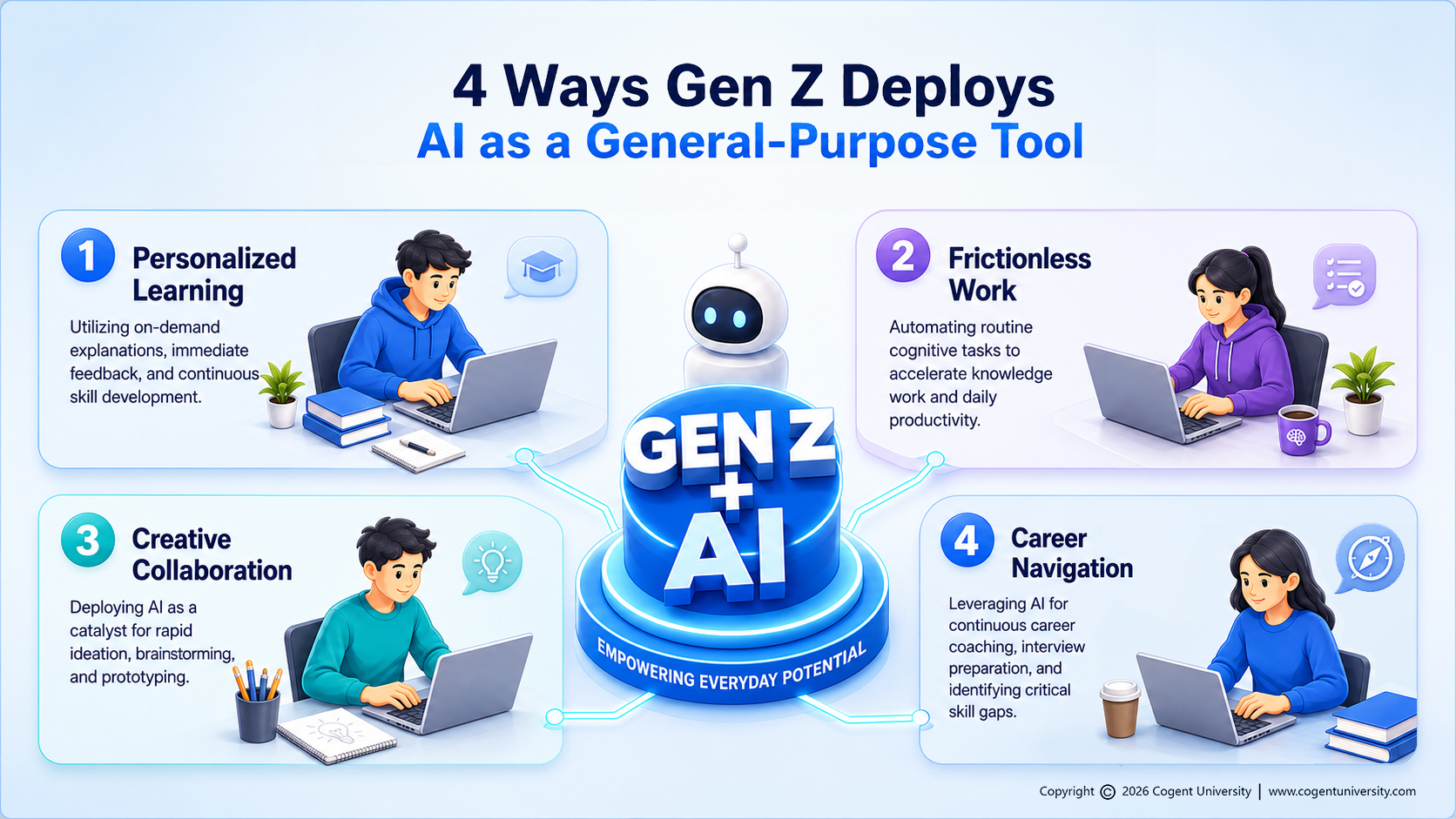
Understanding how Gen Z uses AI provides a glimpse into how future employees may expect work itself to function.
How Gen Z Uses AI for Learning
One of the clearest examples of this shift can be seen in how Gen Z approaches learning.
Traditional learning models are often structured around fixed resources: textbooks, courses, training modules, presentations, and instructor-led sessions. While these remain important, AI has introduced a more interactive layer to the learning process.
Instead of searching through multiple websites to understand a concept, students can ask AI to explain it in simpler language. Instead of rereading an entire chapter, they can request summaries of key ideas. Instead of waiting for feedback on a presentation or written assignment, they can receive immediate suggestions for improvement.
In many ways, AI is becoming a personalized learning assistant.
A student studying economics can ask for real-world examples of inflation. An aspiring software developer can request explanations of coding concepts and generate practice exercises. A marketing graduate can use AI to understand customer segmentation, campaign planning, or market research techniques. The interaction is conversational, adaptive, and available on demand.
This behavior extends beyond formal education.
Young professionals increasingly use AI to understand unfamiliar industry terminology, prepare for meetings, learn new software platforms, practice interview questions, improve business writing, and explore emerging skills. The learning process becomes continuous rather than confined to classrooms or training sessions.
Research suggests that this appetite for ongoing development is already defining the generation. The Deloitte Gen Z and Millennial Survey found that career growth and skills development remain among the highest priorities for Gen Z professionals. AI aligns naturally with that mindset because it offers immediate support whenever knowledge gaps emerge.
The implications for employers are significant.
For decades, workplace learning has largely followed a structured model. Employees attend training sessions, complete modules, and periodically update their skills. Yet workers accustomed to AI-supported learning may increasingly expect knowledge to be accessible in real time.
This does not mean organizations should abandon structured learning programs. It means they may need to complement them with tools and systems that support continuous learning within the flow of work.
Forward-looking organizations are already exploring how AI can enhance onboarding, personalize learning pathways, recommend skill development opportunities, and provide contextual support as employees perform tasks.
The broader lesson is that Gen Z is helping redefine what effective learning looks like. Speed matters. Personalization matters. Accessibility matters. Organizations that recognize those expectations may be better positioned to develop talent in an increasingly dynamic business environment.
How Gen Z Uses AI at Work
If AI is changing how Gen Z learns, it is also changing how they approach work.
The popular narrative often portrays AI as a disruptive technology that will transform entire industries overnight. In practice, many of the most common workplace applications are far more practical.
Young professionals frequently use AI to handle routine cognitive tasks that consume time but add limited strategic value. Drafting emails, organizing notes, summarizing meetings, creating report outlines, brainstorming ideas, researching topics, and generating presentation structures are among the most common examples.
The goal is not necessarily to avoid work. The goal is to reduce friction.
Consider a junior marketing executive preparing a campaign brief. Instead of staring at a blank document, they may use AI to generate an initial structure. A software developer may use AI to troubleshoot a coding issue before escalating it to a colleague. A business analyst might ask AI to summarize a lengthy report before conducting deeper analysis.
In each case, AI functions as an accelerator rather than a replacement for expertise.
This distinction is often overlooked in public debates about automation.
The most effective AI users are not those who simply accept whatever the technology produces. They are individuals who combine AI-generated outputs with contextual knowledge, critical thinking, and professional judgment.
This pattern is reflected in broader workplace research. Microsoft's latest Work Trend Index highlights how employees increasingly use AI to support writing, information gathering, analysis, and communication. Rather than eliminating knowledge work, AI is increasingly becoming part of how knowledge work is performed.
For employers, the opportunity is substantial. Employees who can automate repetitive tasks may have more capacity for collaboration, problem-solving, customer engagement, and innovation.
However, organizations should resist viewing AI adoption as a technology rollout alone.
Providing access to AI tools is relatively easy. Building responsible AI capability is considerably harder.
Employees need guidance on verifying information, evaluating sources, identifying inaccuracies, protecting sensitive data, and understanding when human oversight is required. Without these skills, productivity gains can quickly be offset by quality issues, security risks, or poor decision-making.
This is particularly important because AI adoption is often happening from the bottom up. Many employees are experimenting independently, discovering use cases on their own, and developing habits before formal policies exist.
That reality presents both a challenge and an opportunity. Organizations that proactively support responsible AI usage can harness employee enthusiasm while reducing risk. Those that ignore the shift may find themselves reacting to AI-driven workplace behaviors rather than shaping them.
The growing presence of AI in everyday work is not simply changing how tasks are completed. It is changing expectations about how work should be organized, supported, and executed. And Gen Z, more than any previous generation, is helping define what that future may look like.
AI as a Creative Partner for Gen Z
If AI is reshaping how Gen Z learns and works, it is also changing how they create.
For previous generations, creativity was often viewed as a distinctly human capability, something rooted in imagination, originality, and personal experience. AI has not changed that fundamental reality. What it has changed is the creative process itself.
Many Gen Z users do not see AI as a replacement for creativity. They see it as a collaborator.
A young marketer might use AI to generate campaign concepts before refining them with audience insights. A designer may explore multiple visual directions through AI-generated prompts before selecting a final creative path. A content creator might use AI to brainstorm video concepts, captions, storylines, or content calendars. Writers increasingly use AI to overcome creative blocks, generate outlines, or explore alternative perspectives.
The technology is often involved at the beginning of the process rather than the end.
This distinction matters because it challenges one of the most common misconceptions surrounding AI. The assumption is often that AI-generated content is intended to replace human creativity. In reality, many users treat AI as a catalyst for ideation rather than a source of finished work.
This approach aligns closely with broader workforce trends. As AI takes over more repetitive tasks, uniquely human capabilities such as creativity, communication, judgment, and problem-solving become increasingly valuable. The World Economic Forum's Future of Jobs Report identifies creative thinking among the fastest-growing skills employers expect to prioritize over the coming years.
For Gen Z, AI is often helping expand creative possibilities rather than narrowing them.
This trend is particularly visible in the creator economy. Whether building personal brands on LinkedIn, launching online businesses, producing videos, developing newsletters, or creating digital products, young professionals are increasingly using AI to accelerate production and experimentation.
Tasks that once required specialized expertise can now be approached with lower barriers to entry. Someone with a business idea can quickly generate branding concepts, draft website copy, create social content, and conduct market research before investing significant resources.
That does not eliminate the need for skill. It changes where skill is applied.
Success increasingly depends not on generating content but on evaluating, refining, contextualizing, and improving it.
For employers, this presents an interesting opportunity.
Many organizations continue to view AI primarily through a productivity lens. Yet younger employees often demonstrate its value as a creative tool. Marketing teams, product teams, innovation groups, and communications departments may find that AI-fluent employees bring new approaches to brainstorming, prototyping, and problem-solving.
The lesson is not that every idea generated by AI is valuable. Rather, AI can dramatically expand the number of ideas considered before human judgment determines which ones deserve further development.
How Gen Z Uses AI in Job Searching and Career Growth
The influence of AI extends well beyond classrooms and workplaces. Increasingly, it is becoming part of how Gen Z navigates career development itself.
Historically, career guidance came from university counselors, mentors, professional networks, or online resources. Today, many young professionals supplement those sources with AI-powered tools.
They use AI to refine resumes, tailor cover letters, prepare for interviews, research industries, identify skill gaps, and evaluate career options. A graduate interested in cybersecurity can ask AI to explain career paths within the field. A marketing professional can seek guidance on transitioning into product management. An aspiring manager can explore leadership competencies required for future roles.
In many cases, AI functions as an always-available career coach.
This is particularly significant because Gen Z is entering a labor market characterized by rapid change. The rise of AI itself is reshaping skill requirements across industries. Roles are evolving faster than traditional education systems can adapt, making continuous learning and career agility increasingly important.
Research from LinkedIn Learning consistently shows that skill development has become one of the primary drivers of career mobility. Employers are increasingly hiring for capabilities rather than fixed credentials, while workers are expected to continuously update their knowledge.
AI fits naturally into this environment because it lowers the cost of self-directed learning.
A professional no longer needs to wait for formal training to explore a new skill. They can begin learning immediately, identify resources, and create personalized development plans using AI-supported guidance.
At the same time, AI is changing how individuals present themselves professionally.
Personal branding, once considered optional, is becoming an increasingly important aspect of career growth. Gen Z professionals use AI to improve LinkedIn profiles, draft thought leadership content, refine professional bios, and communicate their expertise more effectively.
This does not mean AI guarantees career success. Employers still evaluate experience, achievements, communication skills, and cultural fit. However, AI is helping many young professionals navigate career development with greater confidence and efficiency.
For business leaders, this trend reveals another important shift. Future employees may arrive with stronger expectations around career growth, personalized development, and continuous feedback. Organizations that support those expectations are likely to be more attractive to emerging talent.
Yet amid all this enthusiasm lies an important challenge, one that many organizations are only beginning to address.
Comfort with AI is not the same as competence.
And that distinction may ultimately determine whether AI becomes a source of competitive advantage or organizational risk.
AI Fluency Is Not the Same as AI Literacy
One of the most important conversations surrounding AI today has little to do with technology itself
It has to do with judgment.
There is a growing tendency to equate frequent AI use with AI expertise. Because Gen Z is often more comfortable experimenting with AI tools, it is easy to assume they possess a deeper understanding of how those systems work and where their limitations lie.
That assumption can be misleading.
Being able to use AI effectively is not the same as understanding its strengths, weaknesses, risks, and implications.
This is the difference between AI fluency and AI literacy.
AI fluency refers to the ability to interact with AI tools comfortably. It includes writing prompts, generating outputs, exploring use cases, and incorporating AI into daily workflows.
AI literacy goes much further.
It involves understanding how AI models generate responses, recognizing the possibility of inaccurate information, evaluating sources, identifying bias, protecting sensitive data, understanding intellectual property concerns, and knowing when human oversight is essential.
The distinction is becoming increasingly important as AI adoption accelerates.
A recent Salesforce research study found that while younger generations are among the most active users of generative AI, concerns around trust, transparency, and responsible usage remain widespread. Adoption is rising faster than understanding in many organizations.
This creates several risks.
One of the most obvious is overreliance.
When AI consistently provides fast and confident answers, users may become less likely to challenge outputs or independently verify information. Yet even the most advanced AI systems can generate inaccurate, incomplete, or fabricated responses.
In a workplace setting, this can have significant consequences. Incorrect market data, flawed analysis, inaccurate customer communications, or poorly sourced research can quickly undermine decision-making.
Another challenge involves verification.
Many employees know how to generate content using AI. Fewer know how to validate it. Critical thinking becomes even more important in an AI-enabled environment because the ability to assess information quality often matters more than the ability to produce information itself.
Data privacy presents another concern.
Employees may unknowingly input confidential business information into public AI systems without understanding how that data is processed or stored. What appears to be a harmless shortcut can create compliance, security, or intellectual property risks.
There are also broader concerns around originality and skill development.
If employees rely too heavily on AI-generated outputs, they may struggle to develop foundational capabilities independently. Writing, analysis, problem-solving, and communication skills still matter. AI can accelerate these activities, but it cannot replace the underlying expertise required to evaluate and improve the results.
This is why organizations should resist framing AI adoption solely as a technology initiative.
The real challenge is building workforce capability.
Employees need technical access to AI tools. But they also need education on responsible use, ethical considerations, verification practices, and sound decision-making.
The companies that succeed with AI will not necessarily be those with the most advanced tools.
They will be the ones that combine technology adoption with strong judgment, governance, and workforce development.
And that is where many organizations still have work to do.
What Employers Can Learn from Gen Z's AI Habits
Gen Z's relationship with AI offers a glimpse into how future employees are likely to interact with technology. Rather than waiting for formal training programs or top-down mandates, many are already integrating AI into learning, productivity, creativity, and career development.
For employers, the lesson is clear: AI adoption spreads fastest when tools are intuitive, useful, and embedded into everyday workflows. Employees are more likely to embrace technologies that help them save time, solve problems, and learn new skills than those introduced solely as transformation initiatives.
At the same time, organizations should recognize that access alone is not enough. Employees need guidance on how to evaluate AI outputs, protect sensitive information, verify sources, and apply human judgment. As the Microsoft Work Trend Index highlights, AI usage is growing rapidly across workplaces, making practical AI literacy just as important as technical access.
How Companies Can Support Responsible AI Adoption
Organizations looking to harness AI effectively should focus on four priorities:

- Provide secure, approved AI tools that align with security and compliance requirements.
- Build AI literacy across teams, helping employees understand both the capabilities and limitations of AI.
- Establish clear governance, including role-specific guidance on acceptable use and data privacy.
- Encourage experimentation with accountability, allowing employees to explore AI use cases while maintaining responsibility for outcomes.
The goal is not to restrict AI adoption, but to create an environment where employees can use it confidently and responsibly.
What Gen Z and AI Mean for the Future of Work
As Gen Z moves into larger roles within organizations, AI-assisted work is likely to become the norm rather than the exception. Skills such as prompt design, information evaluation, critical thinking, and decision-making may become as important as traditional technical competencies.
Organizations may also need to rethink entry-level work, training programs, and leadership development. As AI handles more routine tasks, employees will be expected to contribute through analysis, creativity, communication, and judgment.
Ultimately, the future of work will be shaped not only by the capabilities of AI, but by how effectively people learn to work alongside it.
How Cogent Infotech Helps Organizations Prepare for an AI-Enabled Workforce
AI transformation is not solely a technology challenge, it is also a workforce challenge. Organizations need the right tools, governance frameworks, and talent strategies to ensure AI adoption delivers meaningful business outcomes.
Cogent Infotech helps organizations navigate this intersection of technology, workforce readiness, and digital transformation, enabling businesses to build AI-enabled teams that are prepared for the future.
Gen Z's use of AI is more than a technology trend. It is an early signal of how the next generation expects learning, work, and creativity to function.
For business leaders, the opportunity is not to control every use of AI, but to guide it with the right tools, training, governance, and workforce strategy. Organizations that learn from Gen Z's AI habits today will be better prepared for the digital workplace of tomorrow.
Ready to build an AI-enabled workforce for the future?
Partner with Cogent Infotech to strengthen AI literacy, workforce readiness, and digital transformation strategies that help your teams innovate with confidence.


.jpg)

