


RAG Is Growing Up: Why Enterprise Retrieval Is Moving Beyond Vector Search



Summary
- Vector search alone breaks down at enterprise scale. It loses context when documents are chunked, confuses exact identifiers like “Policy 4.2” and “4.3,” and ignores permissions, versions, and jurisdiction.
- A production-ready enterprise RAG architecture layers metadata filtering, hybrid retrieval, and reranking. In Anthropic’s tests, combining these techniques cut failed retrievals by up to 67%.
- GraphRAG adds multi-hop reasoning and audit trails. Agentic RAG should follow only once retrieval is governed.
- Cogent Infotech helps enterprises audit RAG implementations and move from pilot to production.
Introduction
The initial wave of enterprise Generative AI followed a predictable trajectory: teams indexed policy documents into a vector database, attached a Large Language Model (LLM), and delivered a functional prototype capable of querying internal knowledge bases. While these pilots successfully secured executive alignment, their underlying architectures broke down under operational conditions.
At scale, the failure modes became immediate and costly:
- Precision Deficits: A procurement analyst querying a specific contract reference code received semantically adjacent, yet legally incorrect, clauses.
- Context Leakage: A regional lead received HR policy guidelines for an incorrect jurisdiction due to weak metadata constraints.
- Governance Gaps: Compliance auditors were unable to trace model outputs back to authoritative source records, exposing the organization to significant operational risk.
These outcomes are systemic rather than anomalous. Gartner initially predicted that at least 30% of GenAI projects would be abandoned after proof of concept by the end of 2025. Its later analysis found the actual figure was worse: at least 50% were abandoned after proof of concept. The drivers behind this high failure rate (compromised data quality, inadequate risk controls, escalating compute costs, and unverified ROI) rarely stem from the core LLM. Instead, the bottleneck lies within the retrieval layer, which consistently fails to deliver contextually precise, deterministic, and permission-aware data to the model.
Moving beyond pilot-stage limitations requires maturing Retrieval-Augmented Generation (RAG) into a production-grade infrastructure. While vector search remains a core component, an enterprise-ready retrieval stack must integrate hybrid search (combining dense vectors with sparse keyword matching), deterministic metadata filtering, cross-encoder reranking, Knowledge Graphs, and agentic retrieval orchestration.
The following analysis provides CIOs, CDOs, and enterprise architects with a practical roadmap for this transition, outlining the structural limits of naive vector retrieval and defining the path toward GraphRAG and Agentic execution.
Where Vector Search Falls Short in the Enterprise
Vector search earned its adoption through semantic capability: converting unstructured text into dense vector embeddings allows models to retrieve conceptually aligned content without exact keyword overlap. Querying "employee time off," for instance, successfully surfaced a document titled "Leave of Absence Policy." While effective for open-ended queries over bounded, homogeneous datasets, this approach degrades when exposed to enterprise-scale data assets characterized by high volume, overlapping nomenclature, granular version control, and strict entitlement controls.
- Context is lost when documents are chunked
Most RAG pipelines split documents into small chunks before embedding them, because models and vector indexes work best with short passages. The problem is that meaning often spans chunks. A line stating that revenue rose 3% on the prior quarter tells the system very little if the company name and the reporting period sit two paragraphs earlier, in a different chunk. The embedding for that line carries none of the surrounding context, so it may never be retrieved for the question it actually answers.
Anthropic's engineering team, which uses a similar example, identified this as a core weakness of conventional RAG: splitting documents into chunks frequently removes the context needed to retrieve them accurately. In enterprise documents, where a table, a clause, or a footnote depends on the section heading above it, naive chunking quietly degrades accuracy at scale.
- Exact matches are not semantic similarities
Semantic search is designed to find meaning, not strings. That becomes a liability when users search for identifiers: a part number, a policy version such as "v4.2," an error code, a SKU, a regulation citation, or a customer account ID. To an embedding model, "Policy 4.2" and "Policy 4.3" look nearly identical. To a compliance officer, they may be entirely different obligations.
This is the category of question where pure vector search is most likely to return something plausible but wrong, which is exactly the kind of error that erodes user trust fastest.
- Proximity bias and overlapping terminology
Vector retrieval returns the passages that sit closest to the query in embedding space. Closeness is not the same as relevance. Large organizations reuse the same vocabulary across departments: "onboarding" means one thing to HR, another to customer success, and a third to IT security. "Exposure" means something different to a risk team than to a marketing team. Without additional signals, the retriever cannot tell which meaning the user intends, and it tends to favor whichever documents are most numerous or most generically worded.
- More context is not better context
A common workaround is to retrieve more chunks and let the model sort it out. That creates its own problems. Research by Liu and colleagues, published in the Transactions of the Association for Computational Linguistics, found that language model performance can drop substantially depending on where relevant information sits within a long input, with models doing best when key facts appear at the beginning or end of the context and worst when they are buried in the middle. Newer models handle long inputs better, but the underlying lesson holds: more context is not the same as better context.
- No awareness of permissions, time, or jurisdiction
Finally, a pure similarity search has no native concept of who is asking, which region they are in, or which version of a document is currently in force. It will return a superseded policy, a document from a restricted department, or guidance meant for another market if the wording is similar enough. In a consumer demo, that is an inconvenience. In a regulated enterprise, it is a governance incident.
None of this means vector search is obsolete. Even Microsoft Research, whose work popularized GraphRAG, notes that vector RAG excels at local questions whose answers closely resemble the query and sit in specific passages, such as "who," "what," "when," and "where" questions.
The Building Blocks of a Modern Enterprise RAG Architecture
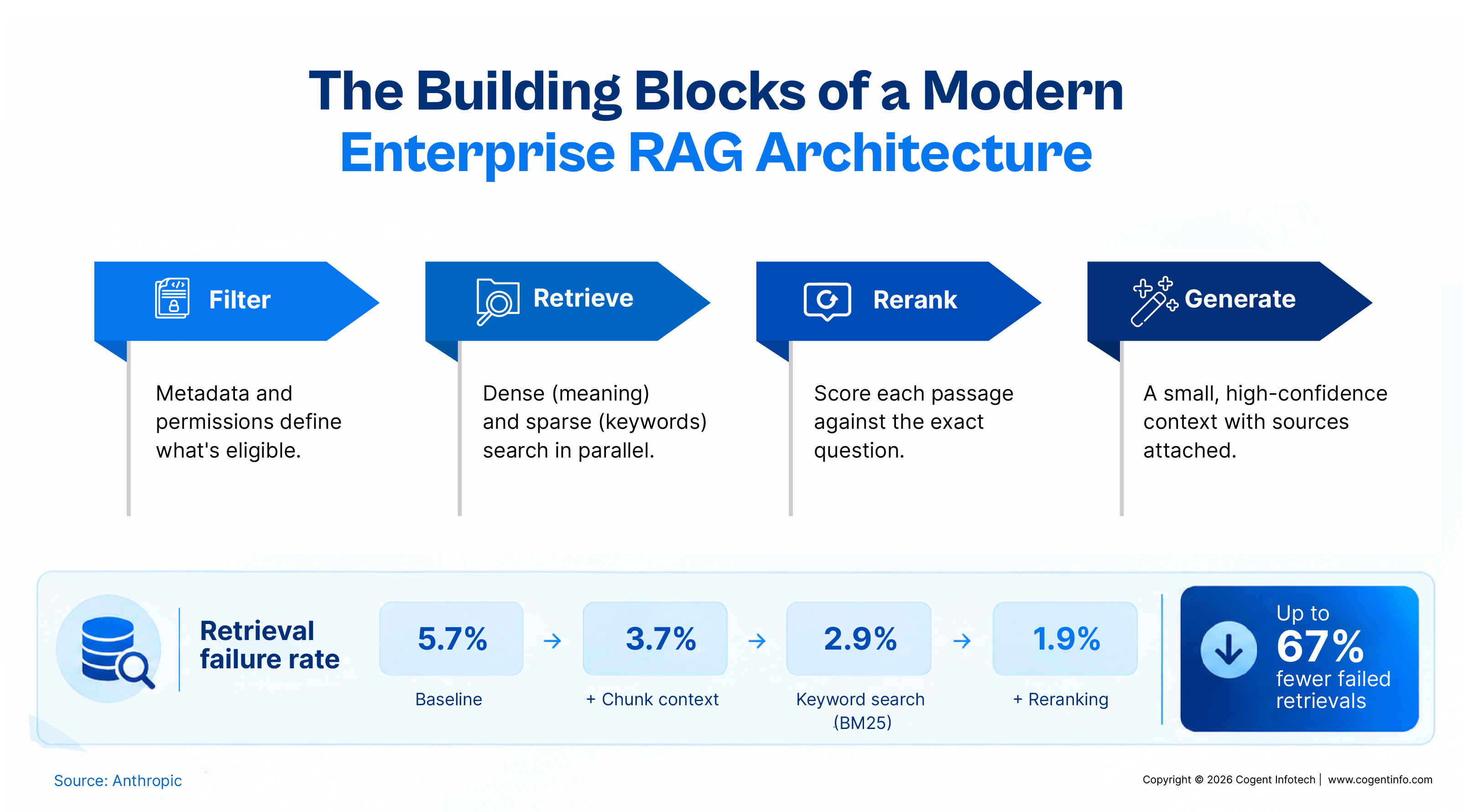
Organizations that have moved past the pilot plateau tend to make the same three upgrades first. None requires replacing the existing vector store. Each adds a layer that narrows, sharpens, or verifies what the retriever sends to the model.
- The metadata imperative: filter before you search
The most important question in enterprise retrieval is often not "what is similar?" but "what is eligible?" Before any semantic matching happens, a mature pipeline narrows the search space using structured metadata attached to every document and chunk. Typical attributes include:
- Region or jurisdiction, so a user in Germany receives the German policy, not the US version.
- Effective date and version status, so superseded documents are excluded by default.
- Department, business unit, or product line, so overlapping terminology is disambiguated by source.
- Security classification and access rights, so the retriever only considers content the user is already entitled to see.
Pre-filtering on these attributes does two things at once. It improves accuracy, because the semantic search now runs over a smaller, more relevant pool. And it enforces governance at the retrieval layer, rather than relying on the language model to ignore content it should never have seen. For AI governance teams, this is the difference between a policy that exists on paper and one that is enforced in the architecture.
The practical challenge is that metadata is only as good as the pipelines that produce it. Many enterprises discover that their document repositories carry inconsistent tags, missing dates, or no classification at all. Building RAG pipelines that extract, normalize, and maintain this metadata during ingestion is unglamorous work, but it is frequently where the largest accuracy gains are found. Gartner makes the same connection, citing failed RAG implementations as a direct consequence of data that is not AI-ready and recommending that teams build skills in RAG-specific data pipelines, vector databases, and knowledge graphs.
- The rise of hybrid retrieval
Hybrid retrieval runs two kinds of search in parallel and merges the results:
- Dense retrieval uses vector embeddings to capture meaning, paraphrase, and intent.
- Sparse retrieval uses keyword-based ranking methods, such as the widely used BM25 algorithm, to reward exact term matches, including rare identifiers and codes.
Each method covers the other's blind spots. Dense retrieval finds the "time off" policy when the user asks about "vacation." Sparse retrieval finds "Policy 4.2" when the user types "Policy 4.2." The two result sets are then combined, commonly using a rank-fusion technique that rewards documents ranked highly by both methods.
The gains can be substantial. In Anthropic's published retrieval experiments across several domains, adding brief context to each chunk cut the top-20 retrieval failure rate by 35%, and pairing those enriched embeddings with BM25 raised the reduction to 49%, from 5.7% to 2.9%. The same work illustrates a second lesson: relatively low-cost ingestion-time improvements, such as prepending a short note on where each chunk sits within its source document, can meaningfully reduce the context-loss problem described earlier. These are vendor benchmarks on specific datasets, so enterprises should validate the size of the gain on their own content.
- AI reranking: less noise, better answers
Hybrid search improves recall, meaning the right passage is more likely to appear somewhere in the candidate set. Reranking improves precision, meaning the right passage is more likely to be among the few that actually reach the model.
A reranker is a specialized model that takes the user's query and each candidate passage together and scores how well that passage answers that specific question. Because it evaluates the pair jointly, it is far more discerning than the initial similarity search. A typical pattern retrieves a broad set of candidates, reranks them, and passes only the top handful to the language model.
In the same Anthropic study, adding a reranking step on top of hybrid contextual retrieval brought the overall reduction in failed retrievals to 67%, taking the failure rate down to 1.9%. Anthropic also notes the trade-off: reranking adds latency and compute per query, which is why reranking depth should be tuned to the use case rather than set to maximum everywhere.
Together, these three layers turn retrieval from a single similarity lookup into a governed pipeline:
- Apply metadata and permission filters to define what is eligible.
- Run dense and sparse retrieval in parallel over that eligible set.
- Fuse and rerank the candidates.
- Send a small, high-confidence context window to the model, with source references attached.
The result is fewer irrelevant tokens sent to the LLM, lower inference cost, and answers grounded in the right version of the right document for the right user. This layered pattern does not eliminate hallucinations, but it significantly reduces one of their most common root causes: poor retrieval.
GraphRAG: Bringing Relationships and Auditability to AI
Hybrid search and reranking solve the problem of finding the right passage. Some enterprise questions, however, cannot be answered by any single passage. They require connecting facts that live in different documents, systems, and teams.
Consider a supply chain leader who asks: "Which of our tier-two suppliers affected by the new export restrictions also supply components for our highest-margin product line?" Answering that requires linking a regulatory update to a list of suppliers, those suppliers to components, and those components to products and their financial performance. A similarity search might retrieve the regulation and a supplier list, but it cannot reliably trace the chain between them. This is known as multi-hop reasoning, and it is where GraphRAG earns its place.
- How graph-enhanced retrieval works
GraphRAG adds a knowledge graph to the retrieval layer. During ingestion, the system identifies entities (suppliers, products, contracts, regulations, people, systems) and the relationships between them (supplies, governs, owns, depends on, supersedes). At query time, the retriever can traverse those relationships rather than relying solely on textual similarity.
Microsoft Research, which popularized the term, showed that a graph-based approach performs especially well on broad "sense-making" questions across large datasets. In its head-to-head evaluation, which used a language model to judge pairs of answers, GraphRAG beat a conventional RAG baseline on answer comprehensiveness and diversity, with win rates of roughly 70 to 80%. The underlying paper explains that standard RAG struggles with global questions aimed at an entire corpus, such as identifying the main themes across a document set, because those are summarization problems rather than lookup problems.
In practice, most enterprise implementations do not replace vector or hybrid retrieval with a graph. They combine them. The graph identifies the relevant entities and relationships, and vector or keyword search retrieves the supporting text for each.
- Why explainability matters for regulated industries
For financial services, healthcare, insurance, energy, and public sector organizations, accuracy alone is not enough. Teams must be able to show how an answer was produced. A knowledge graph makes that possible in a way that embedding similarity does not.
When a graph-enhanced system answers a compliance question, it can expose the path it followed: this control maps to this regulation, which applies to this business unit, which is governed by this policy, version 3, effective from this date. Each hop is a named, inspectable relationship. That traversal path becomes an audit trail that risk and compliance teams can review, challenge, and sign off on.
Compare that with a pure vector result, where the only available explanation is that a passage was mathematically close to the question. One can be defended to a regulator; the other cannot.
- A realistic view of the trade-offs
GraphRAG is not a universal upgrade. Building and maintaining a knowledge graph requires entity extraction, schema design, and ongoing curation, and full graph indexing can be computationally expensive on large corpora. It delivers the most value where relationships genuinely drive the questions being asked: supply chain dependencies, compliance frameworks, organizational structures, product configurations, and customer or asset hierarchies. For straightforward document lookup, hybrid search with reranking is often sufficient and far simpler to operate.
The cost picture is also shifting. Microsoft's LazyGraphRAG variant defers language model use until query time, and the company reports indexing costs on par with vector RAG and about 0.1% of full GraphRAG. Microsoft itself notes that this does not make full graph indexing obsolete, so teams that need a curated, governed graph of named entities will still invest in deliberate schema design.
The strategic decision is therefore not "vector or graph," but which questions justify the additional structure.
Looking Ahead: The Shift to Agentic RAG
Every architecture described so far still treats retrieval as a single step: a question comes in, context goes out, an answer is generated. In Agentic RAG, retrieval becomes a process the system plans and manages, not a lookup it performs once.
An agentic system first reasons about the question. Is it a fact lookup, a comparison, or a multi-part investigation? It then decides which sources to consult and in what order: a policy repository through hybrid search, a knowledge graph for relationships, a data warehouse through a structured query, or a live system through an API. After each step, it checks what it has found, identifies gaps, and retrieves again if needed.
Consider a customer operations leader asking, "Why did escalations from our enterprise accounts in the Nordics rise last quarter, and which open cases are most at risk now?" A static RAG system would summarize a few documents. An agentic system might query ticketing data for escalation trends, filter by region and account tier, correlate them with recent release notes and incident reports, and then pull the open cases that match the pattern. The result is a prioritized list the team can act on, and a sign that enterprise AI search is shifting from answering questions to supporting workflows, with a human still in control of the action.
- Maturity before autonomy
Agentic RAG amplifies the quality of the retrieval layer beneath it. An agent that orchestrates five retrieval calls over poorly governed data simply produces errors five times faster. Gartner has cautioned that over 40% of agentic AI projects will be canceled by the end of 2027, due to escalating costs, unclear business value, or inadequate risk controls. Organizations that skip the retrieval foundations described above are likely to repeat the pilot-to-production gap with agents, at a higher cost.
- Guardrails that make agentic retrieval enterprise-ready
Because an agent acts on a user's behalf, the controls around it matter as much as its reasoning. Four principles separate production-grade agentic retrieval from an impressive demo:
- Inherited permissions. Every query the agent makes runs under the requesting user's entitlements, never a broad service account.
- Step-level logging. Each retrieval and the sources it used are recorded so any answer can be replayed and reviewed.
- Bounded autonomy. Limits on steps, systems, and cost per query prevent runaway loops and unexpected bills.
- Human approval for consequential actions. Agents can draft and recommend, but changes to customer records, financial data, or external communications pass through a person.
These controls should scale with autonomy. Gartner recommends classifying agents by how much they can do, from read-only retrieval to fully autonomous action, with governance tightening at each level. It warns that by 2027, 40% of enterprises will demote or decommission autonomous AI agents because governance gaps surfaced only after production incidents. Getting this right is what allows risk and compliance teams to approve agentic use cases at all.
The Business ROI of Mature Retrieval
Architectural upgrades matter to the board only when they change business outcomes. Mature retrieval does so in three ways.
- Faster time-to-insight: When the retriever returns the right passage the first time, people stop rephrasing questions, cross-checking answers manually, or abandoning the tool. Multi-hop and agentic capabilities compress investigations that once spanned several systems into a single guided inquiry.
- Faster customer resolution: Support teams depend on precise answers, such as the warranty terms for a specific product version or the fix for a specific error code. Hybrid retrieval with metadata filtering is well suited to these questions, helping shorten handling times and reduce avoidable escalations.
- Trust with high-stakes data: This is the most strategic benefit. A preregistered Stanford RegLab study of leading legal research products, tested in 2024, found that, although retrieval reduced errors compared with a general-purpose model, the tools still hallucinated between 17% and 33% of the time. The lesson is not that RAG fails, but that retrieval quality, governance, and traceability shape how much risk remains. Layered retrieval, source citations, and graph-based audit trails can help lower that risk and make errors easier to spot, giving organizations a firmer basis for extending AI into higher-stakes work such as contract analysis, regulatory reporting, and strategic planning.
There is also a cost benefit: sending fewer, more relevant passages to the model lowers token consumption per query, which matters as usage scales to thousands of employees.
A Phased Roadmap for Maturing Your Retrieval Stack
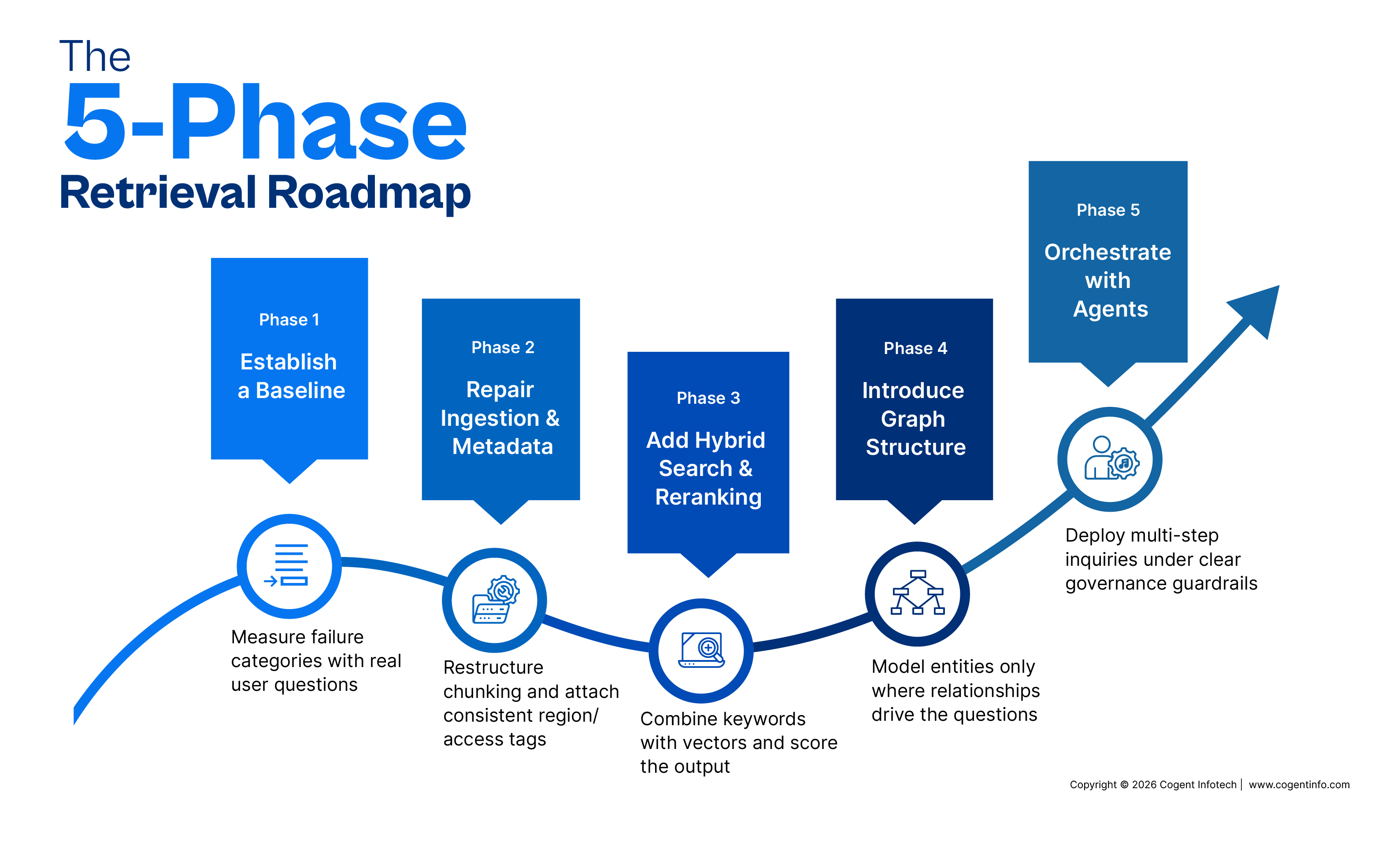
Few organizations can rebuild their retrieval layer in one program, and few need to. The most reliable path treats each upgrade as a phase with its own measurable return, so that investment follows evidence rather than enthusiasm.
Phase 1: Establish a retrieval baseline
Start by measuring what you have. Assemble a representative set of real user questions, including the identifier lookups, version-sensitive queries, and cross-department questions that cause trouble today, and record the correct source for each. Then evaluate retrieval separately from generation. If the right passage never reaches the model, no amount of prompt tuning will fix the answer. This baseline turns vague complaints about accuracy into specific, fixable failure categories.
Phase 2: Repair ingestion and metadata
Most of the failure categories found in Phase 1 trace back to ingestion. This phase restructures chunking so that sections, tables, and clauses keep their context, and it attaches consistent metadata for region, effective date, owner, and classification. It is also where access controls are mapped into the index, so that permission filtering happens before retrieval rather than after generation.
Phase 3: Add hybrid search and reranking
With clean, well-labeled content in place, introducing keyword retrieval alongside vectors and adding a reranking stage often produces a clear, measurable improvement in answer quality. Re-run the Phase 1 question set to quantify the gain and tune reranking depth against latency targets.
Phase 4: Introduce graph structure where relationships drive the questions
Use the evaluation data to identify the questions that still fail because they require connecting entities across sources. Build graph capabilities for those domains first, such as supplier networks or control-to-regulation mappings, rather than attempting to model the entire enterprise at once.
Phase 5: Orchestrate with agents under clear guardrails
Only once retrieval is reliable, governed, and measured should agents be introduced to plan multi-step inquiries. Start with read-only, advisory workflows, prove their value against defined business metrics, and expand autonomy gradually as monitoring confirms that the system behaves as intended.
Across every phase, continuous evaluation and observability are the common thread. Retrieval quality drifts as content, users, and regulations change, so the question set built in Phase 1 should become a permanent regression test for the platform.
Conclusion: Enterprise RAG Architecture Is Now an Engineering Discipline
Vector search gave enterprises their first practical path to grounding generative AI in their own data. It remains an essential part of the stack. But the organizations successfully moving generative AI into production have learned that reliability comes from layers: metadata filters that enforce governance, hybrid retrieval that captures both meaning and exact matches, reranking that sends the model only what it needs, knowledge graphs that make reasoning traceable, and, increasingly, agents that orchestrate all of it.
Executive takeaway: Treat your enterprise RAG architecture as core data infrastructure, not an application feature. Measure where retrieval fails today, fix the data and metadata foundations first, and add graphs and agents only where the business questions demand them.
This is where Cogent Infotech works alongside enterprise technology leaders. Our teams help organizations audit existing RAG implementations, design hybrid and graph-enhanced retrieval ecosystems suited to their operational realities, and build and scale the data pipelines, search infrastructure, and governance frameworks needed to move from pilot to production with confidence. If your generative AI initiatives are reaching the limits of basic vector search, we would welcome a conversation about what the next stage of your architecture could look like.
Ready to scale your GenAI initiatives? Partner with Cogent Infotech to build reliable, secure, production-ready RAG solutions.

