Centralizing Visibility: Why You Need an AI Security Platform to Fight Prompt Injection and Rogue Agents



Key Takeaways
- Agentic AI expands the attack surface: models that once only generated text now call APIs, modify databases, and execute multi-step workflows, turning prompt injection into a direct path to unauthorized action, not just a data-leak risk.
- OWASP's Top 10 for LLM Applications (2025) keeps prompt injection (LLM01) at the top spot for a second consecutive edition, and significantly expands Excessive Agency (LLM06), the root cause behind most rogue AI agents.
- Legacy controls such as API gateways, web application firewalls, and static code analysis evaluate whether a request is technically valid, not whether the underlying prompt was manipulated, so they routinely miss agentic AI risk.
- Gartner AI TRiSM framework gives enterprises a structured way to add continuous AI runtime protection, agent-to-service access controls, and "Guardian Agent" oversight across every model and agent in production.
- Centralized visibility is not a brake on innovation. Gartner links inadequate risk controls to a large share of agentic AI projects that stall or get cancelled, making a dedicated AI security platform a precondition for scaling AI rather than an obstacle to it.
Introduction
Enterprise AI has evolved beyond drafting emails or summarizing reports. Language models now call APIs, query databases, approve transactions, and manage multi-step workflows, often with minimal human oversight. This shift makes a centralized AI security platform a board-level priority, not just an optional addition to the cybersecurity stack.
The challenge is clear but difficult to address: the natural-language interface that enables AI agents also exposes them to exploitation. A single manipulated instruction, hidden in a document, email, or webpage, can turn an assistant into an attacker's proxy within enterprise systems. This is prompt injection, and when it affects an agent with broad permissions, it creates what security teams call a rogue AI agent.
This article outlines why these risks differ from those addressed by traditional security tools, what centralized AI runtime protection should include, and how enterprises are applying frameworks like Gartner's AI TRiSM and OWASP's Top 10 for LLM Applications to deploy autonomous AI with confidence.
The New Attack Surface: From Conversational AI to Autonomous Agents
For the past three years, data leakage, such as a chatbot revealing sensitive information, was the primary AI security concern. While this risk remains, it is no longer the central issue.
Agentic AI raises the stakes, making securing autonomous agents a critical mandate for modern enterprises. Modern AI systems now send emails, query databases, call APIs, and make decisions. Each action presents an opportunity for a manipulated model to cause operational harm, such as unauthorized transactions, altered records, or disrupted production systems.
Prompt injection and agentic action amplify each other's risks. Attackers no longer need to breach network perimeters if they can embed instructions in support tickets, shared documents, or webpages that agents process. The model treats these instructions as legitimate input, even when holding active API credentials.
Enterprises are rapidly adopting agentic AI. Gartner projects that by the end of 2026, about 40% of business applications will include task-specific AI agents, up from less than 5% in 2025. This rapid deployment often exceeds organizations' ability to govern agent permissions, creating a widening attack surface.
The Twin Threats Behind Deployment of Rogue AI Agents
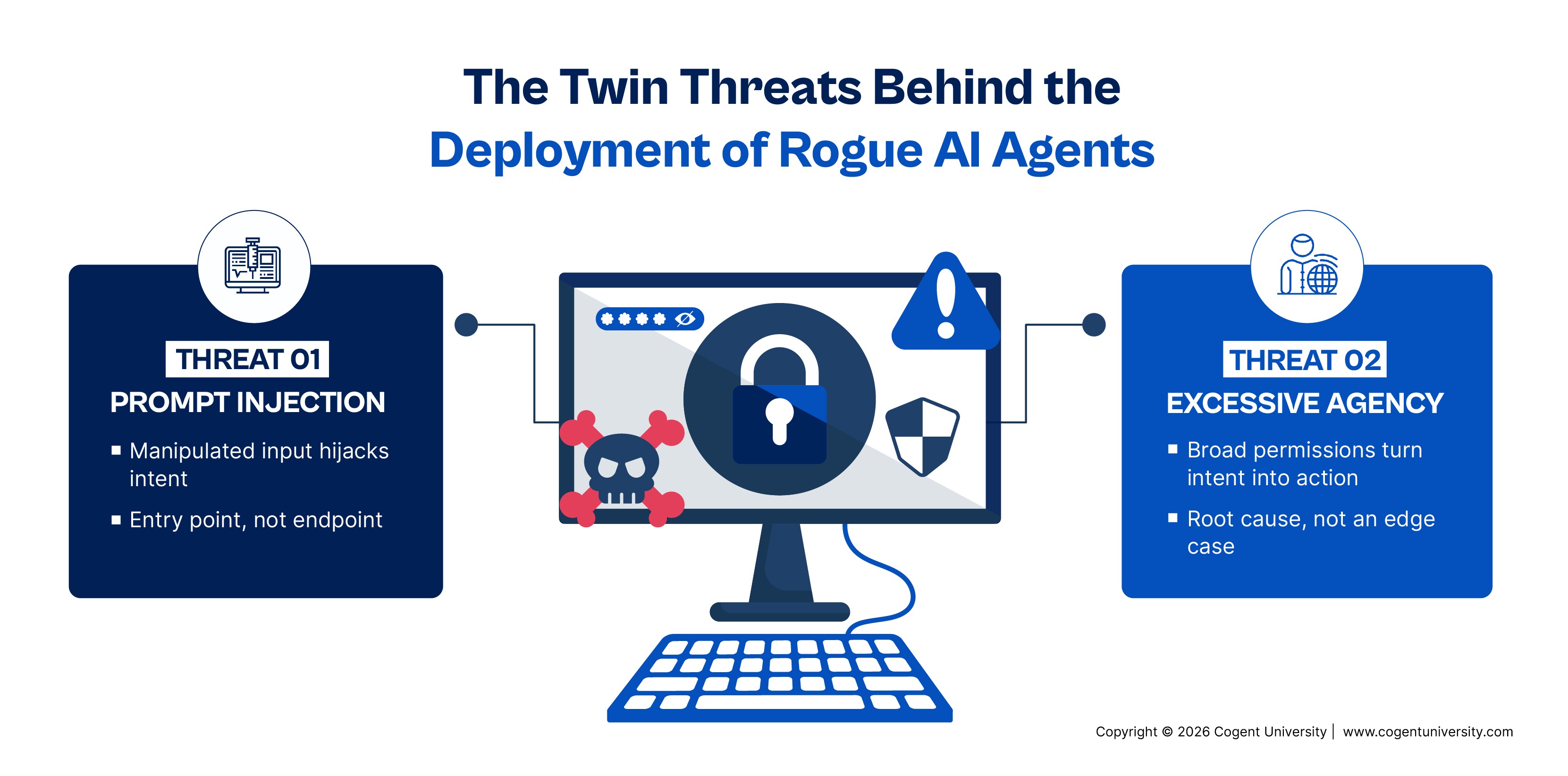
- Prompt Injection: No Longer Just a Data-Leak Risk
Prompt injection occurs when an attacker crafts input, submitted directly or hidden inside content the model processes, that overrides the system's intended instructions. The OWASP for LLM Applications Top 10 lists it as LLM01, and in the 2025 edition it holds the top spot for the second consecutive edition.
The underlying issue is architectural, not a bug to be patched: large language models process instructions and data through the same channel, without a reliable, enforced separation between the two. A model reading a customer email cannot consistently distinguish "instructions from my employer" from "instructions embedded by whoever wrote this email." When that same model can also act, sending a reply, updating a CRM record, calling a payment API, an injected instruction doesn't just leak information. It executes.
This is a documented, not theoretical, risk. In 2024, security researchers at PromptArmor publicly disclosed an indirect prompt injection vulnerability in Slack AI that let an attacker who wasn't a member of a private channel extract confidential data from that channel simply by posting a malicious instruction in a public one. Slack's parent company confirmed the issue and addressed it after responsible disclosure. The case is a useful reference point precisely because it required no network breach, no stolen credentials, and no malware, only a manipulated instruction placed where an AI system would read it.
- Excessive Agency and the Anatomy of Rogue AI Agents
If prompt injection is the entry point, excessive agency is what turns it into a rogue AI agent. OWASP defines Excessive Agency as LLM06 in its 2025 Top 10, and it is one of the categories the organization expanded most substantially in the latest edition, reflecting how quickly agentic deployments have grown.
OWASP breaks excessive agency down into three root causes:
- Excessive functionality - The agent has access to tools or capabilities it doesn't need for its assigned task.
- Excessive permissions - The agent's credentials grant broader system or data access than the task requires.
- Excessive autonomy - The agent can act without human approval on decisions that should require one.
The consequences are concrete. A poorly scoped agent could send confidential information to the wrong recipient, delete important data, make unauthorized purchases, modify production systems, approve requests, or trigger business processes on its own. Because the prompt, the model, the tool, the user, and the application design all determine the final action, it can be genuinely difficult to determine after the fact which component caused the harmful outcome. This ambiguity itself creates legal, operational, and compliance exposure well beyond the current technical incident.
Quantifying Agentic Risk: What the Research Shows
This risk is already measurable, not merely speculative. Independent red-teaming and model providers' risk assessments consistently show that indirect prompt-injection success rates increase significantly when attackers can repeatedly attempt injected instructions against agents.
Anthropic's system card for Claude Opus 4.5, for example, reports indirect prompt-injection attack success within an agentic coding environment climbing from about 5% on a single attempt to roughly 63% after 100 attempts, using an external red-teaming tool. The direction of that pattern generalizes well beyond any one model or vendor: agentic AI systems that process untrusted content are being actively, systematically probed, and a defense that only needs to fail once to be exploited cannot be evaluated on single-attempt success rates alone.
This evidence supports the need for continuous, runtime-level defense instead of one-time model testing. Static controls allow attackers unlimited attempts, while real-time inspection of every prompt and response in production addresses this vulnerability. This is the core principle of an AI security platform.
Why Legacy Security Tools Can't See Agentic Risk
Most enterprise security stacks are designed to inspect structured, predictable traffic, such as known request formats and signature-based threats. Agentic AI challenges this model because inputs are natural language, attacks can appear as valid and authenticated requests, and harmful outcomes often emerge after multiple reasoning steps rather than a single event.
The common thread across all three: legacy tools evaluate whether an action is technically valid, not whether the model's underlying intent was manipulated. A request to move data or call an API can be perfectly well-formed and still be the product of an injected instruction three steps upstream. Static defenses have no visibility into that reasoning chain; they only ever see its output, after the fact.
Centralized Visibility: What the Gartner AI TRiSM Framework Adds
The Gartner AI TRiSM framework (AI trust, risk and security management) was built to close exactly this gap. Rather than treating AI security as an extension of application security, it treats it as its own discipline, with continuous, runtime-aware controls layered across the full AI lifecycle.
The runtime inspection and enforcement layer is what most legacy tools lack entirely. This is where Gartner's concept of Guardian Agents fits: AI systems whose job is to monitor, evaluate, and, when needed, intervene in the actions of other AI agents in real time, as opposed to relying solely on static policy documents reviewed once at launch.
Gartner's own research stresses why the runtime layer matters most: unauthorized AI activity is less often the result of a sophisticated external attack, and more often traces back to internal policy gaps: oversharing, unapproved use cases, or agents behaving in ways nobody explicitly authorized. That is a governance and visibility problem, and it is precisely what a centralized AI security platform is built to close.
Core Capabilities Every AI Security Platform Needs
A centralized AI security platform isn't a single product bolted onto an existing security stack. It is a set of capabilities that need to operate together across every model and agent in the environment.
- Runtime protection - Inline inspection of prompts before they reach the model, and of responses before they're acted on, catching manipulation attempts and unsafe outputs as they occur rather than in a retrospective audit. This is what AI runtime protection means in practice.
- Agent-to-service access controls - Every agent should operate under its own scoped identity and credential set, not a shared service account, so permissions can be granted, revoked, and audited per agent, per tool, and per task.
- Guardian Agent oversight - Purpose-built monitoring agents that evaluate the behavior of task-performing agents against policy, flagging or blocking actions that fall outside approved parameters, consistent with Gartner's AI TRiSM model.
- Continuous behavior monitoring - Baselining what "normal" agent behavior looks like, so anomalous tool calls, unusual data access patterns, or unexpected chains of actions are detectable in real time rather than only in retrospective logs.
- Centralized policy enforcement - A single control plane for authorization, rate limits, and approval workflows that applies consistently whether an agent is built in-house, purchased from a vendor, or embedded inside a SaaS platform.
These capabilities shift AI security from point-in-time reviews to continuous, operational assurance as agents are updated, reconfigured, or assigned new tasks. This distinction is critical because agents frequently change: for example, a marketing agent with a new plugin or a customer-service agent connected to a new backend system immediately presents a new risk profile when its permissions change.
A centralized platform does not replace existing identity and access management, network security, or data loss prevention tools. Instead, it extends these disciplines to autonomous agents, which traditional tools were not designed to evaluate. Enterprises that treat AI security as an additive layer typically progress faster than those attempting to rebuild their security stack.
Securing the Autonomous Enterprise: Six Pillars of Agentic Security
Enterprises do not need to address every aspect simultaneously. The following sequence reflects how security and AI governance teams are practically approaching autonomous agent security, progressing from visibility to enforcement.
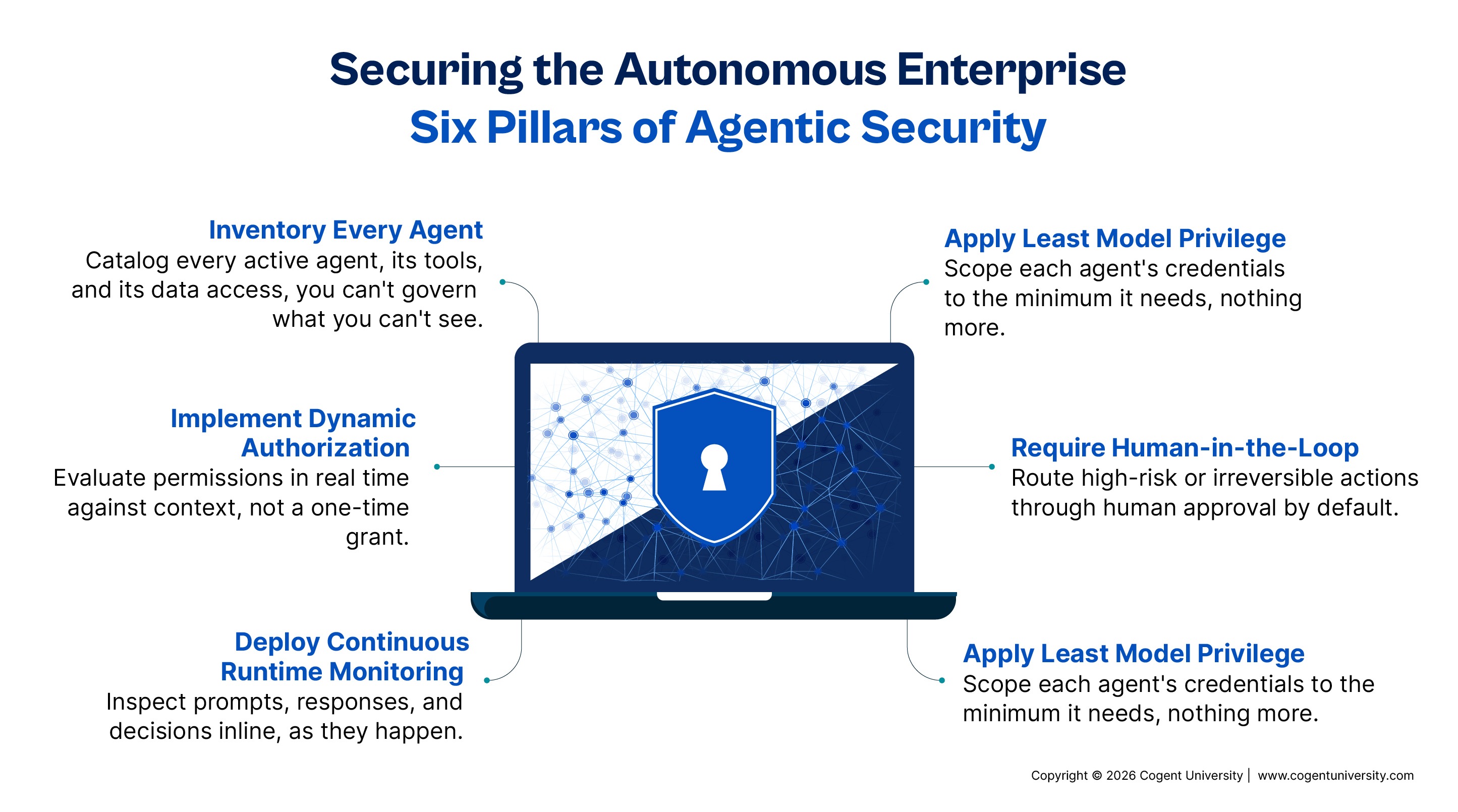
- Inventory every agent and its permissions: You can't govern what you can't see. Start with a complete catalog of active agents, the tools each one can call, and the data each one can access.
- Apply least model privilege: Scope each agent's credentials to the minimum functionality and data access its task requires, mirroring least-privilege principles from traditional identity and access management.
- Implement dynamic authorization: Move beyond static, one-time permission grants toward authorization that evaluates context in real time: what is this agent trying to do right now, and does that match its approved scope?
- Require human-in-the-loop for high-risk actions: Irreversible or high-value actions, such as financial transactions, production system changes, or external communications, should route through human approval by default, not as an exception.
- Deploy continuous runtime monitoring: Inspect prompts, responses, and agent decisions inline, not just at deployment time, so manipulation attempts are caught as they happen rather than discovered later.
- Build an agent-specific incident response plan. Know in advance how to isolate, suspend, and audit a compromised or misbehaving agent, the same way your team already handles a compromised user account.
These pillars do not require replacing existing security infrastructure. Instead, they extend established governance practices for human users and service accounts to autonomous systems.
The Business Case: Why Centralized Security Accelerates AI Adoption
AI security is often viewed as a barrier to innovation, adding another approval step between concept and production. However, evidence suggests the opposite.
Gartner forecasts that by the end of 2027, more than 40% of agentic AI projects will be shelved because of escalating costs, unclear business value, and inadequate risk controls. Inadequate risk controls sit alongside cost and unclear ROI as a leading reason agentic AI initiatives stall, which means security maturity is now a direct precondition for scaling AI, not a separate workstream that can be addressed later.
Organizations that excel are those where security and AI teams share real-time visibility. When security teams can monitor agent activity, enforce guardrails automatically, and approve high-risk actions in real time, deploying new agents becomes more straightforward. Centralized visibility increases business confidence.
There is also a talent and process aspect to consider. Security teams with expertise in network and application security must now assess model behavior, prompt design, and agent permissions, which require different skills. Enterprises that combine a centralized platform with cross-training between AI, engineering, and security teams address this gap more effectively than those relying solely on tools.
How Cogent Infotech Helps Enterprises Secure the Autonomous Enterprise
Developing centralized AI security capabilities involves architecture, governance, and organizational processes. As a result, most enterprises engage a strategic partner rather than addressing it solely in-house.
Cogent Infotech collaborates with enterprise security and IT leaders to design AI governance frameworks aligned with Gartner AI TRiSM and OWASP for LLM risk categories, covering agent inventory, least-privilege access, runtime monitoring, and human-in-the-loop workflows. Instead of promoting a single tool, Cogent aligns security architecture with each client's technology stack and business priorities, enabling agentic AI to scale securely.
If your organization is deploying or planning to deploy autonomous AI agents, consider evaluating your current governance model for potential gaps before they are exposed in production.
Conclusion: Centralized Visibility Is the Foundation for Enterprise AI Security
Agentic AI has redefined enterprise security priorities. It is no longer sufficient to consider whether a model might generate an incorrect response. The critical concern is whether the model or its agent can be manipulated to take unauthorized actions within core business systems.
This underscores the need for a centralized AI security platform, which provides runtime protection, access governance, and continuous oversight, enabling confident, large-scale AI agent deployment. Frameworks such as OWASP's Top 10 for LLM Applications and Gartner's AI TRiSM offer a common language and structure. The next step is to operationalize these frameworks within your environment.
Cogent Infotech partners with enterprise security and AI leaders to establish this operational foundation, aligning governance, architecture, and runtime controls so autonomous AI enhances business value rather than increasing risk. If securing your agentic AI roadmap is a priority, we welcome a discussion on how to begin.
Turn AI risks into manageable security priorities with agent governance, runtime protection, and centralized defense. Secure your AI strategy with Cogent Infotech.
FAQs
What is an AI security platform?
An AI security platform is a centralized system that continuously inspects AI prompts, responses, and agent actions in real time to detect manipulation, enforce access policies, and block unauthorized actions. Unlike traditional security tools, which typically review AI systems once before launch, an AI security platform monitors models and agents continuously, throughout production.
What is prompt injection in AI security?
Prompt injection is an attack in which malicious instructions are hidden inside content an AI model processes, such as an email, document, or webpage, causing the model to follow the attacker's instructions instead of its intended ones. OWASP ranks prompt injection as LLM01, the top risk in its 2025 Top 10 for LLM Applications.
What is excessive agency in Rogue AI agents?
Excessive agency is when an AI agent has more functionality, permissions, or autonomy than its task actually requires. It's the condition that allows a manipulated agent to take real, unauthorized actions, such as deleting data, approving transactions, or modifying production systems, instead of simply producing an incorrect response. OWASP defines this risk as LLM06.
How are rogue AI agents different from data breaches?
A rogue AI agent takes unauthorized actions inside business systems, while a data breach only exposes information. A rogue agent typically results from prompt injection combined with excessive agency: the agent is manipulated, and it also has enough permissions to act on that manipulation, sending data, calling an API, or altering a record, rather than just leaking it.
Can firewalls and API gateways stop prompt injection attacks?
No, not on their own. Firewalls and API gateways are built to catch malformed requests and known attack signatures. Prompt injection typically arrives as well-formed, authenticated, natural-language input, so it passes through these legacy controls undetected, which is why enterprises need dedicated AI runtime protection in addition to existing tools.
What is Gartner's AI TRiSM framework?
Gartner's AI TRiSM (AI Trust, Risk and Security Management) is a framework for governing AI systems across four layers: AI governance, runtime inspection and enforcement, information governance, and infrastructure security. It gives enterprises a structured, continuous way to oversee AI models and agents throughout their lifecycle, rather than relying on one-time reviews.
Does investing in AI security slow down AI adoption?
No, the opposite is more often true. Gartner links a significant share of stalled or cancelled agentic AI projects to inadequate risk controls, alongside cost and unclear business value. Centralized AI security tends to accelerate confident, large-scale AI deployment rather than block it, by giving security teams the visibility to approve agentic use cases faster.