Enterprise AI Cost Optimization: 7 Metrics Every CIO Should Track in 2026


Introduction
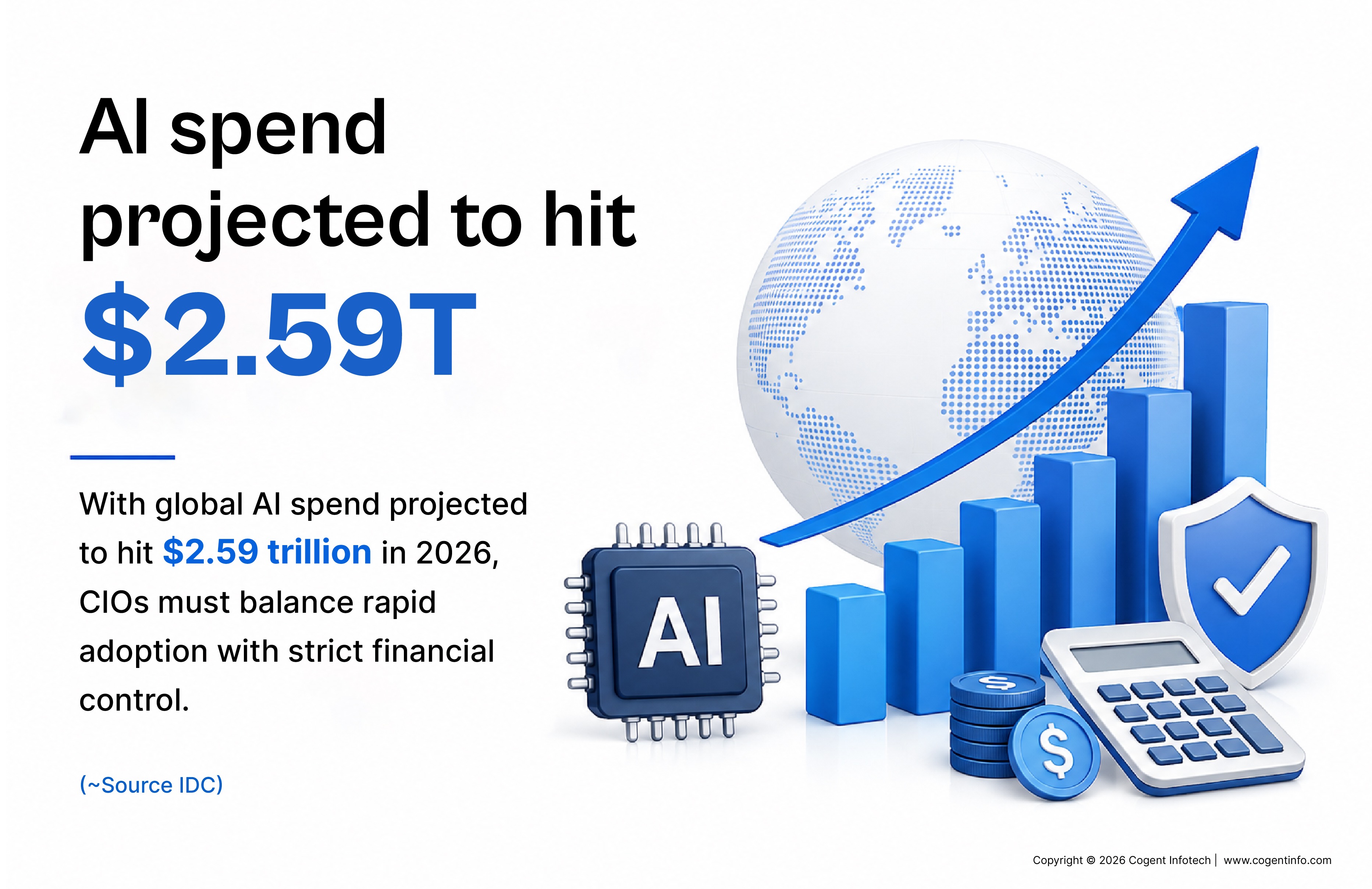
Not long ago, enterprise AI spending lived quietly inside the tech budget. It was reviewed quarterly and rarely made a blip on the boardroom radar. That era is officially over. According to IDC, global AI infrastructure spending is on track to hit $487 billion this year, jumping an incredible 53% from $318 billion in 2025. When you look at the entire picture, including software, hardware, services, and platforms, Gartner forecasts that total AI spending will reach a staggering $2.59 trillion in 2026.
With numbers that big, C-suites and boards are paying attention in a whole new way. A recent Gartner survey of over 200 CFOs highlights a fascinating paradox: their absolute top priority right now is hitting enterprise-wide cost optimization targets. Yet, nearly half (47%) of those same finance chiefs also rank investing in new growth opportunities as a top-five priority. AI sits right at the intersection of these two competing pressures.
The result is a tension that every CIO feels acutely: the need to accelerate AI adoption while simultaneously demonstrating that spending is under control and generating a measurable return. That tension is why enterprise AI cost optimization has moved from a technical concern to a board-level priority, anchoring every modern CIO's AI strategy. It is also why the AI cost metrics that organizations rely on must evolve to match that shift.
Here are the seven key metrics every CIO needs to track this year. These aren’t just about cutting costs; they are about directly connecting your AI investments to real business value.
Why Traditional IT Cost Metrics Are Not Enough for AI
Traditional IT cost frameworks were built around relatively stable, predictable consumption, like server capacity, license seats, and storage tiers. CIOs have spent decades refining cost-per-seat and cost-per-server models, and the instinct to apply that same logic to AI is understandable. However, AI workloads break that traditional model for several critical reasons:
- Consumption is variable and highly volatile: Token and inference costs fluctuate based on demand, model choice, and complexity. A predictable workload in January can easily double by March as adoption grows or pricing tiers shift. The risk is unprecedented: data from FinOps X 2026 revealed that a single misconfigured AI agent can run up a six-figure bill in hours, with one extreme incident approaching half a billion dollars.
- The shift to agentic AI multiplies the cost per interaction: Autonomous systems drastically alter unit economics. Research from EY highlights this scale: in 2023, a simple linear AI workflow cost around $0.04 per interaction. By 2026, a complex, orchestrated agentic system involving tools, reasoning, and iterative loops costs approximately $1.20 per interaction, a massive 30-fold increase.
- AI expenses are fragmented and hidden: Unlike centralized software subscriptions, agentic AI costs rarely show up on one invoice. Instead, they are scattered across model APIs, cloud infrastructure, data retrieval layers, governance overhead, and change management, often becoming visible only after systems move into live production.
- Enterprises are facing a measurement problem, not a forecasting failure: Traditional tools were not built for this consumption model. A survey reported by CIO.com found that a majority of organizations misestimate AI costs by more than 10%, and nearly a quarter underestimate actual spend by 50% or more. Enterprises are using tools designed for static software to manage a brand-new spend category.
- Outcomes matter far more than utilization metrics: Traditional IT tracks infrastructure utilization instead of business impact. In the AI era, a workload can be incredibly cheap per query but a poor investment if it fails to change a business outcome. Conversely, an expensive agent workflow can deliver outsized value to the enterprise.
This is the core argument CIOs need to bring to the boardroom: cost optimization in AI is not simply about minimizing spend. It is about maximizing the ratio of business value created to capital deployed. That requires a new set of metrics, specifically ones that connect technical consumption to operational and financial outcomes, allowing a CIO to explain AI investments to a non-technical board in the same breath as revenue growth or margin improvement.
The 7 Enterprise AI Cost Optimization Metrics CIOs Should Track
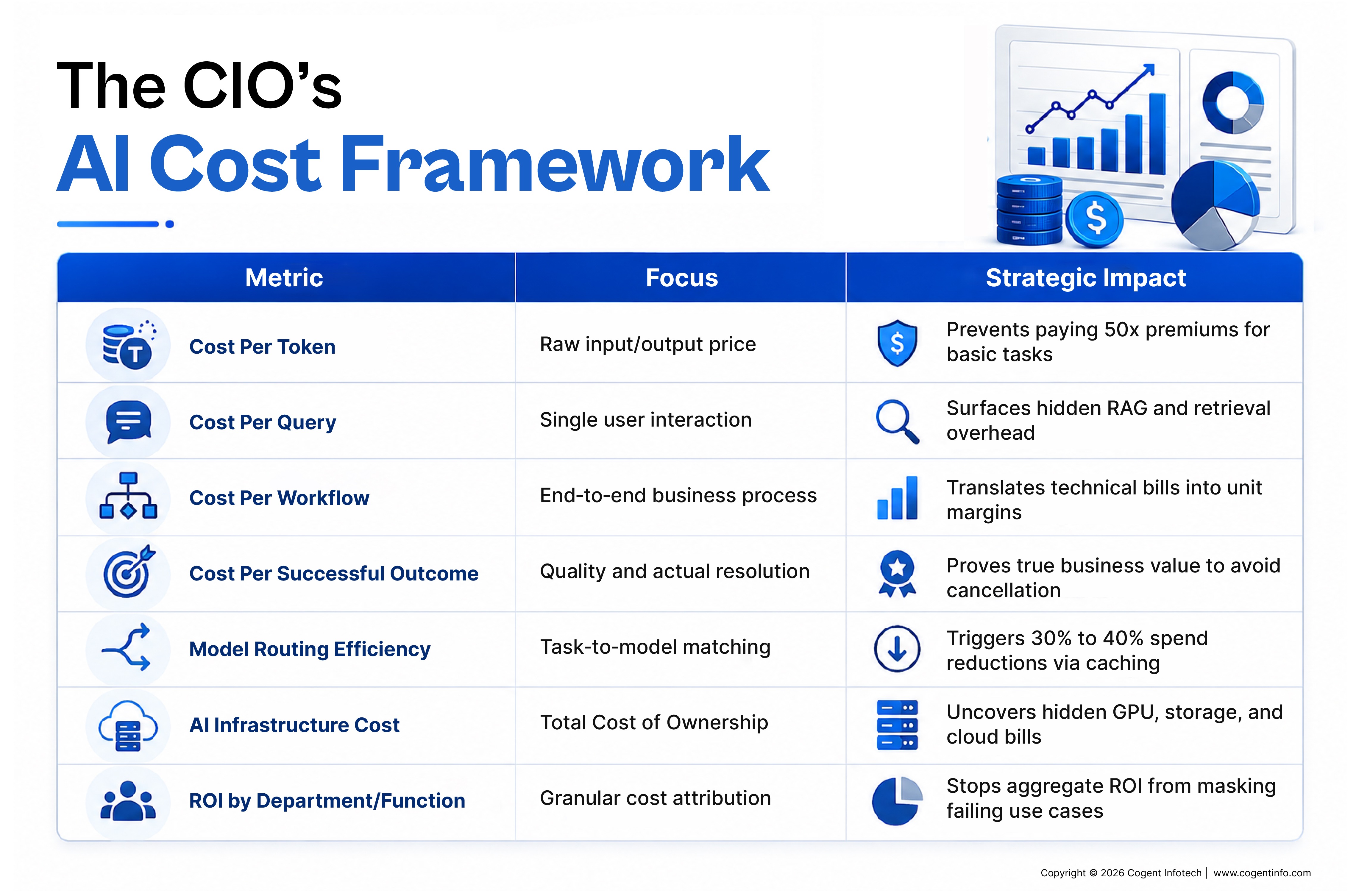
The following framework provides technology leaders with a layered view of AI economics, from the most granular unit of consumption to enterprise-wide return on investment. Each metric answers a different question that a CIO, CFO, or board member is likely to ask.
1. Cost Per Token
Cost per token is the starting point for any AI cost framework. It measures the price charged for each unit of input and output processed by an AI model, serving as the atomic unit of AI economics in 2026.
- Why it matters: Model selection alone can create a 20- to 50-times price differential per token, according to analysis by Optimum Partners. Many enterprises pay frontier-model prices for basic tasks that a smaller, purpose-built model could handle at a fraction of the cost. This frequently happens because the engineer who built the initial pilot selected a frontier model out of convenience, and nobody revisited the decision when the workflow moved from pilot to production at scale.
- The CIO action item: Track this metric by model, by use case, and by team. The goal is to match model capability to task requirements rather than defaulting to the most expensive option. Routine logic, classification, extraction, and summarization tasks make up the majority of enterprise use cases and rarely require frontier-level compute.
2. Cost Per Query or Interaction
While tokens measure the smallest technical unit, cost per query aggregates those units into a recognizable user action, such as a question answered, a document processed, or a support ticket responded to.
- Why it matters: This metric surfaces hidden inefficiencies in prompt design, orchestration, and retrieval architecture. In production Retrieval-Augmented Generation (RAG) pipelines across financial services, government, and enterprise technology, the average query input is often much higher than engineering teams initially estimate. This is due to retrieval overhead, in which relevant documents are injected as context, substantially increasing the token load for every interaction.
- The CIO action item: Track cost per query to gain clear visibility into where spend is being generated, and help engineering and finance teams understand what drives volume. When this figure spikes unexpectedly, it is usually a sign of architectural inefficiency rather than increased actual usage, providing the precise insight you need to prevent invoice surprises.
3. Cost Per Workflow
Cost per workflow is where AI cost measurement begins to connect meaningfully with business operations. A workflow represents a defined, end-to-end business process, such as resolving a customer support ticket, processing an invoice, onboarding a new employee, generating a compliance report, or reviewing a contract.
- Why it matters: Business leaders do not think in tokens; they think in unit margins, cost per transaction, cost per call, and cost per dollar of profit. As Mavvrik's recap of FinOps X 2026 noted, cost per workflow bridges the gap between what appears on the AI invoice and what that spending is actually accomplishing. Organizations that model token volume per workflow type before finalizing their architecture consistently avoid budget overruns.
- The CIO action item: Mandate workflow-level cost modeling as a standard element of any AI deployment business case. Teams that skip this step are the ones left scrambling to reconcile unexpected expenses after systems are live.
4. Cost Per Successful Business Outcome
This is the most strategically significant metric on the list, yet it is the one most enterprises are not yet tracking consistently. It measures the cost to achieve a defined, measurable result, such as a customer issue resolved, a risk flagged and acted on, a deal closed through AI-assisted selling, or a regulatory filing completed accurately.
- Why it matters: A workflow can technically complete without actually producing value. An invoice can be processed but still contain errors. A support ticket can be closed without the customer's issue being resolved. Cost per successful business outcome captures quality and impact rather than just completion. Gartner warns that more than 40% of agentic AI projects are predicted to be cancelled by the end of 2027, citing escalating costs, unclear business value, and inadequate risk controls as the primary drivers. Furthermore, research from Deloitte's 2026 State of AI in the Enterprise report found that organizations where senior leadership actively shapes AI governance achieve significantly greater business value than those that delegate governance to technical teams alone.
- The CIO action item: Use this metric to connect spending directly to outcomes. Tracking cost per successful outcome is the best way to ensure your organization does not become part of that Gartner cancellation statistic.
5. Model Utilization and Routing Efficiency
As enterprises deploy multiple AI models across different functions and use cases, managing which model handles which task becomes a massive financial lever. This metric measures whether the right model is being used for each job and whether capacity is being used effectively.
- Why it matters: In organizations with mature AI operations, intelligent model routing, prompt caching, and context compression have collectively produced 30% to 40% reductions in AI spend without touching product quality. These are not small optimizations; they represent real, structural savings that require visibility into utilization patterns before they become actionable.
- The CIO action item: Track the percentage of AI interactions handled by appropriately scoped models versus overpowered ones, and pinpoint where caching or routing improvements could reduce inference costs. In the language of traditional IT, this is the equivalent of rightsizing compute, and it has the same return profile.
6. AI Infrastructure and Inference Cost
AI infrastructure cost captures the full operational cost of running AI workloads, including cloud compute, GPU utilization, storage for model weights and training data, data platforms, retrieval infrastructure, and the integration layers that connect AI into enterprise systems.
- Why it matters: Companies frequently underestimate total cost of ownership because they focus strictly on model API costs and overlook the surrounding infrastructure. EY's research on agentic AI notes that while token costs are most visible, they represent only a fraction of the total cost. Infrastructure, governance burdens, and organizational change costs are often fragmented and become visible only after scaling.
- The CIO action item: Build a consolidated view across cloud bills, managed AI service invoices, and internal infrastructure costs. Organizations that implement cloud optimization alongside AI governance prove that cloud savings can fund AI investment. For example, per ECI Research analysis, one global technology company reduced cloud spend by 30% while simultaneously increasing engineering throughput by embedding economic accountability into engineering workflows.
7. ROI by Department, Use Case, or Business Function
The final metric is both the most important and the most frequently missing: AI return on investment measured at the level of a specific department, use case, or business function.
- Why it matters: An enterprise-level AI ROI figure tells you very little because the aggregate hides the variance. A strong return in customer service automation can easily mask a failing deployment in procurement. Without use-case-level visibility, CIOs cannot make rational decisions about where to invest more, where to scale back, and which initiatives deserve continued support. McKinsey’s 2026 research on technology budget allocation makes the stakes clear: at top-performing companies, two-thirds of technology leaders are “very involved” in shaping enterprise strategy, versus 52% elsewhere. AI ROI metrics aren’t a side conversation from business strategy. They’re built alongside it.
- The CIO action item: Build strict cost and benefit attribution into your projects from day one. Tag all the AI spend done by team, product, and business unit so your analysis reflects actual consumption and operational outcomes rather than estimated allocations. Organizations managing this well often treat AI spend in the same way mature cloud teams treat compute: with clear ownership, defined accountability, and regular business reviews.
How These Metrics Improve AI Governance and ROI
Individually, each of these seven metrics provides a useful signal. Together, they form an AI cost intelligence framework that connects spending to business value at every layer of the organization.
- The Infrastructure Layer: At the infrastructure layer, tracking cost per token and model utilization gives engineering teams the data required to rightsize workloads and route queries intelligently.
- The Operational Layer: At the operational layer, analyzing cost per query, cost per workflow, and total infrastructure expenses gives AI FinOps and corporate finance teams the visibility needed to allocate budgets, catch anomalies, and build reliable forecasts.
- The Strategic Layer: At the strategic layer, evaluating cost per successful business outcome and departmental ROI gives CIOs and the C-suite the hard evidence needed to make capital decisions and prove AI value to the board.
This layered perspective also reinforces governance in ways that isolated cost tracking cannot. Deloitte's 2026 AI research reveals that just 21% of enterprises possess a mature AI governance model, highlighting a persistent gap between initial experimentation and scaled, secure production. Organizations that tie financial visibility directly to business outcomes are far better equipped to establish the regulatory frameworks that allow AI to expand safely.
At FinOps X 2026, Revenium co-founder Jason Cumberland offered a blunt reality check: leadership teams unable to measure the financial return of their AI workflows will not get a free pass from their boards much longer. Industry analysts expect this financial reckoning to hit by 2027 as boardroom patience for unmapped tech spending disappears. The enterprises that scale AI successfully over the next 12 months will be those that balance execution speed with systematic oversight, bringing finance into the technical architecture conversations well before production deployment rather than after the bills arrive.
Conclusion: Focus on Business Value, Not Just Spend Reduction
Framing enterprise AI cost optimization purely as expense reduction misses the point. Cutting AI spend without understanding what that spend produces isn’t optimization. It's a risk. The goal isn’t to spend less on AI. It’s to spend more deliberately, so every dollar can be traced to a workflow, an outcome, and a business result.
The seven metrics above (cost per token, cost per query, cost per workflow, cost per successful business outcome, model utilization and routing efficiency, AI infrastructure and inference cost, and ROI by department or use case) give CIOs a framework for doing exactly that. They shift the conversation from invoice management to value management.
NVIDIA’s State of AI 2026 report found that 42% of organizations now name optimizing AI workflows and production cycles as their top spending priority. The companies pulling ahead aren’t necessarily the ones spending the most. As several FinOps X 2026 speakers pointed out, they’re the ones that can measure outcomes, make informed calls, and steer investment toward business goals.
CIOs who build this measurement discipline now won’t just control costs better. They’ll be in a stronger position to make the case for continued AI investment, keep initiatives aligned with business priorities, and lead the shift from AI experimentation to scaled enterprise value.
Partner With Cogent Infotech to Build a Scalable, Value-Driven AI Strategy